|
2013-10-21
Monday
Looking back at the 1950s today is almost like watching a different
existence. The young Swedish boy we introduced into the story was in his
early teens and was consuming impressions with a wide open and innocent
mind.
Like everybody else he had been playing cowboys and Indians for years and
had read numerous cartoons and watched many movies on the same topic. The
Indians were admittedly depicted as heroic, but at the same time capable
of an extremely vicious cruelty which implicitly was attributed to their
lack of a civilized moral standard, the one that characterized us, the
white masters.
Since capability of moral judgments is mostly innate, it’s just natural
that the boy reflected on the extermination of the Indians and the
supremacy that Europeans self-righteously claimed. But with his naïve and
ignorant mind he accepted the general attitude then that those backward
and uncivilized people were doomed to perish when confronted with the
highly cultivated white men.
It’s only in recent times that this attitude slowly has been turned in a
more morally conscious direction, and the extermination of twelve million
Indians has been called by its correct name: genocide. (Only people like
Ayn Rand withheld even in a mature age the moral vindication of murdering
primitive people just because they are underdeveloped).
A related occurrence was the slave trade, albeit in that case there was a
moral standpoint raised even in school. But the white man conquering
Africa and stealing human beings was not considered the great crime, more
so the slavery itself. And since America had abolished slavery the main
problem was solved anyway.
The young boy had become a grownup man before he had the comprehensive
picture clear to his perception. (For this he had to thank one of the
greatest thinkers ever: Noam Chomsky, the American whose books he started
to read in the 1970s.) And the picture was not just clear, but so
embarrassingly simple that he thought his own culture was deranged
(pretending) not to understand an ounce of it.
Through the ages a number of imperialist powers, one crueler than the
other had plagued the world. The last and most omnipotent of them all were
the European conquerors from the 17th century and on, headed by
Britain, accompanied by countries like Spain, Portugal, Holland, Belgium
and Germany (even Sweden owned a small island in the Caribbean for some
years).
We the Europeans subdued practically the whole world: America - both
continents - Africa, Australia and large parts of Asia. In the process we
exterminated millions of indigenous people, enslaved amounts of them,
stole their land and resources and finally left the surviving remnants to
slow genocide. (Some left over Indians in the world’s richest country
today still live in impoverished areas where the life expectancy is less
than 50 years.)
In one sentence we the Europeans have been global murderers, robbers and
slave owners. “Well, wait a minute!”, says someone. We have also given the
world democracy, capitalism, science, technology and civilization. That’s
all correct, with one qualification: we haven’t given anything (least of
all democracy); peoples of the world have had to regain everything through
their own struggle.
One common procedure when we "gave" the colonies “freedom” was to install
a vicious dictator who kept the people suppressed and poor, while securing
the land’s prosperity for themselves, a few local capitalists and above
all, for western investors. These dictators were supported by us till the
bitter end (then we tried to install new ones). Democracy was the first
thing we sacrificed for these noble purposes. All this and a lot more have
we suppressed in favor of a daydream in which we see ourselves as saintly,
moral role models.
Hypocrisy is but the weakest possible word for our attitude. When people
around the world now free themselves in a more substantiated meaning, it
follows from a weakening of the originally European power, and mainly the
power of our spear head, the United States. South America is a showcase
for this new development of liberation from USA, consequently in one
country after the other regaining some real democracy, raising the living
standards for the poor and conducting socially conscious politics.
In the past 400 years of western imperialism the world as a whole has
become richer on an unbelievable scale, much thanks to technological
development based primarily in the white man’s world. At the same time the
same world has been plagued with horrifying poverty, which we have done
little or nothing to prevent (rather exacerbate). It has served us well to
keep the world's masses down, something most people know but prefer not to
think about.
We now hear about progress in the world on different fronts. Poverty,
infant mortality, illiteracy, diseases and other plagues decrease, while
the living standard for a new middle class slowly increases. That these
good signs match the attenuation of neo-imperialism of European origin is
naturally much more than coincidental.
2013-10-14 Saturday
The young Swedish boy we talked about the other day perceived some of the
more obvious signals from mass media in the 1950s, but he couldn’t
comprehend the fundamentals of the messages. Only much later in life their
blatantly propagandistic elements appeared quite clearly to him.
Most persistent were the innumerous descriptions of the monstrous and
appalling Communism with its threatening ambitions to conquer the world. In
one drawing clear in his memory, the Soviet Union was depicted as a giant
octopus enfolding the whole globe with its fat tentacles.
Years later he recognized that the eastern bloc was comparatively weak, and
effectively contained within its borders. The octopus was us, the Europeans
and our descendants, of which the spearhead and master was the United States
of America, controlling the world with some thousand military bases in more
than a hundred countries around the globe. (But we were of course the good
ones, so that was a different case.)
Another particular memory of media propaganda has threads that lead into the
present (and to a certain terrorist attack in Kenya). In the early 50s the
papers began printing caricatures (in Der Stürmer-style) of a man
with a large, hooked nose and black evil eyes. The despised man’s name was
Mohammad Mosaddegh, the Prime Minister of Iran, appointed in accordance with
Iran’s constitution. What evil he had done to deserve such contempt was
something that escaped the young reader of the daily paper in those days.
That Mosaddegh was guilty of serious crimes seemed obvious, since he was
overthrown by force. Again, only years later the boy learned that the coup
was staged by US and British intelligence. The man’s crime, though, was
known by the world at the time: Mosaddegh had the strange thought that
Iranian oil in some way belonged to the Iranian people, and wanted to
nationalize it. This was to cross the most critical and dangerous line.
Since
1906 Iran had a parliamentary constitution which large groups wanted to
protect. When the western powers thus installed a dictator, he had to
suppress opposition with brutal methods, and Iran became a bloody and
torturous tyranny. With his western support the Shah managed to stay in
power for 26 years, travelling the world in his fancy uniforms and with his
adored young wife frequently portrayed in glossy women’s magazines as some
kind of fairytale royalty.
Evident today is that the oppression under the Shah dictatorship worked as a
pressure cooker, benefiting the most radical forces, in this case the
religious extremist. If the western powers had contained their obsession
with stealing Iran’s oil, and instead supported the Iranian constitution and
its legally elected Prime Minister, the fundamental Muslims would presumably
not have come to power.
This pattern repeats itself over and over again. In Iraq it took absurd
proportions leading to the recruitment of battalions of new fundamentalist
Muslim terrorists everywhere. They now pop up in numerous places, the last
time in Nairobi, Kenya.
The causality is simple and clear: western violence and subjugation of other
people come first, what we call terrorism follows. The easiest way to stop
terrorism is hence to stop creating it.
2013-10-12 Saturday
We still
remember the dreadful terrorist attack in the Westgate mall in Nairobi,
Kenya two weeks ago, where 67 innocent people were killed by a Muslim
group. The attack made my newspaper pinpoint “the psychotically violent
Muslims” as one of the world’s most serious threats.
The report evoked an old memory also concerning Kenya, from a time when
the young and clueless boy got his fragmented information about the world
only from the fattest headlines and the most agitated stories. One of
these was about the Mau Mau-movement in the 1950s. A gang of blacks had
taken up arms and started an appalling uproar in which they killed people
right and left, often in the most brutal way. Media conveyed the image of
a bunch of black monsters lacking all normal human traits.
Most of the Mau Mau victims were black countrymen (loyal to the British
authorities), but 32 Europeans were also killed. This was the ultimate
proof that the perpetrators were insane madmen. All in all the insurgents
killed around 2 000 people, while they themselves suffered some 20 000
dead, 90 000 imprisoned and more than one million deported to guarded
villages.
Swedish media then just copied biased Reuter reports which vilified the
black insurgents in the most blatantly racist fashion. Of course the young
boy believed it all, and it gave him the conviction that Negroes weren’t
human beings in all aspects, and that the white man’s conquering of
colonies was nothing but a vital part of a civilization process benefiting
the indigenous people. (When he many years later read Heart of darkness
by Joseph Conrad, he had already realized the white man's unforgivable
guilt, and the book cemented his insight permanently.)
Totally forgotten then, and often repressed later, is the horrendous
background to the uproar. For decades the British had slaughtered blacks
in Kenya, stolen their land and banished survivors from the most
productive areas of the country. Even the not so soft-hearted Winston
Churchill thought (in 1908) that “it
cannot be necessary to go on killing these
defenseless
people on such an enormous scale”.
Some years after the Mau Mau-movement was crushed Kenya became a free
country under the leadership of Jomo Kenyatta, who had spent seven years
in prison convicted as alleged member of Mau Mau. Nowadays no one with an
ounce of moral awareness can deny the fundamental responsibility that
Britain carries for what happened in Kenya during the colonial era.
“The psychotically violent Negroes” have today become “the psychotically
violent Muslims”. And the basic responsibility for creating this love of
violence lies with the same imperial powers, originating from Europe.
Furthermore the very rationale is the same: the European's and their
descendant's ambition to dominate and control as much of the world as
possible, if necessary with military force. Just in the last decade,
hundreds of thousands of Muslims have been slaughtered in illegal and
immoral wars, now followed by terrorizing drone attacks.
The counter-terrorism that this aggression has induced is in any case
predicted by western intelligence services, and not a surprise. It’s just
the newspapers that aren’t “allowed” to describe such realities. My
paper’s denunciation of the Mau Mau movement 60 years ago resembles its
attitude towards Muslim violence today in that it lacks all perspective.
The fundamental reasons for the violence, although completely decisive,
are not part of the “discourse”.
2013-09-22 Sunday
Carema Care
was a Swedish company making large profits on welfare services, such as
nursing homes for elderly. After inspections by the National Board of
Health and Welfare, Carema was criticized for not having trained their
staff according to agreements and for reporting a wrong number of
employees. For this the company was fined SEK 11.6 million. But what
upset the public most was something that leaked two years ago.
Nurses then reported to media that they were ordered by Carema managers to
weigh the diapers used by the elderly, in order to insure that the diapers
were not changed too often (and thus impinge on profits). That’s a kind of
“efficiency” in which private enterprises certainly outscores its public
competitors. Carema became a despised laughing stock among the public, and
when further mismanagement was disclosed they lost a number of contracts,
and had difficulty winning new ones. Something had to be done.
What could be better than to change the company’s name? Carema became
Vardaga, a most appropriate name since it sounds rather silly in a Swedish
ear (its English analogue would be “Weekdaya”). So now they can go on
again like their colleague companies to collect tax payer’s money, pay
high bonuses and dividends, and laugh all the way to the bank.
Privatization of societal operations in Sweden has been marked by
everything from irritating frictions to upsetting scandals, without
displaying any obvious, let alone proven, advantages or gains for the
society.
One illustrating event was the partial privatization of the Swedish
Pharmacies, formerly a state monopoly. Part of the company was to remain
in state ownership, and a number of stores were to be sold. It so happened
that I visited my local pharmacy some time after this “reform” to buy a
prescribed medication, only to find – for the first time ever – that the
drug was out of stock. My store was incidentally one of those still state
owned, but they had immediately adopted the “private” way of saving money:
reduce stocks.
Letters to the editor in my paper, and then news articles, soon confirmed
that my experience was shared by many others. Some people had suffered
serious problems not getting access to vitally important drugs. It turned
out that statutory accessibility (“within 24 hours”) and other rules were
not followed by the pharmacies. One of the reasons for this was that the
comprehensive computerized inventory system that the monopoly had built
naturally wasn’t as functional as before. This is once again private
“efficiency” gaining profits, but for the whole society highly
inefficient. Costs are transferred to the public, together with all kinds
of other problems.
Privatizations of welfare services in Sweden have exploded under the
right-wing leadership since 2006. Today’s paper reveals the high profits,
generous bonuses and dividends that characterize the private welfare
businesses. “Studies made show that those companies have higher return on
equity than average businesses”, reads the article. According to an
economics professor “they meet a weak counterpart in the municipalities”
that contract and pay for their services.
As we saw in this column the other day it seems as if the cup finally is
filled. When even our right-leaning Stockholmers start to react toward
political stupidity we have come a long way. It remains only to be seen
how to turn this huge tanker around. Or as a high official in a private
welfare company spitefully remarks: “Once you’ve squeezed the caviar out
of the tube, it is quite difficult to get it back in again”.
2013-09-20 Friday
Finally things have
started to happen here, not just in the agitated minds of the ordinary
citizens, but also in opinion polls studying political preferences. The
bourgeoisie majority in Stockholm has collapsed!
Sweden went through an opinion mystery when the center-right parties took
power in 2006, immediately starting their crusade against the welfare
society. The new government cut allowances for the sick and the unemployed
while handing tax breaks to the well-offs. After having seized power also
in many municipalities, the reactionary servants for the rich started to
accelerate privatization of schools and welfare services, thus granting
generous profits for some, paid by the commonly collected taxes.
The man in the street was shocked, not knowing that he had voted for such
a radical shaving of his old social democratic society. “It was all to be
read in our election manifesto” said the government, well aware that it
was in the small print out of media’s interest and well muted by
themselves. As the devastating effects of the new policy for people in
need became obvious, a large majority was furious. In two years time the
government had reached a record low rating in polls. The opposition was 40
percent larger than the government parties together, and a regime change
in the elections less than two years ahead was considered inevitable.
For reasons I have not seen much discussed, that self-evident incident
didn’t occur. For many, though, the main reason was quite apparent: the
leadership of the Social Democrats had driven so far to the right that
they didn’t even oppose the glaring absurdities in the government’s
welfare policy. Then the elections became a matter of imagery and
demagogy, disciplines in which the opposition lagged far behind.
This government’s second term, starting in 2010, marked a steady
continuity as far as privatization and attacks on welfare were concerned.
No gains in efficiency and quality have been reported, nor any other
advantages with the right-wing policy, but certainly a swarm of scandals.
First of all there were local politician’s shameless handover of common
property to private persons, more or less at random, and with a symbolic
price-tag. This was most endemic in the Stockholm area and it went on in
spite of the apparent criminality of the whole procedure. It’s clearly
against the law for a municipality to favor specific persons or companies,
in front of others, economically or otherwise. And municipalities are
often convicted in court for this and other offences, but they cannot be
punished! Not seldom they just go on breaking the law!
Privatized schools have on average given too high (i.e. false) grades, so
far with impunity; they have a lower proportion of qualified teachers and
fewer teachers for pupils with special needs; they usually abolish
libraries etcetera. These are measures taken, at the expense of education
quality, to increase profits for the owners, some of them foreign private
equity firms based in tax havens.
I could fill pages with scandals connected to the present neoliberal
policy forced on the Swedes, but for the moment just one more, this one
concerning private schools. One of the larger school businesses (JB
Education), with some 30 schools, went bankrupt during the summer,
creating problems for hundreds of students. It so happened that directly
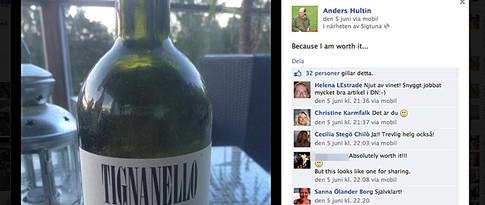
after announcing the bankruptcy the CEO updated his Facebook-account.
There he posted a picture showing a bottle of a 100-dollar wine, to which
he added: “Because I’m worth it”.
A politician,
or anyone else in a serious position, had better withdraw after such an
update, but this juvenile guy will probably go on to “lead” other
businesses. This is how we learn where the power lies (as if we didn’t
know already).
To finally reach the point: Yesterday’s paper reported on a poll
announcing a record drop in support for the bourgeoisie parties in
Stockholm. That city is normally a firm base for right-wing ideas, with
its well-paid central bureaucrats, private and state (and parasitical).
Consequently it’s usually a problem area for the Social Democrats. Now,
since last year, the leading right-wing party (Moderaterna) has plunged
4.9 percent units, and the Social Democrats gained 4.6. With these figures
in the next election the opposition will take over the City Hall.
When even the brats in Stockholm have had it, then the sun may start to
shine again!
2013-09-13 Friday
The other day we introduced our readers into the fascinating (and scary)
mind of our Prime Minister - Fredrik Reinfeldt - by serving some hints from
his first printed publication The Sleeping People. As we mentioned,
the book starts with a dystopia describing a future society in which young
people die from a mysterious disease caused by too much welfare. On the
whole the terrible future the author foresees is one where the society takes
so much care about the citizens that it all transforms into an Orwellian
horror chamber.
This part also has a revealing discussion about emotions. Here Reinfeldt
really discloses his inner thoughts and his ideology. In his world emotions
obviously is something that can exist only in a person’s private world. For
someone to care for many unrelated people seems unthinkable to him. It
sounds like this in the dystopia:
“Emotions were a threat to the ideology of the welfare state. Caretaking was
to be rationally managed by the State. […] If people tried to take care of
each other, the welfare state would surely be cut out. That would create a
society where some had people who loved them and took care of them, while
many had none, and that wouldn’t be fair.”
Apart from the naïve formulation, the author’s view is clearly revealed;
there is no trace of irony. A straight corollary from what he writes is that
people who “take care of each other” (in the private sphere) automatically
are indifferent about everybody else outside that sphere. And he goes even
further to claim that emotions are exclusively private; there is no such
thing as emotions directed towards any one fellow human being regardless of
kinship or friendship.
For those who had hoped that it was some kind of misprint, Reinfeldt crushes
that hope by repeating the same thesis some pages later. There he writes
that physical contact was advised against in the totalitarian welfare state,
because it could lead to feelings and emotions “sometimes very strong
emotions, and they were equivalent with weakness. Then you started to care
about some but not about others; emotions were not fare and lead to a
society with different emotions.”
Reinfeldt’s technique to implant “welfare” into the standard Orwellian
oppressor state is nothing less than ridiculous. And it’s not a coincidence
that his dystopia of welfare penetrating and breaking up the society bears
resemblance with the anti-Muslim horror forecasts spewed by extreme
right-wing circles today. Ultra right and empathy are obviously incompatible
concepts.
It has indeed been said by some that Reinfeldt lacks empathy. Judged from
this ominous publication there is a lot in such an assessment. Maybe it’s
just that right-wing thinking involves inability to make abstractions, to
think outside of a small circle with “the self” in the center? Who knows?
Maybe it’s therefore the Prime Minister is known for his many travels around
the country “talking to the ordinary citizens”. If one can’t visualize
reality in normal ways it’s perhaps the only manner in which to enlighten
oneself.
Those who seek an explanation to this governments harsh austerity measures
targeting the sick, the unemployed and poor people in general, will find on
odious key in Fredrik Reinfeldt’s book The Sleeping People.
2013-09-11 Wednesday
This is the
day when we honor the memory of 9/11 with its thousands of murdered
victims, and send our thoughts to their surviving family members, relatives and friends. It was
an act of horror, partly designed and orchestrated by the CIA. This is not
a conspiracy theory, just a fact. Even the US Secretary of State was
somewhat involved in the deadly process.
A completely legitimate democratic government was overthrown by military
violence, the presidential palace bombed and the president killed. The
democratic regime was replaced by a US backed, fascist style military
dictatorship of the kind that we, the US and its henchmen, so often have
preferred rather than presidents that take actions to benefit the poor,
the sick and the illiterates.
It all happened in Chile on this day 40 years ago. At that moment in
history Sweden had an ambassador in Santiago named Harald Edelstam. He
took courageous initiatives to help thousands of targeted Chileans to
leave the country. He’s said to have saved, personally, up to 1 300
individuals from probable torture and death.
To its credit my bourgeoisie paper today has a full-page article on the
Chilean 9/11 (and not a word about the other 9/11, which used to dominate
the news on this day every year). They have a telling story about Julio
Baraibar, a Uruguayan who now is an advisor to the president of his
country. In 1973 he was in Chile and was apprehended there by the
military, but freed by Edelstam. In his own words:
- But it was a near thing. When we arrived at the airport I was stopped by
three civilian policemen. They tried to squeeze me into a car. I fought
against it, when Edelstam rushed forward and grabbed me, shouting to the
policemen: “If you want him you have to kill me first.” He saved my life.
Continues Julio Baraibar:
- The memory of Raoul Wallenberg is much celebrated in Sweden, and rightly
so. But for me and many other survivors of the Chilean coup Harald
Edelstam is almost in the same category. He was a great man, a champion
for human rights whom you in Sweden should be very proud of.
Well, Edelstam was mostly an embarrassment for the conservative officials
in the Foreign Department, and when he soon was declared persona non
grata by the Chilean junta it was a relief for many of the old guys.
It suffices to say that his memory cannot compare with Wallenberg’s on the
same day. He was soon quite forgotten (today’s article is a pure
exception) and died in 1989. His memory is nowadays celebrated in Chile,
and he has been honored with a memorial park in Uruguay. Nothing of that
kind has been allotted him in his home country.
Edelstam may rather be compared with Folke Bernadotte, another hero saving
lives, and likewise (but not as fully) forgotten. The two share the same
destiny: they didn’t have the right friends and the right enemies to
become saints, like Wallenberg.
Our country has its own 9/11, but on a different scale. On this day 10
years ago the Foreign Minister Anna Lindh was stabbed to death in a
department store in central Stockholm by a young man who was more or less
mentally disturbed. She was at that time already pinpointed as the next
party leader and probable Prime Minister. Despite such considerations she
was walking around with just a friend and no security. It was all too much
like Olof Palme’s destiny.
9/11 could stand as a monument over the horrible and destructive violence
that mankind has excelled in. Since the bloodshed furthermore was
completely meaningless, the day reminds us of the advantages with ending
violence altogether.
2013-09-09 Monday
There is a mystery book in Sweden entitled “The Sleeping People”, written
in 1993 by a man who is our current Prime Minister - Fredrik Reinfeldt.
Those who read the book without knowing anything about the author will
probably assume it to be a work by an overexcited teenager who had got
lost in an Ayn Rand world, but not quite had learned how to master his
native language in writing.
But the man had not the excuse of being a naïve high school student at the
time. He was 28 years of age, chairman of the youth organization of the
large right-wing party (Moderaterna) and since two years a Member of
Parliament. With this book in his CV it should be a riddle how he later
could raise to become Prime Minister (one could say that he perhaps gives
the key to this problem in the book, where he denounces politicians to be
incompetent in most respects, having one single responsibility: to do as
little as possible).
The mystery thing about the book is that it has virtually disappeared.
Residual copies from the print shop have probably been pulped. Libraries
often report it as “lost” and the rare copies that exist have a long
waiting list. But of course it’s saved on the Internet by people who don’t
want to deprive Swedes this unique experience (here
for those who read Swedish). A recent interest has been awakened by a
theater company who has written a stage play based on the book. Reinfeldt
himself refuses to comment on anything connected with his masterpiece,
which he probably wishes he had never written.
(A side aspect here is the remarkable shelter that our media provides
right-wing politicians by helping to bury their disasters in silence. Had
a prominent Social Democrat produced a fiasco like this one, he had been
haunted and ridiculed through frequent ludicrous citations from the book.
That’s how the unbiased bourgeoisie media works.)
The book starts with a dystopian story about a dying young man in a
distant future. “He died for the same reason lots of other young people
began to die that summer, in a disease which soon came to be called the
most deadly in the 21 century, fully comparable to pestilence, smallpox
and AIDS. He died the Welfare Death.” Of course the reader becomes curious
about the causes of that peculiar decease.
Now the reader has to be patient since it takes until the end of the story
to get the answer, which simply is: He died because “he had had too little
to do”. He was so fully taken care of by the welfare society that he was
left with nothing to live for. This was the unspeakable horror that
Reinfeldt obviously predicted if we didn’t abolish the welfare state. This
absurd notion becomes even more nuts when read against the background of
real events in the country when the book was written.
In 1993 Sweden was in the midst of its worst employment crisis in history.
Half a million people – ten percent of the workforce - were in a couple of
years thrown out of the working community and made unemployed, many of
them forever. Still, 20 years later, we have not recovered from that blow.
A triggering factor behind this was the bursting of a home cooked housing
bubble, accompanied by speculation against our currency. The whole process
marked the transition from the Swedish model (high employment rate, high
growth) to the continental model and to the era of neoliberalism, from
which we longer than most countries had been (partly) sheltered.
With the whole economy and the labor market in a dire crisis around him,
Reinfeldt, the young broiler politician, writes a book where he blames
welfare for all of the world’s problems and predicts that societies where
the government cares about ordinary people will end up in total
destruction. That's great, and there are many more “wonderful” flowers to
pick in Reinfeldt’s pamphlet, and we may come back for those later on.
Well, this person is now our Prime Minister! He should be grateful to live
in this gentle country where people care for their fellow citizens, in
accordance with our welfare mindset. Had he been a high US politician, the
talk show comedians there would have ridiculed him beyond limits for the
pretentious trash in his book, most likely.
013-09-05 Thursday
President
Obama has paid us a short visit here in Sweden (in replacement of a
personal meeting with his Russian colleague Putin, whom he obviously wants
to avoid for the moment). Our mainstream media acts as if a divine prophet
has landed and honored us with his mild and enlightened generosity.
It’s just the second time in history that a US president has set foot on
Swedish soil. The first time was Bush II attending an EU summit meeting in
Gothenburg in 2001 (ending in a huge riot giving glaziers plenty of jobs).
So today’s presidential visit is the first one directed solely to Sweden,
albeit as a stopover on a route to G20 in Russia.
This time everything has gone smoothly. Some peaceful protesters were
allotted a safe space, and the city was partly blocked around the
president’s convoy as it moved from the airport and into the town. A press
conference was held where wise and calming statements were made by Barack
Obama. He is certainly a PR genius with an image which attracts us
Europeans.
Our mainstream papers have been filled with awe and self adulation in a
crazy mix, while expanding writings about this one-time event over most of
the pages. One point of discussion has been the observation made by many
that Sweden is the most Americanized country in Europe. Television and
cinemas are over flooded by US entertainment products (not dubbed).
Likewise US influences can be seen in lots of other aspects of everyday
life. This seems to be a contradiction considering the long-time social
democratic tradition here, making it “socialist” in the eyes of many
Americans (“communist” according to Eisenhower and lots of others).
This imaginary contradiction stems from a silly one-eyed conception all
too common in politics, often used as a demagogic weapon: “If you’re on
our side you must agree on everything!” This is also the basis for the
even more brainless concept “anti-Americanism”, which is pasted on people
who express too much and too intelligent critique of US wrongdoings. The
concept has only one analogue: “anti-Sovietism”, invented by tyrants and
also used for the purpose of silencing critics. The Soviet version was a
crime punished with prison or worse, the American version is just a tool
for social exclusion.
It’s an absolute matter of course that USA is a leading nation in a number
of fields, above all in science and technology, but also in many others.
In my taste one even finds the most intelligent political dissidents in
that otherwise very right-leaning society (also in my taste the best Pale
Ale is produced there). The country has the strongest economy, as well as
emphatic citizens engaged in all kinds of beneficial work. For all the
achievements from which the world has benefited USA is worth admiration.
However, to conduct wars of aggression and thereby murder millions of
innocent people is worth our outmost antipathy. Since a majority of the US
population thinks the same it could not possibly be any “anti-Americanism”
to oppose USA in that respect.
Thus you can listen to Noam Chomsky enriching your knowledge and expanding
your perspective – while you have a Coca-Cola. There is no contradiction
in that.
2013-09-04 Wednesday
It has been a long and warm summer
filled with social duties of all sorts. There is "the little life"
necessary to live and for which other tasks must be postponed. We are
after all no isolated islands, but entities in a social whole, consisting
of other human beings. But now the work- and schooldays are here, meaning
back to keyboard for people like me.
2013-07-15 Monday
The former
leader of the Center Party in Sweden, one of the small parties in the
coalition government, was due to resign (some said overdue). As a kind of
monument over her significance she wanted a reduction of value-added tax
in the restaurant sector, and the government granted her that joy. The VAT
was reduced from 25 to 12 percent.
Most people probably found it a rather odd farewell gift (did she have
relatives in the restaurant business, or what? Nothing of the kind was in
any event reported). Her own motive was to boost employment, but why then
restaurants of all utilities? Why not something more wholesome? Questions
that got no answers, at least as I found out.
The mechanism by which employment would increase was based on the usual
dogmas of the neoliberal belief system. A reduction of VAT would lead to
lower prices, leading to more customers and then more employees. That this
procedure was expensive, costing the state close to one billion dollars
the first year, was no big deal for the Center party or its colleagues in
the government. Jobs have a cost!
Today my paper (Dagens Nyheter) wrote about the outcome of the costly tax
reform, based on an official report from the Central Bureau of Statistics.
It says in short that there are no visible effects on employment in the
restaurant sector whatsoever. In fact, two years before the reform
employment in restaurants was almost 15 percent higher than today. Only
naïve believers in economic “theories” can be surprised.
My newspaper had earlier made a brief study of restaurant prices, and then
found out that those in fact had gone up after the tax cut. In summa:
more expensive meals and no new jobs; another example of a neoliberal
fiasco! What this makes clear is certainly that all the tax payers money
spent on this farewell gift have ended up as profits in owner’s pockets.
If exactly the same amount of tax payers money, now spent on more luxury
goods for wealthy people, had been used for more important purposes, it
could have paid salaries for a few thousand nurses or teachers or other
professionals desperately needed in the decaying welfare sector of this
formerly exemplary society. Now we may instead go down to the harbor and
enjoy the beautiful sight of the ever-growing fleet of shining white
yachts.
2013-07-12 Friday
A fairy ring from cyber space:

2013-07-04 Thursday
That “the
efficient market hypothesis” is just a dogma in a political religion and
not a substantiated scientific suggestion is frequently demonstrated. So
as with other religious dogmas, facts and evidences don’t matter. A belief
is a belief. So when I now point at another small example illustrating
this confession among economists and politicians, I don’t expect to break
any news or to convert any believer.
The Swedish neoliberal government undertook as one of its first measures
an attempt to reduce youth unemployment by applying "market mechanisms".
Thus they cut the payroll tax, making it 35 percent cheaper to hire young
people, 18 to 24 years old. This tax reduction has been in place for some
six years now, and the result is obviously zilch (or negative).
The union organizing commercial workers have studied the outcome of the
tax reduction and found that the share of employees aged 18 to 24 actually
is lower today than it was before the reform. One may conclude that
the whole thing was counterproductive and that a substantial sum of
taxpayer’s money just has ended up as company profits (not at least in
McDonald’s accounts). This study rendered some nine lines in a narrow
column in my daily paper today.
As if the editor doesn’t read his own paper, the lead article today
praises the Prime minister for his new attempts to counter youth
unemployment, in which reduction of payroll taxes still plays an important
role. Luckily the intended reforms contain other elements and are carried
through in collaboration with the unions.
One can imagine a number of reasons why employers don’t act according to
the econoligious scripture. The union who performed the study suggests
that the wage cost is unimportant compared to the need for competent
workers who can do the job properly. And a thinking employer cannot be
expected to expand his workforce with a young person just because he or
she is 35 percent cheaper. Either his business needs an additional worker
or not, and in the case it does he will prefer someone fully capable. Such
considerations seem quite plausible.
Swedish youth unemployment is remarkably high compared to corresponding
countries. This is but one of the achievements by the right-wing
government who jumpstarted in 2006 with neoliberal attacks on welfare in
an announced effort to “create jobs”. Initially there were some positive
effects on employment, but they soon faded out, only to be replaced by
clear deterioration as the finance crash hit the world. And collateral
damage among people in need of societal support was of course extensive
from the very beginning.
That financial nuking of the world in 2008 was naturally also a direct
product of neoliberal dogmas in action. And there are two consistent
effects of all these neoliberal actions: to enrich the rich end impoverish
the poor. These are so consistent that they must be thought to constitute
the very purpose of neoliberalism.
2013-07-03 Wednesday
Good morning NSA! I’m
European and leftist, indeed sharply opposed to terrorists, including
state one's. But you’re most welcome to my site, if there is something to
be found. Knowledge is an easy burden, especially with the modern
electronic memory technology we dispose of in these days.
My Postcard today will probably be of minor interest to you, but on the
other hand: even seemingly insignificant pieces of information can build
up to an important whole.
I will write a few words about something called PPM-funds here in Sweden,
which is a part of an almost twenty year old multi-party agreement on the
public pension system. To please a number of liberal (=antisocialist)
groups a small part of the pension funds were assigned to be invested
individually, by each and everyone. The outcome of this capitalist
playground must be characterized as a failure.
Banks and brokers happily jumped on the wagon and created funds which they
registered at the PPM authority. Today there are 800 different funds,
though not different in one aspect: they all produce tons of profits for
their fund managers. Since no ordinary wage worker possibly can make an
informed choice between 800 funds, there has emerged a second level of
professionals who are cutting gold, the advisors.
Many of these funds are managed by “special experts” with high salaries,
and therefore demand an annual fee of up to 2 percent of the total
capital, regardless of the return of the funds. As shown over and over
again these “expert” funds perform on average worse than simple and cheep
index funds. Despite of that indisputable fact the scam goes on year after
year, showing the grip banks have on the public mind.
Well, ordinary people are not stupid when it comes to their personal
affairs. Most of them make no choice at all. In their case the money lands
in a large publicly managed fund, “the idlers fund”. This fund gives, as
one could expect, a higher return than most of the commercial ones.
Already from this circumstance one can conclude that the whole idea, built
on a capitalistic dream, is a total fiasco.
Today we could joyfully read in the paper that the Central organization
for the workers unions (LO) has been gifted with a really social
democratic leadership for the first time in many years. The headline read:
“LO demands abolishing of PPM”. This is not a day too soon and certainly
in line with people’s wishes as demonstrated by their unwillingness to
even take notice of the system. (To my knowledge no polls have been taken
about peoples view on the matter, which is symptomatic when all parties
agree on something ludicrous.)
So, there is maybe a brighter future. He who survives will discover.
2013-07-02 Tuesday
This
Swedish summer hasn’t really taken off yet. Temperatures are just around
15o C and there's lots of rain, but warmth is promised by the
next week. At the same time we read about record heat in USA with 50 plus
degrees, torturing people there. So we shouldn’t complain here, but we
still do. To be self centered is certainly one of the attributes
characterizing human beings. And we are biased at that.
My daily (DN) illustrated this latter fact in a naïve way the other day,
writing about the TV channel RT (Russia Today) on account of the channel’s
huge success on the Internet, passing one billion hits on YouTube. RT’s
key to the achievement, according to the reporter, is huge funding from
the Kremlin and a populist content appealing to young people. He opens his
article with this sentence:
“Julian Assange and
Bashar al-Assad, American anarchists and Swedish crackpots – all of them
have their say on RT, the Russian TV channel spreading an ‘alternative world
view’ with the help of Kremlins money.”
He could probably expect
a tap on his shoulder from his editor for defaming Assange – DN’s favorite
spittoon - already in his first sentence. American anarchists, like for
instance Noam Chomsky, are arguably among the more clearheaded people in
that powerful country, which obviously isn't a favorable quality in the
eyes of the reporter. Then he goes on to give examples of the biased
reporting by RT.
The recent riots in a Stockholm suburb were naturally covered by RT. They
then interviewed some odd persons belonging to marginal extremist groups
with no support whatsoever among normal people. That’s of course biased, but
it’s also a reminder that mainstream media constantly excludes those groups
and just focus on people who “represent” something or somebody, regardless
of what they have to say (as long as it mainly is within the accepted
scoop).
RT’s bias is most prominently revealed by their way to select news, says the
article. The purpose is to produce “a picture of the world where USA and
other western countries are the major culprits”. This is to be read in a
newspaper which thoroughly chisels out a specific world view by a very
deliberate choice of news as well as topics for editorials. But of course it
is done with a delicate technique so as to make readers really believe that
they are reading an objective paper.
One important part of this technique is to allow, occasionally, a dissident
voice to appear in the cultural section (which most people don’t read). One
prerequisite is though that the dissident is well known, i.e. an accepted
dissident (though it is a contradiction in terms). Then they can go on and
bombard the readers with reports and editorials about every possible misdeed
made by “enemies” such as China, Iran, North Korea, Putin’s Russia, Chávez’ Venezuela,
Correa’s Ecuador, nowadays al-Assad and, of course, Cuba. Thus since 70
years leaving out all the monsters that have served “us”, regardless of the
horrendous atrocities and innumerable murders those monsters have performed.
The clueless naivety lies in accusing others to be biased, thus implying to
be "objective" oneself. As Noam says: we are all biased. To intimate that
one possesses something called “truth” in political matters is not just
presumptuous, but outright stupid. Even a natural scientist may be biased;
the difference between him and a political reporter being that he usually is
capable of changing opinion when faced with evidence.
2013-06-01 Monday
Summer is a short interlude in which a Swede
tries to squeeze in the essence of life. That's why my keyboard is
collecting dust. But I will return to it now and then.
2013-06-11 Tuesday
Now there
are suddenly a number of individuals called “Edward Snowden” on Twitter (a
problem with identity hijacking that eventually should be solved to
maintain credibility for the otherwise excellent medium). The real Edward
Snowden, the whistleblower, now lines up with Bradley Manning to be among
the most worthy candidates to be awarded the Nobel Peace Prize. We all
realize that neither of them will ever become laureates, and we also know
that this reflects the “moral” principles that we uphold in our part of
the world, the rich part where we appreciate the ruling principles and the
rulers.
In 2010 the Chinese dissident Liu Xiaobo was awarded the Peace Prize for
his exemplary work for the improvement of human rights in his home
country. He couldn’t attend the Prize ceremony since he was sentenced to
eleven years in jail for subversion, by a court in Beijing. His dissident
work for freedom of expression and against state oppression is brave and
worth all kinds of encouragements. But it has little or nothing to do with
promoting peace as rather precisely verbalized in the will and testament
of Alfred Nobel.
The feats carried through by Bradley Manning fits much better with the
will which says that the prize shall be awarded “those who have done
the most or the best work for fraternity between nations, for the
abolition or reduction of standing armies and for holding and promoting
peace congresses”. By his revealing of war crimes in Iraq he
contributed to an ending of illegal war operations, and to some degree
presumably facilitated the ending of the war; an exemplary peace action.
Edward Snowden has at least merits on the same level as Liu Xiaobo when he
discloses his own country’s covert operations aiming at controlling its
citizens in a fully Orwellian manner. It’s almost marvelous to view the
moral neutrality with which the US administration defends its repressive
blow against fundamental human rights, offences of a kind that it harshly
condemns China for. It certainly is doublethink in its most genuine
meaning.
Here in Sweden we had our own little PRISM-gate forty years ago. Then two
journalists revealed the existence of a secret intelligence agency (IB),
not known by anyone outside a small circle, for instance not by the
parliament. IB’s instructions were diffuse, as was its monitoring. One of
IB’s main purposes was to keep control over the Swedish “communists”, an
important and quite wide task in the vivid 1960s. Particularly
compromising was that IB had close connections with the Social Democrats,
and to some extent was used for the party’s own shady purposes.
After an extended legal procedure, accompanied by intense media debate,
the two journalists and one whistleblower were each sentenced to one year
in jail, for “espionage”. One of them, Jan Guillou, is nowadays a famous
and popular novelist and writer, a bestselling multi millionaire. His
companion, Peter Bratt, also made a comeback as journalist but on a more
modest level. The whistleblower, Hakan Isacson, disappeared from public
life and is now dead.
Bradley Manning and Edward Snowden can expect something much harsher than
a one year sentence, and they deserve all the support every honest
inhabitant on the earth can give them.
2013-06-08 Saturday
“We have
failed, thus the system works” is the somewhat defeatist conclusion by the
CEO of a Swedish private school business, as he lets his company abandon
27 of its schools. He doesn’t mention with a single word the turbulence he
thus creates for students and their parents, as for teachers and other
employees. We have not been able to uphold enough quality, he says (though
he means profit), and it’s therefore quite in order that we are punished
by the consumers.
His company has fallen through and he is offered space in the most
important paper for an apologetic article about the private school system.
He writes: “During my 20 years of working in private schools [in Sweden we
use the euphemism “free schools”] in different positions, I have
innumerable times witnessed clear evidences for the effects that
competition from private schools have had on the public schools.” The
overwhelming fact which he thus shamelessly overlooks is that the Swedish
schools, during exactly those 20 years of privatization, has plummeted
scandalously in real quality, as measured by the most reliable
international organs.
The man is lying through his teeth when he claims that “quality” has
something do with the student’s choice today. Schools are sold like tooth
paste, parents and students bombarded with brochures promising the best
computers, attractive sports programs, the most fancy study tours and
other fringe benefits. The only “quality” aspect that may have penetrated
the market is which private schools offer the highest (fake) grades.
Before privatization there was no right for parents to choose schools for
their children, writes the man (whose name we may exclude, out of mercy),
only partly correct. Mainly on the elementary level was it previously
mandatory for children to attend the nearest school. In the old days all
post-elementary education was optional, and the schools, often a hundred
years old or more, were mostly situated in cities. Freedom of choice was
practically unlimited. Since the schools usually had been around for many
decades, their reputation was established and their specialties well
known. But since they were all state monitored the difference between them
were marginal, which has shown to be a guarantee for a high quality system
(as for instance proved by Finland today).
Private enterprises can successfully carry on all kinds of businesses. But
for some societal activities public monitoring and ownership is superior.
One illustrious example is the privatized US health care system, which
according to Noam Chomsky is an “international scandal”. With twice the
per capita cost of any industrial society and with an outcome for some
important heath indicators equaling those of very poor countries (like
Cuba) it cannot be called a functioning system. Educational systems are
obviously in the same category.
As long as Sweden had a monopolized school, owned and monitored by the
state, our educational performance placed at the very top of international
ranking lists. Just as today’s top nation Finland has almost entirely
public schools. (For higher education it may be a different story, but it
still seems that successful universities have been free of charge, and
many have had free admission. It’s still to be seen what ongoing
neoliberal measures may do to real quality in universities in the longer
run.)
The author keeps harping on the same mumbo-jumbo string throughout the
whole article, as if he thinks that nobody ever heard of the alarming
reports on the collapsing Swedish educational performance that fills our
media daily. It’s almost comical, and gives us another indication on the
intellectual standard upheld by well-paid representatives of economic
power. Lie greatly is an old recipe when your arguments are disastrous.
But this is something only those in power can do.
2013-06-03 Monday
Returning
to keyboard after two weeks irl, finding that Sweden has passed another
milestone on its way backwards in history. Riots in Stockholm with young
kids burning cars and throwing stones at policemen resemble similar
actions in more class divided and segregated countries like France and
England. And the reasons why this happens are subject to speculations,
which from a leftist perspective of course deal with societal properties.
From the right-wing such speculations are sometimes rejected on the
grounds that we have no scientific knowledge about the phenomenon. (One
notorious editorial writer in Dagens Nyheter who ridiculed the arguments
from the left had herself just made a horrendous speculation about the
sharply increasing number of suicides among children. She had argued that
one reason for more boys and girls to kill themselves is that they have
been too easily declared sick.)
What else than unemployment and exclusion from normal societal relations
might foster the meaningless violence? Do we need more scientific
knowledge to get a basic understanding? Probably not. In affluent
communities where kids go to universities it never happens that cars are
set on fire and policemen attacked. (Some collateral damage may occur from
flying champagne bottles when rich kid’s parties go wild, but that is
easily condoned.)
The very class conscious ruling groups have continuously sharpened the
class war with neoliberal weapons during three decades now. One result is
the growing number of resource-poor people, becoming unwanted in the
working community and simply superfluous in the society. One important
neoliberal way to “help” them is to further deprive them of means of
survival, with the pretext of thus “increasing employment”.
In societies such as ours where we are controlled, not by coercion but by
persuasion, reactions against harsh conditions tend to be arbitrarily
directed. The economic forces that make people jobless have no faces or
names. The businesses that don’t employ immigrants or uneducated are
impersonal bodies. With some justification the expelled may feel attacked
by an enemy, but it’s an anonymous enemy who doesn’t show up on the battle
field. Thus something else must be good enough as a target…
Self-evident speculations need no proof.
2013-05-16 Thursday
Today’s
Dagens Nyheter had a comment on Swedish income distribution in its
main editorial, in which it stated that the large leap in income
inequality occurred in the 1990s, under a Social democratic regime. It’s
true that Göran Persson, first as Finance minister and then as Prime
minister, aimed a deathblow at the Swedish public sector through austerity
measures without precedent, resulting in massive layoffs from which the
country hasn’t recovered yet.
The prehistory is about a bursting housing bubble and speculations against
the Swedish Crown during the preceding Carl Bildt government. The Central
bank had tried to defend the Crown with 500 percent interest rates, vainly
of course, and was ultimately forced to abandon the fixed exchange rate.
So when Persson took charge the country was more or less in the hands of
the international finance industry. He had to go to New York to more or
less be insulted by young and arrogant “finance puppies” with instructions
on how Sweden should adjust to the Washington Consensus, or neoliberal
principles as they are called in Europe.
Persson was well known for his hostility towards intimidations. So he
decided to make Sweden independent of the arrogant ones by strengthening
the state finances and thus make the country less vulnerable, at any cost.
Together with austerity measures in the private sector, due to the
bursting bubble, the result was that one out of five employees countrywide
lost their jobs in a couple of years. And since the well-offs seldom are
affected by such starvation cures the process led to a widening income
gap.
When claiming that Swedish income inequality isn't a result of right-wing
policies Dagens Nyheter relies on a group of economists who refer
to the Gini coefficient as a measure of income inequality. This index is
problematic in many ways. Possibly it doesn’t measure correctly the shift
that has taken place here, where a small minority of rich people have
gained considerably and the sick and unemployed have taken a harsh blow,
while the middle classes have seen some improvements. To illustrate this
kind of weakness in the Gini coefficient we can cite from Wikipedia:
“[…] for a population EE where the lowest 50% of individuals have no
income and the other 50% have equal income, the Gini coefficient is 0.5;
whereas for a different population FF where the
lowest 75% of people have 25% of income and the top 25% have 75% of the
income, the Gini index is also 0.5. Economies with similar incomes and Gini
coefficients can have very different income distributions.”
One can add that income
is only one of the aspects of economic status. Wikipedia again: “Sweden can
show a low Gini coefficient for disposable income of 0.31 thereby appearing
equal, yet have very high Gini coefficient for wealth of 0.79 to 0.86
thereby suggesting an extremely unequal wealth distribution in its society. These
factors are not assessed in income-based Gini.”
But Dagens Nyheter is quite correct in the assertion that the
neoliberal process started under the Social Democrats. In fact it began with
extensive deregulations in the 1980s, followed by Persson’s general blow in
the 1990s. The lesson is that people with sound wishes for a decent society
have nowhere to turn nowadays, at least not in the voting booth. Is it time
for a really democratic and really popular movement, maybe?
2013-05-15 Wednesday
In 1995
Sweden had the most equal income distribution among the 34 OECD countries,
a recent report tells us. Since then we have had the fastest growing
income gap of all the industrialized countries in the world, and we have
now fallen to rank 14th in OECD. The neoliberal policy has
fulfilled its main purpose: to enrich the already rich and impoverish the
already less affluent. One of the consequences is the resurrected soup
kitchens, a reminiscence from a really poor past, and a sign of a
dysfunctional modern society.
One neoliberal politician said in a radio interview today that he and his
party welcomed this development, since they considered it vital that
education and energetic work pay off. There is just one fallacy with that
argument: those who have profited on the growing gap are the already very
rich, a very small group for which lack of moral constraints probably is
more important than good education. Those who paid most of the bill are
the already poor.
For the two thirds in the middle, economy has improved somewhat (though
most likely not in proportion to the increase in production). Thus there
is no popular basis for large scale protests. But in their hearts many
Swedes perhaps feel that this is not Sweden, the mother of modern welfare
states. Why should we let us be ruled by neoliberal dogmas, when that kind
of religious fanaticism is on the brink of collapse? Its fatal
consequences can be seen in southern Europe, among other places, and
beginning in parts of South America it has started to be thrown out the
window.
Our country has since long been considered the most Americanized in
Europe. With a time lag of 10 to 20 years we have followed USA in a
number of respects (though keeping large differences in others).
Ironically we are catching up on the neoliberal front when the days of
that ideology hopefully are numbered.
2013-05-14 Tuesday
I hadn’t
turned off the radio when I fell asleep yesterday and woke up in the
middle of the night at the sound of a firm but mild voice. It was a female
teacher who had been fired because she had refused to give her students
higher grades than they deserved. The orders to do so had come from her
headmaster, who naturally felt the wishes from the owners of the school
and understood what it meant to lose a competitive advantage on a free
market.
It was a program produced by the Swedish public radio, and it soon became
clear why it was aired when very few normally are awake. The first teacher
was followed by others with similar experiences. Some students who were
interviewed thought it was “understandable” that private schools gave too
high grades. As the program rolled on the listener got the impression of a
school system that had sacrificed all elementary moral principles on the
altar of profits.
As I’ve mentioned earlier the debate in this country is gaining momentum
at last, after two decades of gradual degradation of education. That’s why
the radio program I’d listened to could be sent at all in public
broadcasting. And the greedy capitalists have put themselves in the
situation, threatening their possibilities in the “market” altogether. But
we know perfectly well why they do it. It’s not from any suicidal
instinct, but for total lack of interest in a future beyond the next
quarter.
In an economy where private enterprises are vital for effective and
progressive production, it’s a scandal that simple and unlimited greed
should be allowed to compromise and perhaps ruin the whole system. Up till
the mid 1970s and the neoliberal dissolution of the social fabric,
capitalism worked fairly well (in the rich countries). Financial
activities were regulated, barring the horrible excesses we’ve seen since.
The result from the growing production was distributed with reasonable
equality, and the welfare state was gaining ground, gradually improving
support for the sick, unemployed and other poor.
If “the owners of the world” had been content with owning almost
everything, and not strived to own it all, we could have had the Great
society that so many once hoped for. Now we must instead contemplate Marx’
words that
capitalism carries the seed of its own destruction. Or in the words of the
old Swedish saying: He who grasps for too much often loses it all.
2013-05-13 Monday
Some Swedish
sleepwalkers have suddenly woken up and realized that private enterprises
aren’t perfect for every kind of societal activity, for instance not for
elementary schools. One of those is the former Prime Minister Göran
Persson, cited in today’s paper. Perhaps he was inspired by a lengthy
interview by the Swedish Radio last Saturday with the chairman of the
Norwegian conservative party, Erna Solberg, expected to be her country’s
next Prime Minister.
This right wing party leader firmly declared that her country would never
accept for-profit companies in the school system. All but a few percent of
elementary schools in Norway are owned and run by the public sector. The
exceptions are schools with specific pedagogic or religious fundaments.
But they are not allowed to make profits, and are usually owned by some
kind of foundation.
This orthodoxy is tied specifically to the educational sector. Private
companies are not barred from other parts of the public sector, such as
for instance health care. In Norway, as in Finland and Denmark, the world
of schools is considered a common interest in the highest degree, and must
therefore be sheltered from private interests, and indeed from private
profit making.
In Sweden our neoliberals have been allowed to drench the school system in
sloppy capitalism, thus bringing to ruin one of the best educational
systems in the world. The destruction began with a bourgeois government in
1990, and has resulted in a miraculous catastrophe in just two decades.
The first step was to introduce freedom of choice, which of course sounds
nice for most people. The thing is that children formerly attended the
nearest school, and that all schools had the same high quality. So the
freedom of choice was an ideologically motivated end in itself, which
introduced a destructive segregation.
The next step was to let in lucrative private enterprises, fully and
lavishly financed by tax payers. Record profits attracted venture capital
firms, based in tax havens. Now the destruction of the school system
really took off.
Today influential social scientists are prepared to derive the school
fiasco mainly to this deregulation and privatization. Comparative analyses
show that the best schools systems (Finland) are characterized by a high
degree of equality in and between schools. Highly segregated schools are
typical for failed systems, like the Swedish one. And segregation is a
natural consequence of the neoliberal principles introduced here.
The leader of our Social Democrats, Stefan Löfven, (despite his
long-standing experience as a blue collar worker) doesn’t see any problems
with private profit-making in the public sector, although many in his
party do. (We thus find this Social Democrat far to the right of the
right-wing party in Norway.) A compromise was reached at the last Party
Congress, but the divide is still there. We will probably have to see how
far the degradation of the Swedish school will go until the most profound
sleepers will open their eyes.
2013-05-10 Friday
A not to serious spring virus has kept
me away from the keyboard, but things have improved...
2013-05-04 Saturday
I just listened to a speech by Noam Chomsky and woke up a bit extra by a
cool side remark of his: the fact that animals have more rights than human
beings. It sounded weird at first but became clear after some thinking.
It’s in our culture considered not just wrong and immoral, but indeed
criminal to mistreat animals. We are obliged to feed and care for our
domestic animals and guarantee them a dignified life.
No such legal requirements are applicable to humans, except in
very specific and exceptional cases. It’s mainly up to each and everyone
to take care of himself as best as he can. To deny a starving person food
would not per se be a crime, as it would be if the suffering
individual was one’s own animal. The spirit of this legislation reflects
the bourgeoisie principle for humans, that it’s everyone for himself in
this harsh world.
Civilized societies naturally have legislation that gives people with very
special needs some support from the public sector. But this is just a
token of ordinary decency, not empathy in principal. Western countries
usually reject the articles concerning social rights in the UN Universal
Declaration of Human Rights. As much as those countries harshly accuse
adversaries with abusing human rights, they completely reject important
parts of the same Universal Declaration.
Who was the ancient thinker who considered monkeys smarter than humans for
not having learned how to speak, since it protected them from being
oppressed and exploited?
2013-04-30 Tuesday
In Sweden tonight
every fourth child, age 15 – 18, will get drunk. Above 18 the figures are
probably even more depressing. It’s namely Valborg, one of the
traditional holidays drenched in alcohol here in the Vodka belt.
The days to come the cleansing departments in our communities will be busy
decontaminating public areas from heaps of cans, bottles and destroyed
items of all kinds. Wrecked lampposts will have to be repaired. Divers
will get an extra training opportunity picking up all things thrown into
ponds and lakes in our cities.
In my paper today a writer reports from a walk by a lake in Stockholm,
after Valborg, where he happened to see the divers in action. Up came a
rocking horse torn away from a nearby playground, a shopping cart filled
with seaweed, a bicycle (of course), a road sign and so on. Everything
loose seemed to have been thrown into the lake.
- One would think, said one of the men at the lake, that it would be worse
in Vårby gård [the poorer residential area] where we also work. But there
they don’t drink. Our reporter writes:
“Valborg is the great
holiday for the dying Swedish shabbiness. Valborg is the last monument over
postwar Sweden, over the flip side of the Golden Age, over all that which
took place in the shadows while Olof Palme gave speeches.”
In our nowadays extremely segregated larger cities the immigrants form a
massive majority in specific areas. There they have no Valborg to celebrate,
and if they had, many of them wouldn’t drink alcohol at all and there would
be no destruction.
This is the only visible threat from Muslims: in the long run they
will “out-sober” us.
2013-04-28
Sunday
Today we learned that a Swedish Foreign Ministry after all can be quite
flexible and even rational. Although Swedish citizenship is a matter for
the Migration Authority to decide on, the Ministry interfered in precisely
such a case ten years ago.
The matter involved a woman charged in 2004 by the US for recruiting spies
on behalf of Cuba. It so happened that the woman since 1996 had been
married to a Swede, incidentally an employee at the Foreign Ministry. An
application for Swedish citizenship that she made was rejected by the
Migration Authority in 2002. Her husband then asked the Ministry to
interfere, which it did by sending a letter to the Authority, recommending
citizenship for the woman.
According to the letter, the woman “may also be deemed to be in need of a
Swedish citizenship”, implying that the Ministry had some not publicly
known information about the background. The Authority then changed its
decision and the woman is now a Swedish citizen. As such she cannot be
extradited to the US on the charges in question.
When Ecuador urged Sweden to issue a guarantee that Julian Assange
wouldn’t be extradited to the US, in case he should appear for
interrogation in Sweden, our Foreign Minister Carl Bildt had a different
approach. “I
cannot make any statements that constrain the judicial system in any way”,
he said, adding: “and that I don’t think they [Ecuador] understand, if I
shall be quite honest” explained by the fact that “the principle of
judicial independence is not that firmly rooted in Ecuador”.
The difference in principles between the question of citizenship and that
of extradition cannot reasonably be decisive. (More important is probably
that the government in the former case was lead by the Social Democrats.)
As far as I’m aware, at least, a government may interfere in issues that
involve relationships with other countries. Such aspects take precedence
over ordinary instructions. As illustrated for instance when a former
Swedish government (regrettably a Social Democratic) - with impunity -
helped CIA to transfer suspected but not convicted prisoners to Egyptian
torture chambers, thus breaking both national and international law.
We can rest assured that Bildt’s opinion in the Assange case isn't based
on any principles, known or not known by Ecuador or anyone else. They
express simple politics, adjusted to promote Mr. Bildt’s personal
ambitions on the global foreign policy arena, on which it always pays to
submit to the super power.
2013-04-22 Monday
Now with afterthoughts coming to surface we can see some commentaries on
the safety issue in the fertilizer plant in West, TX. But during the first
few days news reports and Twitter were surprisingly lacking this important
aspect. Though reading quite a lot about the catastrophe I scarcely found
a word from an expert of any kind. Reporters in the studios interviewed
reporters on location about the prevailing risks with this or that tank,
not getting any answers.
Here I’m a victim of cultural differences. Had a disaster like the one in
West taken place in Sweden, almost the first thing reporters would have
done had been to look up the best available experts and had them explain
in detail how and why such an explosion could happen. Secondly the
company’s responsible managers would have been put against the wall and
really held accountable for every imaginable neglect or mistake.
But this is a Swedish characteristic which we don’t share with our Danish
neighbors, who make fun of our security mania, as they see it. “Swedes put
on the seatbelts when they park their cars in the garage” is one saying.
Consequently Denmark had its own explosion, similar to that in West.
In a suburb of the city Kolding, in the middle of a living area, a company
had been allowed to store 284 tons of fireworks. The catastrophe started
with a small fire in a container, after which flying fireworks made the
fire spread. A judicious police chief realized what possibly could happen
and ordered evacuation of 2,000 people within a radius of more than one
kilometer. That un-Danish man saved many lives that day.
When the fire reached the main storage building it all blew up. A woman
described the scene in a radio interview. She stood outside the evacuated
area together with a man, who whined about the unnecessary evacuation,
when she saw a huge fireball and was hit to the ground by the shock wave.
One firefighter was killed, 24 people injured. Without the evacuation the
death toll would have counted in hundreds. More than 2,000 buildings were
damaged, 355 of them severely, of which 176 became inhabitable. Total
costs were estimated at € 100 million.
It may be rather boring to always think of safety, but it’s on the other
hand quite fun to be alive.
2013-04-19 Tuesday
As long as there is a payoff between safety and profits, one can never say
that deadly accidents in industrial processes are acts of God, or bad
luck. Most commentaries on Twitter seem to presume that the explosion in
the fertilizer plant in West, Texas, was some unexpected, horrendous
calamity.
The fact that ammonium nitrate is an explosive has been well known since
centuries (and was also known by McVeigh and Breivik, with terrible
consequences). The first thing for the responsible authorities to regulate
is a sufficient safety distance between fertilizer plants and the nearest
residential areas.
Within the plant it’s technically possible to reduce the risk for a total
explosion to minimal levels. It’s in the end just a matter of money, and
thus a matter of profit reduction. From what has been reported so far
about the West accident it seems that the safety culture in the plant
wasn’t on top. But the full picture will presumably be revealed when the
Chemical Safety Board has completed their study in the future.
At first glance the immediate concern for this accident is internal to the
US, and nothing for foreigners to worry about. But in principle the
problem is global, as is the solidarity with workers in their quest for
basic security in the workplace. United States is a leading nation in many
respects, and the deterioration of workers security during the neoliberal
era has been spreading globally.
Lysekil, Sweden, where I happen to live, is a small town on the west
coast, one hundred kilometers to the north of Gothenburg. The town has
some 7,000 inhabitants and harbor Scandinavia’s largest oil refinery,
Preemraff. Tiny Lysekil thus has the fourth largest export company in
Sweden, as well as the second largest port in terms of quantity of cargo
handled.
Preemraff has for the last couple of years suffered from consequences of
the neoliberal disease called short term profit maximization. Austerity
measures and downsizing in critical functions are main symptoms. Together
with a harsh and insensitive “war” against employees also in other
respects the safety effects have most certainly been negative. (As a token
of a possible change a new CEO has recently been assigned.)
In plants where deficiencies in the safety culture and quality system may
lead to enormous catastrophes, every effort or expense should be put into
the work to secure the safety in every detail. Just as quality standards
are agreed to by almost every country in the world, these efforts to
enhance worker safety, and the safety of other citizens, should be
enforces on the grounds of international solidarity.
2013-04-18 Tuesday
This morning’s commentary on the Swedish radio about the situation in
Venezuela, following the recent presidential election, was very “balanced”
indeed. Our public service radio is a model for impartial journalism,
ruled as it is by a board formally independent of political bodies,
including the government. It’s thus instructive how this objectivity was
expressed by the reporter.
We learned of course that there is hostility and violent protests on both
sides in Venezuela, for which no party seemed more responsible than the
other. The fact that one side won the elections and the other side lost
it, which usually is very important in a democracy, obviously didn’t
impress the reporter. He just conveyed the claim made by the opposition
that the elections had been fraudulent, thus leaving the impression that
this probably could be true.
A really neutral reporter could have been expected to do his home-work,
and draw some lessons from all earlier elections held under the Chávez’
era. He had then easily found the testimony made by former president Jimmy
Carter in his role as head of a monitoring organization: "As a matter of
fact, of the 92 elections that we’ve monitored, I would say the election
process in Venezuela is the best in the world” - but nothing of that in a
“balanced” report, of course.
In a slightly patronizing tone we were instead informed that the two sides
“had not talked to each other since the military coup in 2002”, much like
naughty children. This is a wonderful example of our kind of impartial
information, with its subtle implication that both sides were in a way
equally responsible for the coup.
Let’s make a thought experiment about something completely unthinkable.
Let’s say that some army generals undertook a military coup in Taiwan to
carry out a socialist transformation, supported by China. If the coup (as
in Venezuela) was smashed in two days, these generals would surely not see
the daylight again for the rest of their lives, if they had any further
living to expect. (Apart from that, the risk for a world war would
certainly be significant.)
But when treason and coup d’états are performed by “our” side it’s
important not just to forgive the traitors, but to protect them from all
unpleasant consequences. And it leads much further than that. If the legal
head of state tries to obstruct the traitors from expressing for instance
their wish to assassinate the president, the whole “free world” must raise
as one man to protest against such barbarism and rude violations of
democratic principles.
By apportioning the guilt equally between the two parties the Swedish
Radio fulfills its demand for objectivity, and no one can complain. When
Chávez was alive, on the other hand, neutrality did in no way prevent the
radio from reporting thoroughly about all problems created by the
government. That the underlying bias in favor of the opposition,
implicitly considered to be a counter force to Chávez’ “undemocratic”
rule, also favored the old plutocratic elite was of no concern. That's how
easily ideology can be produced, and sold as perfect public service
objectivity.
2013-04-16 Tuesday
The other day I was supported by the European Union on an important issue!
But let’s take it from start.
Here in Sweden we have luckily come through the last global financial crash
with our feet down, and our fiscal balance in order. For this we have first
of all to thank the sick and unemployed who have paid much of the bill and
further tightened their belts, so ordered by a government who pretended that
austerity measures would “create jobs”, which of course hasn’t happened.
A second factor is that the new emerging economies around the globe in spite
of the crisis have demanded products from our quite successful engineering
industries, together with our iron ore and other raw materials. As a result
our government has become complacent and saturated with self adulation.
In this agreeable atmosphere no one seems to care about the red light
screaming down the road: the rapidly growing mortgage bubble, which we have
warned about on this page since more than a year now (on the Swedish page).
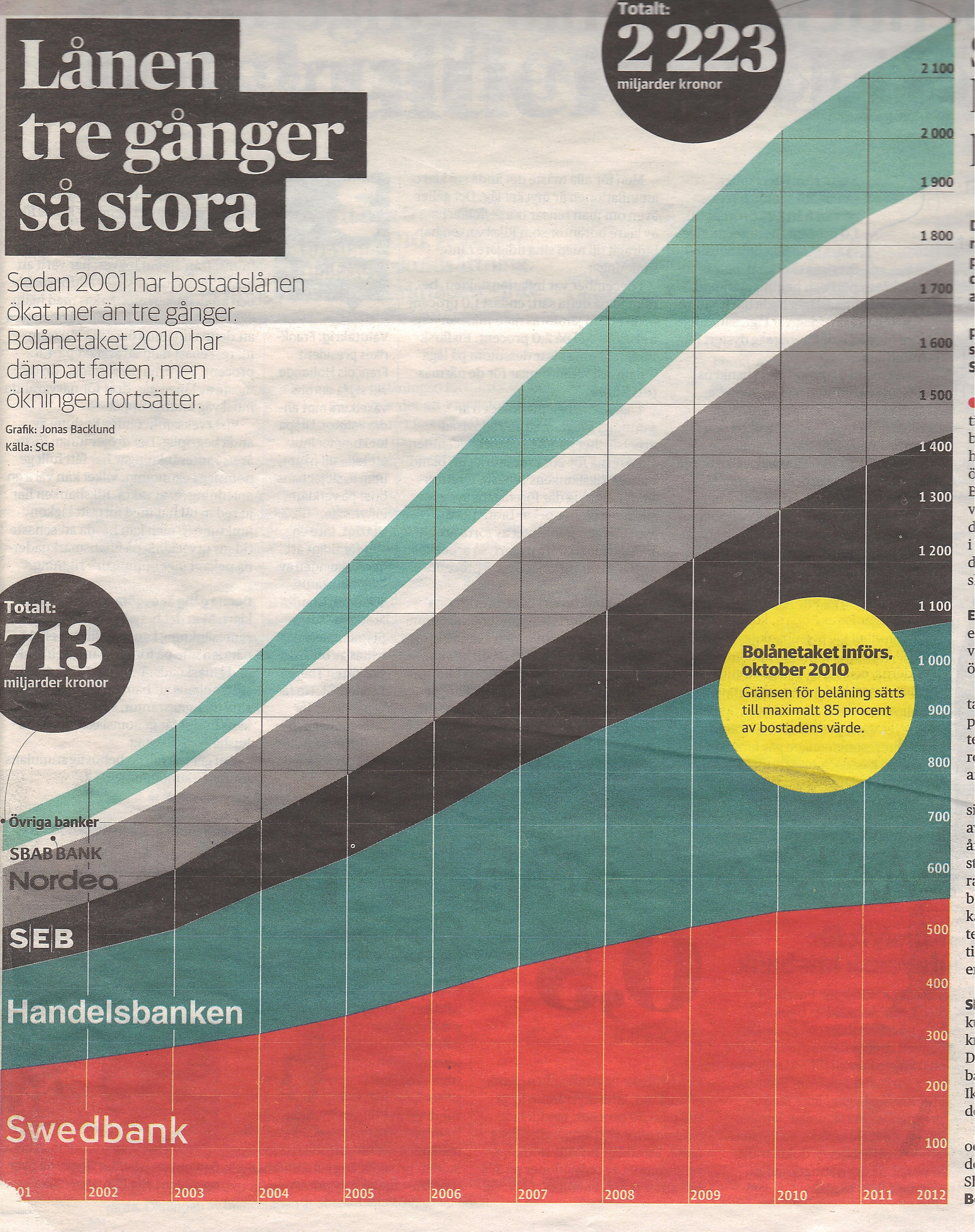
This picture needs no translation. It shows that housing loans have more
than tripled in just one decade. In other worlds: total mortgages have grown
three times more in the last ten years than in the whole Swedish history
before that, ever since the stone age.
There are no economic fundamentals whatsoever behind this debt
explosion. GDP has increased just slightly more than one forth in fixed
prices during the period. (Some of this economic growth is probably fed by
the fictitious money created by the loan bubble.) So, how do responsible
people react to this disaster in creation?
Our Finance Minister admits no problems at all; he is instead pointing at the parameters
that happen to be in good shape for the moment, such as the state finances,
the trade balance and things like that. He pretends not to realize that a
huge and baseless bubble is like a primed bomb ready to explode from the
slightest shaking of the ground. But his view that the government should do
nothing is obviously coming from his neoliberal heart.
The head of the National Bank is aware of the problem but believes that he
has no other means for cooling the housing market than to keep an
artificially high key interest rate. One of the bank’s critical vice
presidents claims that such policy curbs the economy and unnecessarily
creates some 40 000 extra unemployed.
The thing is that the terms for house owners when they borrow money in banks
are extremely liberal. Until recently one could borrow 100 percent of the
house’s purchase price, now reduced to 85 percent. For years banks have not
demanded any pay-offs of loans; on the contrary they have more or less
encourage people to add new loans as housing prices have gone up. Just
recently they have introduced minimal demand for amortizations.
The scene is consequently set for a rerun of the local bubble-bursting some
20 years ago, an event that definitely reshaped Sweden into a more
cosmopolitan form. Welfare started to erode, slowly at first but more robustly
since 2006, and the unemployment level parked on a more international level.
Another bubble bursting will reinforce these tendencies… or create public
uproar.
In a recent report the European Union identifies macroeconomic imbalances in
13 countries. Among them is Sweden, and one point of critique is the high
indebtedness in households and the low amortization rate. Did EU make any
impression on the decision makers? No! The report was
presented in media but without follow-ups. So the inactivity prevails.
One attempt to try to understand this incredible situation could take into
account the religious belief in the market mechanism, so revered by those in
power. Since the condition has emerged seemingly by itself, that’s to say
through market forces, it could in some mysterious way be seen as “natural”
and in “balance”. Then some kind of Invisible God keeps his Hand over us,
and prevents a new disaster to happen. That's called faith. Anyhow, should
the worst thing happen, it'll be on someone else's watch.
2013-04-05 Friday
Our Social Democrats are holding their Congress this week, and one
contentious issue is about profits in welfare businesses. As one would
expect there is a large group of delegates pushing for harsh restrictions
of profit-making in private companies who are performing welfare services.
Everything else would have been remarkable in an old workers party which
once was the driving force in civilizing Sweden.
But our present bourgeoisie government has driven Sweden as far to the
right in these aspects that their colleagues in Europe look like leftists
in comparison. With establishment, media and the economic power on the
same band-wagon there has emerged a kind of “consensus” in opposition to a
large majority of the people.
In any event the party line for Social Democrats on these issues should be
self evident, one would think, not least since only some 10 percent of
Swedes consider the current situation acceptable. There’s only one hitch,
but a crucial one: the chairman has committed himself strongly to the
capitalist standpoint that profits shall remain! Some kind of compromise
is expected to be worked out before voting on the issue tonight.
The large group opposing the chairman’s line is in a delicate situation.
Stefan Lofven was elected chairman after a tragicomic interlude with a man
in charge (Hakan Juholt) who wasn’t quite up to his task and became an
easy game for media (which is overwhelmingly bourgeois, by the way).
Lofven, a respected Union man, was persuaded to take the job, and must now
be cherished.
There is something odd about it all. Here the whole world suffers from the
blow of a finance crash, caused by capitalism in its routine functioning,
and alternative economic perspectives are gaining ground (as in Latin
America). At the same time old “communist” Sweden drifts far to the right
in a remarkable counter-movement. It’s like the last death-throes for a
system without credibility, that has nothing left but the support by
power.
Changing power seems to be the necessary way to go.
2013-04-03 Wednesday
Undoubtedly we as human beings normally perform better when we work in our
own interest. From this axiom our economic scientists have created “the
economic man”, a core figure in a paradigm ultimately intended to justify
capitalism. Then, by slightly misunderstanding Adam Smith, one concludes
that egoism generates the best world possible. The flaws of this theory
are numerous, and usually suppressed in our media.
Sweden – the former role model of welfare states – now has the most market
driven school system in the world, if we by this mean that private
companies nowhere else as easily can pick up tax payers money in school
businesses and turn them into profit. Half of the high schools and one
quarter of elementary schools are privately owned and 100% publicly
financed.
Up until around 1990 the Swedish school system was an international
paragon, welcoming a constant flow of study visits, for instance from
Finland (who nowadays leave its former model far behind in educational
performance). In 1991 Sweden got a right-wing government (with the
infamous Carl Bildt as Prime Minister), and from then on the decay began,
starting with privatizations. One common way of doing this was to hand
over schools, preschools and health centers for a mere pittance to private
persons who more or less happened to be passing.
The generosity with tax payer’s money to school owners has few
equivalents. Students’ parents don’t pay anything at all; schools are in
fact forbidden to demand any kind of payment. Still the owners get
unusually high return on their capital, profits that in many cases are
funneled into tax havens, at that.
Other detrimental system changes were introduced in the 1990s (this time
by the Social Democrats), such as transferring the main responsibility for
schools from the state to the municipalities. Sweden had suffered the
bursting of a home cooked housing bubble, and one purpose of the system
change was to impose austerity and save money.
At the same time teachers’ salaries began to decline in relative measures.
Formerly teachers had the same pay as Members of Parliament; today the
latter earn almost twice as much as teachers. As if this undermining of
schools wasn’t enough, a bureaucratic superstructure imposed misguided
“quality” measures resulting in excessive paper work, stealing valuable
time from the teachers.
A high degree of segregation in and between schools is said to be
detrimental for educational results. While Finland (top ranked in PISA)
possibly has the most equal schools in the world, the privatizations in
Sweden have as expected aggravated segregation.
All in all, this breakdown has not surprisingly led to a rapid sliding
down of our schools in the PISA ranking and other international
comparisons. From a top position two decades ago, we now find Sweden among
the bottom half of OECD countries. And the downhill fall continues.
From this depressing tale we may anyway conclude that privatization is not
an infallible way to improve the outcome of a productive process. It may
sometimes be the exact opposite.
For Swedish readers: Facts above are from an article by Ola Larsmo in
today’s Dagens Nyheter, where he reviews a book by Per Kornhall (article
linked only for DN subscribers).
2013-03-26 Tuesday
My newspaper features bi-weekly a female columnist - Lena Andersson. Apart
from writing interesting think-pieces she is also rational. The other day,
however, I for once happened to disagree with her. It was about the
alleged symbiosis between capitalism and freedom.
She starts with the following crucial reservation: “I cannot judge whether
the capitalist economy in some parts could be organized differently, and
still be free”. Yet, from then on she takes for granted that the
individual freedom we all prefer, inevitably leads to a capitalist society
(even in the distorted form we now experience, obviously).
From this viewpoint she claims that there are only two alternatives:
either capitalism as we know it or a complete command economy where some
planning body, perhaps the majority, decides what we should bye and
consume. (She writes the article rebutting a comic strip by another female
writer, who is arguing for a planned economy.) Convincingly Andersson
predicts that such an economy would lead to further restrictions on all
kinds of freedoms.
Still, Andersson’s view on economic systems seems quite simplistic when
she presupposes that the free society she and we want inexorably leads to
capitalism. In a society where things happen “not because they are
desirable, but because they are permissible”, capitalism will emerge as of
some kind of evolutionary necessity: “The result is not thought out, no
intention or plan hovers over the entirety, no one has any oversight”.
If this idyllic perception of capitalism possibly had some bearing in the
dawn of time it certainly hasn’t today. The entire fabrics of our
societies are entrenched by compelling directives that restrict the
ordinary person’s real freedoms to harmless areas or reduce them to
illusions. And this imperative structure hasn’t materialized entirely
without plans, intentions or oversight. It’s just so that the governing
hand by intention has been kept invisible.
Let’s consider a case where the ruling hand was easy to see, but yet not
made responsible: the capitalist upheaval in Russia, which directly caused
3-4 million deaths during the 1990s. The man in charge was Boris Yeltsin,
surrounded by western advisors, among them a Swede (let’s omit his name
out of mercy) who thought that the transition to capitalism wasn’t swift
and harsh enough.
Yeltsin was indeed sufficiently clever to demand immunity when he handed
over to Putin, but that wouldn’t obviously have been necessary since not a
single person (at least to my knowledge) have brought up the idea of legal
responsibility and indemnity for the deaths and the misery. (We need just
contemplate what would have happened had Venezuela’s transition to
socialism resulted in a comparable death toll. The fact that Chávez on the
contrary increased life expectancy didn’t make him a bit more acceptable
among the “invisible” capitalist rulers, not very surprisingly.)
The very idea that free societies by necessity ends up as capitalist
societies is not just defeatist, but also without meaning. The simple
reality is that all societies mainly are shaped by those in power, which
in capitalist societies mean those with the economic power. Freedoms are
entities that usually are won through popular struggle. Freedoms in
civilized countries are real, but there are also many illusory ones.
Can we for instance call it real freedom if we are coerced to act in a
certain way, unaware of the coercion? If not: how much freedom do we
really have in a society where we are drenched in advertising almost every
second of the day? When not directly monitored by the business community,
we are indirectly steered by conventional norms and pressure from
surrounding fellowmen.
We may speak and write whatever we want, which is a good thing that must
be defended. But there are capitalist societies where the wrong opinion
may render a bullet in the head. Those countries not just exist, they have
been numerous throughout history and they have usually been supported
(sometimes created) by powers in the rich world, that is: by us.
To summarize: Capitalism isn’t the only precursor to freedom. In many
instances it has, on the contrary, been a threat to freedom and life.
That’s not to say that command economies would be a solution to anything,
probably the opposite. Perhaps a modest suggestion would be to try a more
democratic economy as a first approximation.
2013-03-22 Friday
Market economy is in itself a fine thought, provided it works as a really
free system, which it very seldom does. Market distortion is a
prerequisite for capitalism as we know it.
In the ancient agricultural society there emerged occasionally one or
other individual with special gifts. He may have been more industrious and
energetic than others, or perhaps just smarter, but his mandatory traits
were a well developed greed, and total lack of compassion. He started to
save from his harvests, and lend - with profitable interest rate - to his
fellow farmers in bad times. Step by step he could expand his enterprise
and eventually become the big farmer in the village.
To succeed with his business it was important for him never to succumb to
empathy, and to rather see his fellow farmer starve than give away
anything. Ultimately he would become a monopolist, dictating terms for all
kinds of businesses in the village, and make the poor farmers his virtual
slaves. This was the seed of capitalism, and the pattern has remained
unchanged. (It was also the nutrient for the Chinese revolution and other
liberation movements in developing countries.)
Neoclassical economic theory recognizes this process as an anomaly. In a
society with perfect competition there would not even exist such a concept
as profits. As long as a particular business sector produces a surplus for
the owners, competitors would enter the market and lower the prices until
profits were eliminated.
But that’s all theory, just taught in academia. In the really existing
capitalism the core concept is profit, and the main goal for businesses is
to create as much of a monopolistic position as possible. This is the
distorted “free market” that neoliberals think we should leave alone to
create optimal economic development.
So, the problem is not the market economy, it is the lack of a really free
market economy. Since 2008 the whole world has endured the horrendous
consequences of the dysfunctional “markets” exposing the very essence of
its inherent tendencies, partly criminal. For neoliberals to even utter a
sound after 2008 is a sign of utmost temerity, in parity only with their
groundless self-confidence.
2013-03-21 Thursday
Despite having recourses and influence it seems that economic power has
difficulties engaging talented authors capable of writing coherent texts
to promote the interests of the powerful, at least enough to fill a book.
But clever Sweden has been helping out by providing one enthusiastic young
man, admittedly with meager academic credentials, but with the greater
self-confidence. His name is Johan Norberg.
Barely of age had he written a book called In Defence of Global
Capitalism, where he described all the wonders created by the free
market system. (Given that capitalism derives its deepest roots to the 13th
century, it’s quite telling that it still 800 years later has to be
defended.) As the singular event it was, the book was welcomed the way
rain is hailed in the desert. Soon translated into 28 languages it was
greeted by right-wingers around the world, and the young man became the
eagerly awaited new prophet.
The main theme in the book is that world poverty has diminished and
standard of living improved globally, and all this thanks to capitalism.
There is only one thing to say about this line of argument: given the
enormous technological progress under the industrial era, leading to
likewise enormous increase in productivity, it would have been an even
greater shame for capitalism if nothing at all of this ever larger pie had
been shared with the world’s starving masses. The divide between rich and
poor is in itself one of the consequences of capitalism (or, as it
happens, some other economic system), and no self-praise is appropriate
until this gap is closed (you don’t honor a man for beating his wife
somewhat less than before).
Now, as an old welfare state, Sweden wasn’t the most profitable place for
Norberg to dwell in, and he found a better residence at Cato Institute in
the US. There is a cute Swedish incident that the preacher of the free
market’s blessings placed himself in. He had found out that his books were
less abundant in public libraries than those of his ideological
adversaries. Probably smelling some evil interventions he wrote a full
article on this single question, and had the most important paper print
it. Some day later a public librarian was allowed space for a short
answer, saying in essence: When we purchase books we follow market
principles and choose the books our customers demand.
Norberg, of course, detested Hugo Chávez’ policy in Venezuela, but his
arguments, as presented in my newspaper the other day (DN 20 mar) are
certainly interesting. It turns out that Chávez’ achievements were not so
good because the neighboring countries did much better. And to reduce
poverty was “easy” with all that oil money. So, the super-neoliberal
Norberg praises the countries that dismiss neoliberalism and instead imply
social democratic measures! Did the capitalist warrior become a simple
opportunist?
Any neoliberal that is even minimally aware of the horrendous Latin
American capitalist and dictatorial history could do nothing better than
to keep silent. Or else admit that capitalism is past defending, and needs
thorough repair.
2013-03-11 Monday
On this day two years ago mass media around the world reported a chocking
accident, said to be one of the worst catastrophes that has hit an
industrialized country in modern times. And they were not just referring
to the immediate effects of the tsunami in Japan, the killing of 19,000
men, women and children, and devastating of large areas, wiping out whole
villages. No, that was only a secondary event.
The tragedy that filled the newspapers and flooded radio and television
was about a nuclear power plant that collapsed in the same tsunami, and in
which not a single person to this day has been injured by radiation, let
alone killed.
My newspaper has sobered up somewhat during these two years, and allocates
today equal space on the one hand to the real catastrophe with its horrendous
consequences, and on the other to the technical problems of
decontaminating areas around the power plant (two pages each).
Well, the coverage of the real disaster is in fact predominantly about a
fisherman having problems selling his catch, mostly due to psychological
fear of harmless radiation among his customers. So the nuclear aspect yet
again won. More in the margin we can read that rebuilding of the
devastated areas have progressed, although still some 300,000 people live
in interim dwellings.
The reason no one has been injured by radiation are the excessive security
margins applied. Areas around the power plant where
the
radiation doses received by the inhabitants are estimated to exceed the
recommended limit of 20 mSv/y (millisievert per year) are evacuated.
How much is 20 mSv, then? In the part of Sweden where I live one can find
many acre-large areas where one gets this dose and more, some areas the
size of square yards exceeding 200 mSv/y, and single spots with nearly 900
mSv/y! People have lived here for thousands of years, and nobody ever
mentioned evacuation. (The reference is
this report on the IAEA web site, page 9, in Swedish though.)
Even more significant are a number of other places on the globe, probably
headed by Ramsar, Iran. There many people have lived for generations in
the beaming environment of 260 mSv/y without acquiring cancer or other
illnesses more frequently than elsewhere.
It’s hard to counter profound psychological phobia of such magnitude as
that against nuclear power. One of the tragic consequence of the tsunami,
though far less significant than the 19,000 dead, is the enforced negative sentiments
towards nuclear power. We have already seen Germany deciding to close
their plants, and may suspect others to pull the brake.
The tragedy lies in the fact that nuclear power is one of the few
functioning counter measures against global warming, whose impact we most
probably will have to endure before we will see the next nuclear accident
in which anyone will be injured by radiation. And global warming threatens
to cause catastrophes that will fulfill
our media's most exuberant expectations - if there will be any media or
any journalists around when we get there.
2013-03-05 Tuesday
A series of postcards from Sweden that sooner or later wouldn’t touch upon
the subject of sex is not conceivable; especially not when the
contemporary world is confused by our seemingly bizarre sex laws, and
their ludicrous enforcement (now seriously harming a man who is already
risking his personal security in a hard fight for freedom of expression,
challenging governments guilty of war crimes).
The development must be equally confusing for a world which since long
perceives Sweden as a role model of sexual freedom. It must immediately be
said that such a pipe dream doesn’t conform to our own experience here.
It’s close to a mystery how it all came to be.
If we go back to the 1950s, an almost Victorian Puritanism reigned here,
probably in similarity to many other countries. The horrifying fear of
becoming pregnant was heavily restricting sex life for young people,
probably fostering both frigidity and desperation. Contraceptives were not
for sale everywhere, unlike today, and abortions were illegal.
To have an abortion women had to travel to communist Poland (today that
traffic is reversed). A liberal politician who, for principle reasons,
arranged trips to Poland for women in trouble were subject to legal
procedures of some kind, which showed that the laws were to take
seriously. With the exception of very specific indications, abortions were
not legal here until 1974.
From the 1950s I can recall only one Swedish movie with some standing, in
which a woman’s breasts were exposed for a couple of seconds. Not until
the 1960s (and the pill) did the sex liberation become real, like in other
western countries. During this and the following decade a few Swedish
films laid the foundation for an immortal reputation. The perhaps most
memorable was I’m curious, yellow, with a couple of short sex
scenes, which we today would consider really innocent. There was also a
clinical instruction film, successfully circulated world wide as
pornographic.
That was about all there was. Maybe men from other countries visiting
Sweden perceived girls here as more unrestricted and accommodating, but
that was mostly superficial. Real promiscuity was probably not remarkably
more frequent here than in most comparable countries. But a prejudiced
reputation seems harder to wash off the less substance it has.
On the other hand I’m not deeply oriented in global sex habits, so let’s
assume we were a bit more liberated here. What then happened to that
liberation when we entered this neo-puritan new millennium? That is, in
reality sex-life among teenagers is freer than ever. However, in the
politically correct discourse, sex restraints have in some ways become a
weapon for gender feminists against the “patriarchy”.
We have for instance got a legislation to prohibit prostitution, which
makes it illegal to buy sex, but not to sell it. Some women are certainly
in need of legal protection, but to incapacitate all women to ensure such
protection is a double edged tool. (In a fairly logical world this would
at least be an interesting problem for feminists, but the question is
totally ignored.) “Sexuality is now regarded by feminists as a male
deformity”, as one disillusioned man described it.
The basis for this new puritan spirit is postmodern gender feminism that
has achieved hegemony in both the discourse and in concrete politics. Its
underlying doctrine is paradoxical, though. On the one hand there are no
different biological sexes. “Male” and “female” are merely social
constructions which we (for unexplained reasons) have created out of
nothing. On the other hand it’s important to support and promote the
repressed gender, the “females” (that exists only in our constructed
imagination).
Out of this “paradigm” have come the most bizarre applications. To pick
just one example from the horror chamber: there has been issued a
regulation that toys in pre-schools shall be gender neutral. Boys are not
allowed to play with cars and girls not to play with dolls. The most
zealous feminists simply take away what they consider gender-specific
toys, to fulfill the demands. (Luckily, in remote areas, such that the one
I live in, these kinds of stupidities are just neglected.)
If you read Swedish you must visit
Tanja Bergkvist’s blog.
She’s a PhD in mathematics, sharp as a knife and witty like a comedian.
She makes mincemeat of the gender madness, not least the one that has
invaded academia.
Well, this is the climate in which anybody seemingly can be hunted down
world-wide on the suspicion of having “raped” consenting women who bragged
about their performance and didn’t picture themselves as victims of a
serious crime. The “laws” which may produce such “crimes” are flexible in
a way that’s reminiscent of ordinary tyrannies, i.e. laws always prepared
to fit the wanted “criminal”. Its Kafka in a nutshell!
Lunacies like this can’t possibly last forever. But for the moment we can
just raise our voices against the persecution of Julian Assange, and
demand a sane behavior by the appropriate Swedish authorities!
2013-02-26 Tuesday
Neoliberalism excels in new morbid traits in poor Sweden.
We have a public health insurance system that is meant to cover our
economic safety when we get sick. That is, during the first two weeks we
are paid by our employer. The allowances are proportionate to our salaries
up to an unimpressive limit.
Some unions have bargained for complementary insurance, and above that
level people with higher incomes usually take out private insurances to
cover the excess amount. But lots of people have nothing but the meager
public benefit to (try to) live on.
As we have reported earlier in this column, our new wonderful government
has not just tightened the rules for the public insurance, but ordered
harsher enforcement of the implementations. We are allowed be sick, but
just for a specific period of time, and then we must report for work. The
dispensations from that rule are few.
To suffer from terminal cancer is not to be sick enough to get your
benefits for a prolonged period. You have to prove that you definitely are
dying. In today’s news we can read that a bureaucrat ordered a 23 year old
boy to deliver a doctor’s certificate specifying on which day he would
die. Others can obviously accept an estimation that promises a 60 percent
risk of dying in a not too distant future. Then you may get some money, at
least to cover your last supper.
Does this remind us of certain aspects of Nazi practices?
2013-02-20 Wednesday
There is a saying here that we Swedes see ourselves as unsuspecting and
somewhat naïve, characterized by the German phrase “die dummen Schweden”
(which actually is a fake factoid, only prevalent in Sweden). In any
event, and with some justification, we usually trust our authorities and
the welfare system we have built. We feel safe that the system will help
us in some way if we unexpectedly are hit by illness, unemployment or any
other serious adversity.
One thing that many really were unsuspecting about was the ultimate
outcome of the elections in 2006. With a neoliberal government, for six
years stepwise dismantling welfare, more and more Swedes have experienced
that the feeling of safety has become false. First to be hit by “tough
love” were long-time sick, who were cut off from their subsidies and
forced to apply for work. (Since many of them didn’t get healthier from
that treatment, they were back in the insurance program again after a long
period of uncertainty and suffering.)
Next to undergo the wonderful implications of the free market replacing
welfare were the unemployed. Our right-wing government had fooled and
forced people to skip their unemployment insurances (by e.g. raising
premiums) and thus also leave their unions. In the recession now finally
reaching Sweden, ordinary people in hordes lose their “safe” jobs, and
unemployment is up to 420 thousand, or 8.4 percent, a level formally
considered extreme.
As many as half of the 420 thousand jobless have no unemployment
insurance, a completely new and surprising situation. If they have had
employment for a stipulated period of time they get a basic allowance
during 300 days without specific conditions, a payment amounting to just
over §1000 per month. You can barely support a family on such alms, and
after the 300 days it gets even tougher.
Then you have to rely on the municipal’s social office for survival. To
get any means for subsistence there you first have to sell everything
valuable, such as your car and your house. Then you must be prepared to
live a poor man’s life; and all this even if you have no liability at all
to your unemployment. And the fact is that practically all unemployment is
due to lack of jobs and nothing else!
In the wonderful neoliberal world no demands are imposed on the business
community and the corporations, to create more jobs. The unemployed are
fooled with the “theories” of “supply economics” saying that if they just
try hard enough to find a job there will materialize an employment out of
nowhere, through some miraculous process that the holy market principles
will provide. That fairytales like these are told by the most respected
economists tells us a lot about the indoctrination our schools are capable
of. (To be fair: there are also gifted economists telling a different
story.)
One would have thought that neoliberalism by now should have exhausted all
credibility, but no way! In fighting this anti-human ideology we must
ourselves be inexhaustible.
2013-02-15 Friday
My daily paper Dagens Nyheter had an interesting diagram the other day (12
Feb.) showing salaries for the elite relative to the ordinary industrial
workers' wages. The diagram shows the number of ordinary workers' wages
earned by top officials.
The red curve represents the economic elite, such as CEOs in the largest
corporations. Blue is for the bureaucratic elite, meaning top officials in
the public sector, and grey for top politicians. Dark grey shows the
average for the whole elite.
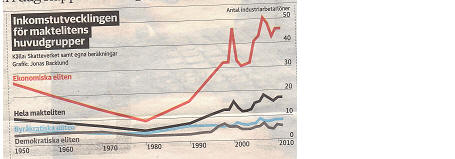
If anyone had any doubts about the purpose of neoliberal economic
principles they can obviously get a hint from this picture. Since we know
that total economic growth in Sweden was higher in the more egalitarian
years up till 1980 then afterwards, the enormous bonanza for the economic
elite is in any case not deserved. What we see is simply a shift in power.
What’s remarkable is that the same picture in principle applies to western
capitalist countries regardless of other differences. Of course the gap
between elite and workers in for instance the US is some multiples wider,
but the pattern is the same. As for the reasons behind this congruent
development I’ve not seen any speculations, let alone any scholarly work
(if any reader has, I will gratefully welcome hints or links).
Immediately after World War II there was a realistic debate in Sweden
about the possible introduction of a planned economy. Even the economic
elite felt compelled to make a number of concessions to avoid such a
“disaster”. One possible speculation could be that the working class came
out of the war as some kind of winner, thus with strengthened confidence.
In those days it was after all self-evident that the Soviet Union had
defeated the Nazis, the worker’s state had crushed the right-wing
extremist state. (Western contributions in the margin could be magnified
out of proportion only when memory had faded, and the cold war had clouded
sound judgment.)
It’s not that economic power in fact would be weaker before 1980 than
today, but it was then somehow compelled to share the outcome of the
flowering economy in more decent proportions with the rest of society. The
power of the employees grew out of organizing and strong unions and was in
Sweden accompanied by determined Social Democrats who implemented
egalitarian principles in parliament and in legislation.
The neoliberal deconstruction of the former societies based on solidarity
was in no means called for by economic reasons. No macroeconomic
indicators have improved in any significant way, but many of the hyper
liberal consequences have been detrimental. Most damage has been done to
poorer peoples in both rich and poor countries.
That is: neoliberalism has been a euphemistic disguise behind which the
economic power has resumed its old slogan: “gain wealth, forget all but
self”. The diagram above is but one clear illustration to this, among many
others.
2013-02-11 Monday
Those days when Olof Palme - with some courage and decency in matters of
world politics - raised his voice against the horrible Indochina wars are
long gone and almost forgotten. Now official Sweden has taken on its role
as humble butler in the United States’ household. It’s interesting to
notice how smoothly mainstream media here adjust to the “correct” policy
even in the fine-tuned details.
A year and a half ago Dagens Nyheter had a story about CIA using a
vaccination campaign as a cover for accessing DNA samples in the hunt for
Usama bin Laden. The story emanated from The Guardian and was obviously
confirmed. Twelve prominent deans of top US public health schools recently
wrote a letter to president Obama condemning the CIA methods, which
already have induced deaths and ultimately may bear responsibility for
severe epidemics.
The journalist’s key to appropriate handling of issues like this is first
of all: don’t use the moralistic undertones that you apply to similar
reports about enemies. Secondly: don’t repeat inconvenient stories, print
just once. These principles were closely followed in reporting of the CIA
scandal. Subsequently the story soon died here (as opposed to instances
where other secret services are caught with similar misdeeds, in which
case memories may last for decades).
Attacks on the vaccination programs started about a year after the CIA
story was leaked. At first the programs were stopped by militant
Pakistanis and the Taliban, then came the killings of personnel engaged in
the vaccinations, and the subsequent closure of the whole programs. Now
the newspapers' reports were repeated and the moral aspects sharply
underlined.
At this stage the CIA story was also presumably forgotten. Thus the
articles could deal in detail with the immoral acts and the dreadful
atrocities performed by the Muslim extremists. Oblivious of history one
journalist ends her article with the sentence: “Taliban have also claimed
that vaccination campaigns are a cover for espionage.” Claimed! Taliban!
(which infers that it is a lie). That’s how media erases history in the
discrete manner we usually don’t detect.
2013-02-08 Friday
Politicians are not paid to be consistent or even commonly sensible, and
their absurdities are not expected to be noticed by journalists if not
fitting the appropriate agenda. Thus there is nothing to be excited about
in a news flash today concerning our former Minister for Enterprise, Maud
Olofsson, and a business deal she made three years ago. Except that it
really is noteworthy, for conscious observers, anyhow.
The thing is that the rather famous Swedish car manufacturer SAAB
underwent a severe crisis after the disastrous finance crash in 2008, like
most other car producers in the world. In the US, president Obama made the
decision to save General Motors from collapsing by injecting an enormous
amount of money. Angela Merkel also stepped in to save German car
companies with large sums. But in the great neoliberal Sweden the
responsible Minister Olofsson proudly raised her voice for the sacred
freedom of enterprise, declaring that “the state shall not own
corporations!”. Thus SAAB got nothing.
What did she do then, when a classical company and a spearhead in car
technology lay in its death throes? Well, she promised to improve roads
and railways to the SAAB hometown Trollhättan, and infuse money into car
research! Now the company is dead, leaving Trollhättan with the highest
unemployment in the country. But the road to Gothenburg is finally
excellent.
It so happened that in exactly the same time as Olofsson uttered her proud
statement she approved of the state’s acquisition of a Dutch energy
company, Nuon, for the neat sum of almost 100 billion Swedish Crowns (15
billion US dollars). We are talking about the same state (through its 100
% owned Vattenfall) that, according to the same Olofsson, shouldn’t own
enterprises at all. Not even to save an important development center for
Swedish car industry and its contractors, and a world famous brand name at
that. (It should be added that Nuon turned out to be a grave economic
problem for Vattenfall all along.)
Today’s minor news flash reveals that officials in Olofsson’s own
department warned her that the price for Nuon was almost 30 billion crowns
too high. Despite that, she approved of the business deal. For this
decision she is now reported to the Parliament’s Constitutional Committee
for further investigation. But since she has left politics there is
nothing to defend. Honor is not at stake in this old affaire, soon buried
in the protocols no one will read.
It suffices to say that these 30 billion, thrown away at a deficient
fossil fuel company and lost forever, could have kept SAAB alive for many
years, perhaps making a successful merger with Volvo possible. But what’s
that worth, compared to (sometimes) guarding the holy neoliberal
principles?
(As leader of the Center Party after Olofsson came Annie Lööf, another
inexhaustible source for bloggers.)
2013-02-07 Thursday
With regard to private schools it’s fair to say that Sweden is the perfect
welfare society for venture capitalists hidden in tax havens. For the
schools to demand tuition isn't allowed and the state provides all
financing through a voucher system in which each student corresponds to a
specific sum of money. Thus there is a kind of competition for students on
the education “market”.
The private schools are quite profitable and considerable amounts of
taxpayer’s money end up in private pockets, often untaxed at that. We have
mentioned earlier how the competition for students takes rather odd forms,
such as offering fringe benefits in more or less fancy variations. An even
more perverse means of competition has been revealed this week by Dagens
Nyheter.
It turns out, actually quite expectedly, that private schools compete by
granting higher grades than public schools. There is a control system
consisting of national, common and standardized tests which are intended
to guide teachers in the judgment of their students’ performances. A study
made by DN shows that some schools, most of them privately owned,
systematically give grades far above what the national tests indicate as
legitimate.
Today the same paper had a miniscule note in 45 words revealing that
teachers in private schools earn less than their public school colleagues.
The mean difference in salaries for elementary school teachers is around
§80 per month and for high schools teachers §289. The often heard argument
that privatization should be a bonanza for the employees didn’t refer to
the salaries in this case, obviously. Well, in a private business money is
intended for profit, so what to expect?
Parents of children in the phase of choosing among high schools are
drenched in brochures from all over the country, enticing them to select
one or the other of endless alternatives. What they could ask themselves
is what purposes all this privatized frenzy should fill, considering all
the documented defects the system as a whole exhibits. And the question is
certainly legitimate since there are no serious studies that show any
substantial advantages following the privatizations. But the ideologically
convinced are eagerly looking for something to expose, so we will some day
here from them.
In the meantime we may just hope that the stream of failures reported from
the privatized utopia will be dammed up, one way or the other. We
obviously don't want to see the Swedish school deteriorate from
privatization to such an extent that repairing becomes impossible (there
are enough problems from other reasons).
2013-02-05 Wednesday
To be poor and healthy is better than to be rich and unwell! That’s an old
saying here, intended to comfort those without money. In reality the rich
have always, on average, had better health than the poor. But in pace with
technological development leading to economic growth, combined with
civilizing progress due to social struggle, the emerging welfare states
have seen also the poor gaining improvements in health. Thus the
differences in life expectancy between diverse social strata have
diminished since the industrial revolution.
That is: this goes for Sweden just up till 40 years ago when things
changed and history began moving backwards. The differences in life
expectancy between the lower and the upper classes started to grow again.
At a recent conference held at the Swedish Academy of Sciences this was
shown to be a phenomenon that appeared in a number of other industrial
countries as well. The empirical facts are indisputable and specifically
clear when classes are defined by educational level.
Though the facts are undeniable there are few verifiable explanations. The
leader of the Swedish section of the research program suggested that life
style factors could contribute to one third of the differences, but that
the rest only is subject to speculation. Some international researchers
interviewed by Swedish radio vaguely pointed at the welfare measures as an
important factor, and urged governments to safeguard the protection of the
weakest in society.
As a non-professional in the field I have the privilege of speculating
with absolutely no constraints. For me the coincidence in time with the
neoliberal counterattack on welfare ideals is a fruitful starting point
for discussion. After the “disturbing” 1960s and the swift capitulation of
the progressives (some of whom disappeared into esoteric or postmodern
fogs and some into corporate boardrooms) both flanks lay wide open for a
sweeping attack, soon to be successful. The shift in Sweden was manifested
politically by the first non-socialist government in three decades,
elected in 1976.
The many ways in which neoliberal measures affect and impair the less
well-off can fill a catalogue. For one thing the welfare state’s
withdrawal leaves the underprivileged alone and vulnerable to the
overwhelming propaganda (advertisement) which is a prime weapon for the
economic power to keep people passive and isolated in consumerism, and
perpetually running in their hamster wheels.
Perhaps more direct effects of neoliberalism on the worker’s self-esteem
as a producer emanate from all kinds of pressures subjected to him under
the pretext of “globalization”, meaning the “need” for ever increasing
profits. This and all other means of depriving the less fortunate of a
true living standard can easily be understood as detrimental to health and
lifespan.
Of course life expectancy for all has risen when measured in an absolute
number of years. But since the inequality between classes in this respect
is increasing there exist a neglected potential to extend lifespan for the
less fortunate. In that sense it’s fair to say that they are deprived of
lifetime, in other words suffering premature and unnecessary deaths. With
my view on causalities this interprets: neoliberalism is lethal!
2013-01-31 Thursday
The choice of words is a subtle and yet effective element in propaganda in
our free media. So when the semi-official Swedish news agency TT (Tidningarnas
Telegrambyrå) issues a news flash about Julian Assange it seems important
to suggest which feelings Swedes should have for this man. TT:s texts are
often copied verbatim by most newspapers and broadcast media, among them
this time Dagens Nyheter.
What’s reported by TT today is, correctly, a Twitter-message that Assange
will run for a seat in the Australian Senate next election, in September
this year. Supposedly to “explain” more about Assange the news flash ends
like this:
“Assange has been hiding in the Ecuadorian Embassy in London since June
2012 to avoid extradition to Sweden where he is accused of sex crimes.”
“Hiding”! A man holding speeches from the Embassy’s balcony, covered by
media all around the world! “Accused”! To anybody’s knowledge he is not
officially accused of anything; he is absurdly suspected for "sex crimes"
against consenting women and wanted for interrogation by a prosecutor.
This is how Swedish journalists, cynically claiming to defend the free
word, insidiously disparage a real fighter for freedom of expression. And
this has become the mainstream media “policy”, as if Julian Assange’s case
above all must be regarded as a matter of national prestige.
It’s a shame to be Swedish in these days, for this and for other reasons
as well!
2013-01-26 Saturday
Our PM Fredrik Reinfeldt is in Davos, Switzerland, to attend the annual
World Economic Forum. My newspaper reports today that he observes a great
interest in Sweden and in our successful handling of the economic crisis.
He probably didn’t reveal that he himself has nothing to do with the
fundamental reasons, which are the high global demand for our raw
materials and for products from our manufacturing industry. Those
components of success are combinations of luck and engineering skills. And
that luck is by the way running out with a sudden and pronounced slow-down
of the economy showing up.
Most likely he neither said that the healthy conditions of the state
finances are to a large extent based on harsh deterioration of living
conditions for the poor and vulnerable. On this gloomy side of the great
achievements my paper had an interesting article past Sunday, as we shall
see.
It could have been bad enough that Swedish welfare has been reduced in
scope, but it has also been ordered to redirect its way of functioning.
The employees in the state welfare institutions, who mostly used to be
empathetic civil servants interested in helping out their more unlucky
fellowmen afflicted with sickness or unemployment, are now replaced by
supervisors overseeing that the unhappy are put under adequate pressure.
(This transition, and the easiness with which it was implemented, brings
to mind a historical event where a whole country was transformed from
highest level of culture to the cruelest barbarism in a few years [no
comparison apart from the easiness!]). The effects of the depressing
process has been documented by a literate woman, a former musician and
songwriter, Nike Markelius, who was admitted space in our #1 MSM Dagens
Nyheter for a short report.
Just coming from surgery and thrown out of the insurance scheme due to new
time limits enforced by the neoliberal government, Markelius was directed
to the state employment service to report for work. There are in reality
no available jobs for her whatsoever, and after a softer transition period
she finally reached the cut, where she had to undergo a “Transfer” to a
new “Program” (like the First Circle in Inferno).
It turned out that the “Program” implied mandatory attendance to
“seminars” conducted by “coaches” from new private enterprises
(multiplying like rabbits to feed from the large funds generously provided
by the government). Studies have by the way shown that the almost half a
million dollars so far spent on these activities have had no visible
effect on the employment processes. Markelius’ documentation of the
“seminars” is Kafka-like.
There was a woman forcing the jobseekers to do meaningless and humiliating
group work; and a pumped-up boy insisting to communicate his “life
experience” to decades older people on how to apply for jobs; obviously
also the compulsory pep-talk about keeping up the spirit, being positive
and all that expected crap.
As we know from this webpage there are no new jobs to apply for in Sweden,
apart from what reluctant politicians can offer in the public sector. The
private sector employs today the same number of people as it did in 1940,
though the population is 50 percent larger today. Unemployed can thus
compete for the jobs that happen to be available in the normal turn-over
of employments, and there will consequently always be a given number of
people without jobs, regardless of phony “seminars”.
All this is so obvious that no responsible person can claim to be
ignorant. Then why do these probably intelligent people create such
imbecile activities? Is it perhaps important to delude people that
unemployment is self-inflicted? Or is it necessary to humiliate and
degrade the victims, and if so for what purpose? Regrettably the correct
answer most certainly is just as stupid as the question.
2013-01-22 Tuesday
How did Sweden regress from the world’s role model of a caring and yet
prosperous welfare society to a neoliberal and thus misanthropic predator
farm (to exaggerate just a bit)? And how large a step isn’t it from Olof
Palme in a protest march opposing the immoral US war against Vietnam, to
the subservient ministers of today eagerly persecuting a hero of the free
word, Julian Assange, just to please the “owner of the world”.
This depressing “development” could however not be regarded as totally
unexpected. Modern Sweden grew out of a feudal-type society, owned and
ruled by an aristocracy (in some respects more pronounced so than in the
neighboring Nordic countries). The class structure was hence well
established when modern capitalists seized power during industrialization.
With that a bourgeois class (middle class in European terms) of
white collar workers, middle management and the like emerged, together
with a working class with competing interests.
Initially the new ruling classes naturally had the upper hand, but through
organization and mass actions the working class successively gained
strength and political influence. From the mid 1930s Sweden then
politically became a social democratic country, and the welfare state
started to take shape. But the anti-socialist political forces were always
just a hairs breadth behind in elections, and always miles ahead in media
and other propaganda recourses, not to speak of economic power.
Telling examples of the influence of right-wing forces can be found for
instance in the pre-war years. Sweden has later been widely criticized and
disdained for deserting from World War II. But in fact the allies perhaps
should be grateful for this “peacefulness”, since history shows that
strong forces, including the highest military commanders, advocated a
Swedish engagement in the war on Germany’s side.
After the Soviet attack on Finland these right-wing activists made an
official move in early 1940. The Military Headquarters’ Chief of staff
presented plans for a Swedish entrance into the war on the side of its
sister nation Finland. These plans were put forward directly to the
government, which was a coalition composed of all the democratic parties.
But the Prime Minister, Social Democrat Per Albin Hansson, rejected the
plan as nonsense.
In the year that followed the activists held public meetings where they
openly argued for Sweden to join the war on the Finnish side. They also
advocated overthrowing of the Swedish government, i.e. propagated for a
coup d’état. Strong sentiments for Finland and its destiny created a not
insignificant support among quite large groups in preferentially
conservative circles. The Social Democrats, who certainly didn’t want a
war anywhere near the German side, had to stand strong against these
forces.
In addition to the warm feelings for Finland there had traditionally been
strong ties with Germany, not least from conservatives of different
shades. A typical but somewhat extreme example of these close ties was the
world famous explorer of Asia Sven Hedin, a pure Nazi himself, a close
friend of Hitler and a recipient of a distinguished Nazi order (with
swastika and all).
Another figure in this gallery was a famous professor, Rudolf Kjellén, who
invented the concepts Nationalsozialismus and Lebensraum ten
years before the Germans. The author Jan Myrdal later wrote that there
were a number of outright Nazis among the teachers in his high school in a
conservative city district in Stockholm. In Gothenburg secret groups of
middle class Nazis were disclosed after the war, and death lists
discovered. None of this ever reached a court (and barely the media). In
my own school in the same city there was at least one known Nazi teacher
still in the late 1950s.
Apart from the outright Nazis there was a larger group of conservatives
that, at least until Stalingrad, viewed the Nazi regime as a means to turn
history “right”, restore Sweden as a great power and strengthen monarchy
in opposition to the form of democracy they considered a rule of
mediocrities. A number of militaries where found in this group.
The soil was thus well plowed and harrowed when the military Commander in
Chief, Olof Thornell, at a cabinet meeting on April 21st 1941 put forward
a detailed plan for Sweden to join with Finland and Germany in the then
expected large attack on the Soviet Union. Thornell was a thin man, and at
the other end of the table sat another thin man, Ernst Wigforss, a social
democrat whose face got white from rage as he listened to Thornell. When
the general had finished Wigforss asked him whether the staff had prepared
any alternative plan for Sweden to join the war on the Soviet side.
Thornell seemed to view the question as malice.
Wigforss was a man of moral stature and he probably contributed a great
deal to the government’s decision to put an end to the military dreams (a
decision which required overruling some conservative forces within the
government itself). But the progressive parts of the political system had
to put in all their efforts to prevent the strong pro-German forces to get
their way. Any thoughts of entering the war on the allied side thus came
out of reach, had there ever been any. So, neutrality prevailed.
This was perhaps a long detour just to show what impressive strength
reactionary forces always have had in Sweden. Progressives have succeeded
to build a welfare state only with the help of fairly small majorities in
the decision making processes. Now those margins have disappeared and we
have a government busy tearing welfare down, piece by piece.
2013-01-18 Friday
Neoliberals are of course aware of the questionable consequences of their
beliefs, as far as moral is concerned. It requires no super brain to
figure out that excessive individual freedom systematically benefits the
already prosperous and harms the less fortunate. And since it’s important
for civilized people not to be bluntly immoral they have to invent a
rationale.
The prime rationale for neoliberalism is fabricated on the basis of a
thesis attributed to Adam Smith, saying that a free market for goods and
services automatically creates the best of all possible worlds. It’s the
famous “invisible hand”, steering everything in an optimal way. Now, first
of all Adam Smith never used the phrase invisible hand in Wealth of
Nations in the alleged context. But more importantly he presupposed
that a free market economy would create a decent and reasonable society
with wealth distributed in a fair way. This part of Smith’s work is
conveniently forgotten, since it says almost the opposite of what our free
market economy does.
On the surface market mechanism do work to monitor production and
distribution of goods and services to meet our demands. To some extent it
depends on the fact that we are propagandized by producers to demand what
happens to be produced. But on the whole the market principles are working
as intended. The problem is that they also inflict collateral damage on a
large scale.
One devastating damage is that market forces now and then crush the world
economy, as we have seen recently. The only thing that can be done about
that fundamental failure in its function seems to be to let ordinary
taxpayers bail out bank owners and high officials. All workable
regulations are forcefully prevented, and we may just sit and wait for the
next crash to come.
Sweden is a hot candidate to be first in line in the next financial
catastrophe, and all responsible powers just look on passively. Swedes are
heavily in debt, mainly as a consequence of extremely liberal rules for
amortizing debts on their houses. In practice there is no time limit at
all for paying back mortgages.
The debts have increased sharply in the last couple of years, as has
housing prices, far above any real growth in economy. The prospects are so
gloomy that a small dampening of the rate of further increase is
reported as good news. The crisis is reflected in the loan-to-deposit
ratio for Swedish banks, as shown in the diagram below (source).
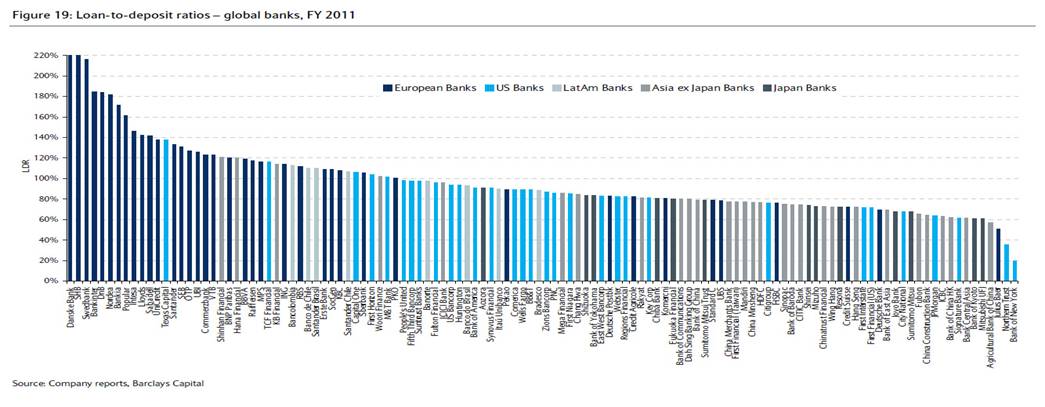
Two of the three banks in overwhelming “lead” are Swedish (the third bank
is from Denmark, a country suffering tough consequence of a housing bubble
that burst). The banks in the 6th and 15th positions
are also Swedish: a remarkable achievement for such a small country. Our
predicament is very much observed in international media and commentary.
Our economy luckily survived the 2008 crash with limited injuries. A happy
mix of raw materials and manufacturing industry that fit the demands from
expanding economies saved us this time. Unfortunately policy makers
thought that we had become immortal, and stopped thinking. Today our
Finance minister declares that effective actions against the exploding
debts cannot be taken, since that would trigger the crisis that he
consequently sees ahead: the housing bubble would then burst.
So, serious attempts to prevent the bubble from bursting will cause it to
burst: a great lose/lose situation that could have been prevented by some
thinking when there still was time. Sens moral: retract any loans
you may have given to Swedes, and do it immediately!
2013-01-12 Saturday
We have been honored with a piquant political scandal here in Sweden
lightening up the January darkness a bit. It’s the small Center Party who
has presented a draft to a document on the party’s main ideas for the
future, peppered with neoliberal excesses never heard of in Swedish
politics. The most exhilarant of these were motions to legitimize
polygamy, open up for free immigration, introduce flat tax, abolish
inheritance laws and compulsory school attending, and some other things in
the same spirit.
This party was once founded by Swedish farmers to guard agricultural
interests and the needs of the countryside generally. In the 1930s the
party had a somewhat brown shadow, but used to defend welfare politics
together with the Social Democrats. When farmers disappeared as a
political force a change of name became suitable. At the same time the
green issues timely popped up and with the help of environmental topics
the party reached 25 percent of voters, and in the elections in 1976 their
leader thus became Prime Minister of the first non-socialist government in
almost forty years.
Since then the party has been on a downward slope now hitting a record low
rating in polls, some 3 plus percent, threatening to send them out of the
Parliament in the next election. In this predicament the neoliberal
volcano erupted, arousing fury among the old party veterans still adhering
to more neutral ideas (the “center extremists” as a comedian once called
them). How this backstairs revolution came about seems suddenly surprising
to everyone. But the answer is a bright young girl, Annie Loof (Lööf with
Sw. letters), 28, recently elected chairman of the party.
Loof has been reading too deeply into the works of Ayn Rand and Robert
Nozick and has become saved. Together with some young allies she has
obviously hoped to bring on a neoliberal revolution in the party, in
opposition to a large majority of party members and officials. The best
one can say about this is that she has committed a grave tactical error.
As to the more philosophical grounds for her extreme neoliberalism one
cannot but marvel. Now, Loof comes from the thin Bible belt of Sweden
where Free-Churchism traditionally has been relatively strong, so elements
of faith are something she probably is familiar with. Her deep belief in
total and individual freedom has in any event religious overtones.
The philosophical problems of complete freedom where thoroughly discussed
(again) in the 1960s and 70s. Before that the founders of the liberal
ideas had already noticed the dilemmas. Is there such a thing as total,
individual freedom at all? Is there freedom for one that doesn’t infringe
on freedom for the other? If my freedom doesn’t affect other individuals
in any way (for instance “freedom to breathe”) do we even talk about
freedom at all in such cases?
Already Karl Marx made the observation that man is a political animal (zoon
politicon) who only in a society could isolate himself. In his view
one individual’s experience of absolute freedom has to be a solipsistic
illusion. We are all dependent on each other and can thus never be to
totally free.
Freedom in the neoliberal discourse has an ultimate signification, namely
the freedom of property owners to dispose of their property without
interference from others. This leads immediately to an institutional
structure that entails the fundamental contradiction to freedom, for
others namely. The priority that ownership implies is the basis for a
business world that constitutes a tyrannical, dictatorial structure in
which orders are given at the top and obeyed downstream.
As the most significant result of the neoliberal epoch the last 30 years
we can note a remarkable transfer of the societal production result from
an overwhelming majority of the populations to extremely small groups of
already rich people becoming even more filthy rich. This is such a
tremendously dominating effect that it has to be considered the ultimate
goal of neoliberalism. Thus Annie Loof’s conception of “freedom” is an
effective way of suppressing the interests of the majority of ordinary
people, benefiting first of all the very rich. It’s a long, long distance
away from the ideals of the old Center Party, and by the way from good old
common sense.
2013-01-10 Thursday
Owen Jones’ brilliant
critique of the Tory government
in the Independent yesterday is self-evidently substantiated, as is the
corresponding judgment on the Swedish government. Both our countries have larger
national incomes than ever before and undoubtedly considerably higher than
in the 1970s.
But in those remote days there was no visible poverty in Sweden and
definitely no soup kitchens. Ordinary people who happened to become
unemployed or sick didn’t have to apply for social benefits (“poor relief”
as it once correctly was called) as many have today. The social insurance
systems worked and people didn’t have to suffer radical deteriorations of
their lives if they accidentally were hit by unemployment or sickness. And
there were certainly no full-time working people unable to live on their
salaries.
On strictly logical grounds it’s impossible that harsh austerity with it's
really severe consequences should be needed today when the societies are
much richer than before. So, where does the money disappear? That’s no
mystery, I’m afraid. Since the 1970s the transfer of the societal
production result from the large majority to a miniscule elite has taken
mind-boggling dimensions.
Most of these gargantuan amounts of money in the hands of a few are then engaged
in gambling games called financial speculations, now and then crushing the
global economy, but not adding much productive value which could be of
importance for the working people. It feels almost embarrassing to write
this down, since it’s all so obvious, at least for people without the
necessary education to blind themselves to the reality.
In one respect it’s somewhat unfair to through all blame on Cameron and
our Reinfeldt, given that they only are the homeroom teachers, eager to
appease the head master’s office, manned by the anonymous economic power.
But they shall anyhow bear responsibility for so willingly participating in
punishing the less fortunate pupils.
2013-01-08
Tuesday
There is just one conceivable explanation why bourgeoisie media in Sweden
and elsewhere express such hatred towards Hugo Chávez, and that is his
economic policy with its purpose to help the poor majority of his countrymen
with food, education, health care and other fundamentals for a decent life.
In this process a minority is affected negatively. Those are above all the
miniscule groups of super rich which often serve as henchmen for US economic
interests (which also “suffers”). In the good old days this type of groups
ruled most countries in Latin America, when necessary with the help of
military forces, often armed and trained by the US, lead by more or less
Nazi style generals (and sometimes with masses of people simply murdered).
In Venezuela there is undoubtedly also a large minority of bourgeoisie
professionals and others who believe they would be better off with a more
right-wing president. These groups implemented the large strikes in 2003
that almost ruined the country. In Swedish media this was described as
“Chávez driving the economy into chaos”. Well, that’s also a way of looking
at things.
Dagens Nyheter published in 2004 an article by the author Mario
Vargas Llosa (then not yet a Nobel Laureate), where he lost all inhibitions.
He described Chávez as a “criminal officer”, “disciple of the tyrant Fidel
Castro”, “coup plotter”, an “enemy of his people” and “a danger for his
neighboring countries”. This demon was turning his country into a
“dictatorship” with the help of his “cruelty”, his “rhetoric of hatred and
vindictiveness” and “populist demagogy”. Through his “despotic and
totalitarian deed” he was giving away his country to “barbarism and
authoritarian obscurantism” (just to pick some of the flowers).
Vargas Llosa’s main point was more interesting. Venezuela’s powerful
opposition had gathered signatures for a petition demanding a referendum on
Chávez’ presidency, in which they expected an easy victory by two thirds of
the votes. It seemed as if the Chavistas in violation of the rules were
trying to block the referendum, and Vargas Llosa’s article was a call to
OAS, UN and EU to counteract that. If this referendum is allowed to take
place “a bloody civil war has been averted” Vargas Llosa asserted.
The referendum actually took place – and Chávez won with 60 percent of the
votes, as usual in an election fully approved of by external monitoring
bodies. Curtain!
Hugo Chávez is naturally no saint. That’s impossible in politics for anyone,
and particularly so when you challenge the core interests of the United
States of America. But it is quite unbelievable that he would undertake all
the hardship just for his own love of power, which is claimed right out in
our media. He would have had a much easier way to the presidency by the
traditional method of subordinating himself under the world’s leading power.
But our media have learned the Goebbels' lesson: if you must lie, make it
greatly!
By denying that Chávez has a philanthropic base for his policy, all those
who oppose him don’t have to present any alternative way to meet the
enormous needs of the large majority in Venezuela. They can then just go on
the same way as in the last five hundred years, completely ignoring the poor
and unwashed masses.
2013-01-05 Saturday
The most prominent Swedish rag, Dagens Nyheter, is in its main editorial
today hoping that Hugo Chávez will die from his cancer: “For the people of
Venezuela it would hardly be a loss if the president the coming years had
some other name than Hugo Chávez”. (I suppose that DN would have a
different approach if the chief editor of the People’s Daily were to hope
for our Prime Minister to drop dead.)
The fortuity that “the election process in Venezuela is the best in the
world” (pres. Carter) doesn’t influence DN in its view that Chávez has
shown “obvious dictatorial tendencies”. For DN it seems insignificant that
the people have had a number of opportunities to dispose of Chávez, but
repeatedly have re-elected him, with large majorities at that. But since
this is not the result that Sweden’s most important newspaper wants, it
cannot be called democracy.
Nor is it democracy that poverty has been reduced, which is the only one
of Chávez’ progressive achievements that DN even mentions. On the other
hand they find enough undemocratic activities to fill half the page. One
obvious of them is the curtailing of the free media. On that one DN
conveniently forgets the role of media in the treason committed in 2002,
when Chavez for a while was illegally overthrown.
On a TV show some time ago well-known actor Sean Penn quietly pointed out
that all these treacherous journalists without notice had been locked up
in prison, had the same kind of coup taken place in the US. But in
Venezuela they cannot be punished since their mentors are to be found in
the US. Instead they are still free to push their reactionary agenda, and
according to what Penn himself heard, propagating the assassination of
Hugo Chávez. (Apparently they can soon drop that kind of immoral and
disgusting talk.)
As for the other breaches of democratic rules one can summarize by saying
that it’s not a tea party (sic!) to challenge a miniscule but super rich
local elite and even more powerful US investors. This is in fact the
really serious crime committed by Chávez: he has bereaved them of the huge
oil profits and reallocated money to benefit the poor. It’s not a soft
power he thereby has faced up to, and the measures required for defense
are in accordance with that.
To finish with one other example of Chávez “dictatorial tendencies”: DN
denounces him for finding his friends in Russia, Iran and Cuba. This is
standard demagogy invented during the cold war. The simple rebuttal is:
where could a country that defies the United States find its friends
otherwise? As a decoder of official policy Dagens Nyheter anyhow confirms
that Hugo Chávez wouldn’t have had any success with asking Sweden to
become a friend.
2013-01-03 Thursday
Two reactions to yesterdays note on Hugo Chávez appeared on Twitter. One
of the tweets equated Chávez with Hitler, and the other implied that
Venezuela is not a democracy. This perception of democracy is certainly
not an extreme position in our western culture. We reserve for only very
solemn occasions the original interpretation of the concept as “rule of
the people”. In practice “democracy” is in place only under special
preconditions.
How about the formal performance of Venezuelan democracy then? Elections
in Latin America have historically been more or less manipulated. The
shadow of the United States has been cast over the region, giving hints of
what a suitable voting result should be. In this perspective the elections
that brought Chávez into power have obviously been remarkably fair.
The receiver of the Nobel Peace Prize and former US president Jimmy Carter
is the founder and figurehead of the Carter Center, among many other
things engaged in overseeing elections around the world. At a meeting in
September 2012 Jimmy Carter was cited saying: ”As
a matter of fact, of the 92 elections that we’ve monitored, I would say
the election process in Venezuela is the best in the world.”
Despite the manipulations many elections in Latin America now and then
have turned out to be “too democratic”, a calamity repeatedly cured with
convenient military coups. “Too democratic” has usually meant that the
small elites have had to give away too many crumbs to the ordinary people.
The wage and wealth gap in Latin America has for a long time been
mind-boggling. When Chávez started his substantial efforts to remedy that
absurdity he was overthrown by the military and the economic elite, but
reinstalled in a few days thanks to popular pressure.
To be considered “democratic” the leaders of a Latin American country
traditionally had to comply with US rules, and with the needs of the local
elites. This principle applies also to other parts of the world. So, for
instance, when the Palestinian population in Gaza voted for Hamas in the
first free elections in the Arab world, it was not an acceptable democratic
result. Consequently the population had to be punished with different
kinds of harassment, not just by the US but also by EU.
But things have happened to shake this old world view, much of it probably
with Hugo Chávez’ initiative as an inspiration. One country after the
other in Latin America has obtained really democratic governments. In
northern Africa old dictatorships, which we in the western world have
supported for decades, were overthrown by their populations. Unrest is
still spreading in the Middle East. In southern Europe people are driven
to desperate acts by brain-dead austerity measures, and we haven’t seen
the end of that story. Even in USA popular unrest, manifested by Occupy
Wall Street and its offshoots, is growing.
It seems that human beings all over the world are recapturing the concept
“democracy”, filling it with the original meaning: Rule of the people.
(Reliable data on Venezuela
is provided by the
Center for Economic and Policy Research
in Washington, founded by economists Dean Baker och Mark Weisbrot,
with Nobel laureates Joseph Stiglitz and Robert Solow in its expert
council.)
2013-01-02 Wednesday
Gloomy reports
from Cuba on Hugo Chávez’ health condition appear. A forth operation in a
short time and not very encouraging statements by the vice president of
Venezuela indicate a troublesome development. The Venezuelans are probably
preparing for the worst.
Here in Sweden the bourgeoisie media has undergone an interesting process
of maturity. For many years Chávez was described as a socialist buffoon
not worthy of anything more than ridiculing commentary. But he was not
just a goofy but also a dangerous clown, who put restrictions on the free
press and didn’t observe human rights, i.e. the few of the articles in the
UN Universal Declaration that we in the capitalist countries consider the
only ones valid.
The fact that the “free press” consisted of traitors, supported by foreign
interests, preparing and propagating for a coup d’état, and then
participating in it, didn’t affect western denouncements of the man
exposed to this criminality. Our media never even reflected over the much
harsher destinies that would have hit conspirators of similar kind in our
own countries: long prison sentences.
Chávez honored many of the other articles of the UD (those that in the
west are ridiculed as “a letter to Sancta Claus”) that urge the signing
states to meet their citizen’s material and substantive needs of different
kinds. Such that in Chávez’ case resulted in a reduction of poverty to
half of its initial level, an increase in the number of primary care
doctors by 1 100 percent, deletion of illiteracy, a sevenfold increase in
the number of meals served in schools, and many other thing like that. For
our brave journalists Chávez’ dedication to his country’s poor inhabitants
seemed only worth contempt. (The coincidence that Venezuela’s GDP has
doubled in just nine years under Chávez leadership is then an inconvenient
fact that has to be suppressed.)
Lately things have changed. An understanding tone has suddenly appeared in
our media, and a concern over the fate of Venezuela should Chávez die. At
best an insight has spread that it isn’t such a bad idea to give
Venezuela’s poor citizens a share of the oil money that otherwise had gone
to US investors, some of it via a small local elite living like Gods and
swimming in money. In the spirit of the New Year: let’s give the benefit
of the doubt to our journalists and assume that they in this case
mysteriously have acquired both brains and hearts.
2012-12-29 Saturday
On request I will briefly repeat in English an earlier piece on the
historical development of employment in Sweden. As in most capitalist
countries there is extensive political verbiage on the question “how to
create jobs”. It’s considered the main responsibility for politicians to
perform this decisive task. But with the exception of the public sector
our politicians have completely failed with their “creation of jobs” for
the last 70 years. Or rather: they have not realized or admitted the total
impossibility to fulfill the task.
The situation can be summarized in one simple picture:
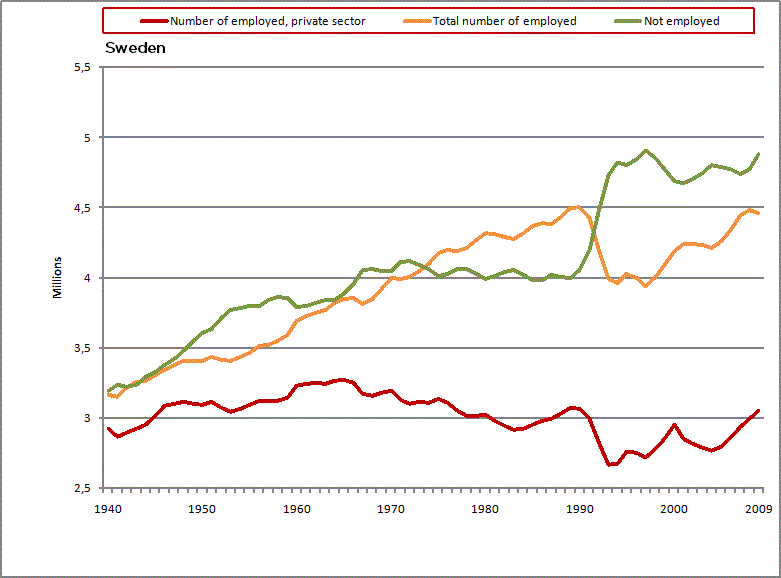
Employment in private enterprises today is thus roughly on the same level
as in 1940. Since that year population has increased by 50 percent, or 3
million people, and GDP by 400 percent. The key to this development is of
course the rising productivity, thanks primarily to remarkable
technological progress. A high pressure to extract profits has ensured
that workforce has been kept at minimum requirements.
For the economic “science” with its love for theories filled with dogmas
and wishful thinking these historical facts are inconvenient and thus
hidden away and ignored. But if we were to study economic patterns on the
grounds of empirical reality it seems obvious that our kind of market
economy cannot solve the employment problem. The economic development can
only just keep up with productivity growth, so that the number of employed
can stay fairly constant.
A total collapse of the labor market has been avoided by the expansion of
the public sector, a way now considered “closed” since taxes can’t be
raised in a neoliberal society. Another way to “solve” the problem of
unemployment was to simply expel half a million people from the working
community in the early 1990s, as a way to deal with a homemade banking
crush. Sweden had deregulated the finance sector in the 80s, which caused
a brain-dead housing bubble inevitably bursting in a couple of years.
The entire herd of pundits in our society – in politics, media and
elsewhere – is either simply ignorant of facts, or they deem the
consistent 70 years long development to be an unfortunate and incidental
anomaly. Thus the discussion is all about different methods to “create
jobs” as if there would be some odd procedure not yet tried during 70
years of failed “job creation”. Not surprisingly most methods that our
present government introduces are definitely creating profits, but not so
many jobs.
It’s not that the facts are entirely hidden. Some time ago a very high
official in the business community – Urban Backstrom - mentioned the
constant employment figures in our premium newspaper, more or less in
passing. When I once corresponded with the head of a conservative
think-tank I realized that he was fully aware of the facts. But regardless
of the critical importance these facts have there is no break-through for
them in the public debate. You don’t have to be a conspiracy theorist to
suppose specific intentions behind this concealment.
But facts hammer on and there will come other, more enlightened eras.
2012-12-26 Wednesday
A twitter reader pointed at the sleeping Swedish people who are seemingly
unaware of the strange and disastrous transformation going on here. And
it’s quite correct that we appeared to fall asleep some time before the
elections in 2010. But before that it was a different story.
The center-right government that came into power in 2006 started with a
chock treatment. Neoliberal measures were enforced without delay, and
people were taken by surprise. “This is what we promised before the
election” the ruling parties said, referring to the fine-print that nobody
had taken seriously. I will mention just a couple of examples.
One of the first attacks was on the unemployment insurances, which here
have a strong connection to the unions. Fees were sharply increased and
also differentiated in a way that hit the weakest unions the hardest.
People started to abandon the insurance in masses and with that also the
unions. This was of course a main goal for the neoliberal government.
(With lay-offs now spreading like an epidemic, we will have to see lots of
people trying to survive on minimal social benefits.)
Another target was the sickness benefits. Among other things harsh rules
were introduced for everybody with long-time sicknesses. After about a
year of sickness the insurances were compulsively ended and the patients
were forced to report to the public employment agency to be tested for
suitable work. This created of course a lot of anxiety and despair, which
certainly not promoted any recovery for the sick.
The situation soon became intolerable and a small turning point came when
a number of oncologists wrote an article in the main paper. They described
how a women with cancer in a late stage hade to report for work to get
some food on the table. This became too thick even for neoliberals and
some exceptions from the rule had to be introduced.
All these strange and frightening “reforms” elicited a public outcry
depriving the government of most of its support. In opinion polls as late
as in early 2009 the opposition had a lead by almost 20 percent points,
which means that they had 40 percent more potential voters than the
government. In a democracy worthy of the name a government with such a
horrible disapproval rate would have resigned voluntarily. But this was a
bourgeoisie government in a country with dominantly bourgeoisie media, and
the question of resignation was never even whispered.
Less than two years later the outcry had died away and we all had gone to
sleep. The disastrous government won the election in 2010, albeit with a
smaller margin. One important reason was that the Social Democrats didn’t
capture the public sentiments and thus didn’t attack the government on the
critical welfare issues. This proud old Worker’s Party had namely been
hijacked by an urban based, middle class leadership ignorant of the core
voters in the industrial landscape far away from the capital. Those fifth
columnists were caught by the crazy idea of “aligning the party to the
center”, for which they were effectively punished by their voters.
The Social Democrat's detrimental leadership from 2010 is gone, but the
policy is not. Neoliberal economics may destroy yet a number of countries,
and possibly cause uncontrollable uproar in that process, but in the
former welfare state Sweden it may well survive the elections in 2014.
2012-12-23 Sunday
Here in Sweden the coming holiday is a time for families and relatives to
join together, exchange gifts, eat and drink too much and simply
socialize. Accordingly it’s not a holiday for lonely people. Back in the
1970s, when solidarity was fashionable, young progressives organized
“alternative Christmas parties” for homeless and other solitary
individuals. Today, when both our political leadership and the zeitgeist
are indifferent towards any kind of commonality, Christmas is tougher
again for the lonely.
We may give our share to charity, as a toothpick on a mountain, together
with our sympathy, which will feed nobody, and just dream of a better
world where true empathy had a say. In such a world compassion would be
something that ruled our societies, and a decent life for all something
that we organized socially and all paid for jointly.
Christmas Eve is the prime holiday here and is called Julafton. The
word Jul has Germanic and pre-Christian roots, which is convenient
since the religious elements in the celebrations nowadays are fairly
eviscerated. The partying is back to its pagan origin which suits us well
in this country, the most secularized in the world. The flip side is that
our neoliberal egoism could have done well with some Christian spirit of
altruistic love.
The best we can do is to work for a society based on solidarity with the
means we possess and with the tools we master. We can also nurture the
glow by practicing solidarity, caring and love within our own private
sectors. On New Year’s Eve we use to make promises for the coming year, a
perfect opportunity for (once again) pledging to become a better human
being in these aspects.
In the spirit of universal love I therefore whish all possible readers of
these lines a pleasant holiday regardless of faith or any other
disparities. I’ll be back in a few days somewhat overfed and with renewed
high aims and aspirations, ready to be disappointed all over again and by
that hopefully stimulated to numerous restarts.
2012-12-21 Friday
(This was the day we weren't supposed
to live through, according to some lunatics. It's comforting and hopeful
that they so often are wrong.)
I received an email from a soul mate expressing concern over the crumbling
Swedish welfare state. Some parts of my reply may be of more common
concern:
As for the Swedish welfare state the picture is of course not totally
black. We’ve had a government lead by our right wing party since 2006, and
they have worked rigorously to dismantle welfare for six years now. In a
way they have been successful to an extent that most people before 2006
had thought impossible, but there are on the other hand some limits that
cannot be passed. They have, at that, actively protected some parts of the
old structure, such as labor unions’ right to collective bargaining, extra
taxes for higher incomes, rent regulations and a number of other things,
thus annoying some of the hard core conservatives.
Your description of how Sweden has been portrayed through the years in USA
applies also to continental Europe. A successful and rich industrial
country that also took care of the ordinary citizens was of course a
threat to those in power. So bad news from Sweden often became great news
spread on front pages in continental papers. As for the US I’m old enough
to have some memory of the myth spread by President Eisenhower that Swedes
were so bored in their sheltered society that they preferred to kill
themselves. Apart from the absurd causality the factual claim of an
unusually high suicide rate in Sweden was completely false. But that
imagination has then got eternal life, it seems.
My country was once leading the welfare development in the industrial
world, but today we should rather speak of the Nordic model since our
neighbors in many respects have passed us. I should say that Norway is the
leading welfare state in our small region. They have a significantly
egalitarian philosophy guiding their social policy, and oil money enough
to implement it. Finland has outperformed us, and most other countries, in
education, just to mention a few things. I recommend you to follow the
development in our neighboring countries, particularly Norway.
2012-12-19 Wednesday
It might be necessary to explain how the exotic system with benefits for
the wealthy (subsidies for buying domestic services) described in
yesterdays note at all could be enforced. A child could realize that the
right wing parties in power sought to satisfy their rich constituencies, a
motive that of course couldn’t be admitted. So, what pretexts were
conjured up?
First to be drawn was the Gender card. “Women” (all women supposedly) were
to be freed from domestic work, thus enhancing their opportunities in
working life and promoting their careers (the “careers” of the cleaning
personnel was not considered, of course). From the beginning it was
obvious for the average thinker that only a small minority of households
would have the financial surplus necessary even to reflect on buying
domestic services. By now that minority consist of about 10 percent of the
taxpayers, a group certainly affluent enough not really to need state
subsidies.
The farcical part of the gender argument became subsequently too obvious,
and it quietly disappeared. Instead the real trump card was found: the
subsidies would counteract the widespread use of black labor in the
business, and promote serious enterprises who pay decent salaries and
taxes. It sounds all too good to be protested against, of course. We all
want illegal activities wiped out. What no one seemed to realize was the
absurdity in the choice of method.
We must take for granted that a state authority never ever would
contemplate paying bribes to criminals to make them avoid committing
crimes. But that is exactly what is at stake here. Tax fraud is a crime
and the rich are compensated with half the cost of domestic services to
make them stay away from becoming criminal. In the debate not a single
pundit is pointing at that embarrassing circumstance. One reason could be
that illegal tax evasion is not considered a real crime after all, despite
of what the penal code says.
But what does the political opposition say? Well, in spite of the fact
that the beneficiaries are an insignificant minority, and those who pay
for their luxury are the rest, it is not “politically possible” to oppose
the RUT deduction at this point. The Social Democrats are not able to take
that seemingly easy debate and have thus totally capitulated. It could be
suspected that the party’s leadership is so bourgeoisified that its
members actually like the whole idea, and personally even may enjoy the
benefits. That last suspicion is just mean speculation, of course, but if
the truth is something else it is deeply hidden.
2012-12-18
Tuesday
Some months ago I mentioned the RUT deduction for domestic work here in
Sweden (rutavdrag) which is a gift from ordinary taxpayers who
themselves cannot afford to pay for such services, generously handed over
to the minority of people rich enough not having to clean their own homes.
Just some 10 percent of taxpayers are sufficiently affluent to be able to
take advantage of that gift.
It’s called a tax deduction for demagogic reasons, but is simply a pure
social benefit. The rich beneficiaries pay only half the bill, the other
half is invoiced directly to the tax authorities by the enterprises that
deliver the services. Apart from the grotesque distributive effect, the
picturesque system creates a voluminous bureaucracy. Among other things a
postal mail must be sent by the tax authorities to the (already
overstretched) rich people after each transaction. This is to guard that
the yearly limit (some §15,000 for a double-income household) is not
passed.
Another task for the bureaucracy is to update the long list of operations
covered by the benefit. One precedent after the other has passed the
decision makers desks. Some of the lasts ones are hilarious. Thus, if you
have a large party at your mansion and need to hire a bartender, the
poorer among your fellow countrymen will pay half the cost for that
essential service. Similarly you are qualified for the same kind of social
benefit if you are in a need for a butler.
The last creative addition to the list ordered by the government has
finally met some opposition. It’s a decision to include into the system
private tutors who help rich people’s children with their school work.
This was a challenge to the deeply rooted opinion that everyone shall have
the same opportunity when it comes to education.
There exist in Sweden nonprofit organizations with voluntary teachers who
help pupils with special needs. One of these groups in Stockholm has had a
modest allowance from the city authorities to cover administrative costs.
Their latest request for money was rejected on the grounds that the
organization was unfairly competing with commercial enterprises! If only
because of the widespread reactions this aroused, the politician in charge
realized that this was a bit thick, and denied the motivation already
announced. Whether the decision about the money will be reconsidered she
didn't say.
These latest events took place the last couple of days. The continuation
of this soup opera can be expected to be equally ridiculous and tragic in
the same manner as hitherto. I’ll keep you updated.
2012-12-12 Wednesday (12-12-12)!
Even Nobel laureates may sometimes disregard (or perhaps forget)
fundamental aspects of their own subject.
At the UN Climate Conference in Doha recently, Dagens Nyheter’s chief
science editor, Karin Bojs, had a lunch conversation with Steven Chu,
Obama’s Minister of Energy. Chu received the Nobel Prize in Physics in
1997 and has “insight and overview as only very few” in Bojs’ opinion.
They came to talk about energy saving measures.
On his visits to Sweden Steven Chu thus “had been somewhat annoyed at all
electric candleholders people have in their windows” (during holiday
season, that is). Bojs explained how important light is in our dark
country, to which Chu replied that we should use LED lamps for our
luminaries for the sake of energy conservation.
Now there are two important observations to do. The first is that all
those shining lights have nothing to do with CO2 emissions,
since practically all electricity in Sweden is generated in either
hydropower or nuclear power plants. The second and more important
observation is that there is no energy to be saved by changing lamps or
turning off lights in our climate. And on this point professor Chu
disregards the first law of thermodynamics, a corollary of which implies
that all energy supplied to the lamps is transformed to heat.
It so happens that our need for light coincides chronologically with the
need for residential heating. So, if we turn out the lights in order to
save energy, we have to add the exact same amount of energy to our heating
system to keep the indoor temperature constant. Thus there is no energy to
save that way! Turning off lights may be productive for places like
California, but not for Sweden nine moths of the year (and the rest of the
year we don't need lamps at all).
Chu also revealed a related hang-up on energy-saving: he always puts the
lid on the saucepan when cocking (and tries to convince his wife to do the
same). This is also a questionable endeavor.
We learned somewhere in high-school that vaporization of water requires
energy. But we also learned that condensation of the steam thus produced
recovers exactly the same amount of energy. Whether this condensation
takes place inside the saucepan (making the lid hot) or in the kitchen air
makes no difference from conservation point of view. The energy is heating
the kitchen and thus the apartment to the same level, lid in place or not.
The crucial fact is that the lid doesn’t affect the amount of water
vaporized or condensed and consequently has no significance for the energy
requirements. There are possible complexities to the case (such as a kitchen
fan), but the main principle is undisputable.
Professor Chu’s approach in these two matters is archetypical for
conservationists also here. Sweden has a state bureau (Energimyndigheten)
completely obsessed with lamp changing and other such irrelevant methods,
simple enough for politicians to comprehend. One is almost forced to
believe that all those pseudo actions are promoted to create illusions of
decisiveness on environmental protection issues by those in power.
Of course there are completely different actions needed to cope with the
real environmental problems. Those actions are probably severe and
pervasive on a scale not pleasant to realize, carrying with it a complete
remake of our lifestyles in the wealthier parts of the world. It could be
tempting to postpone such actions, just to find that we thereby bring
forward the end of mankind.
2012-12-11 Tuesday
A
well-established yearly Internet conference is arranged in Sweden; in 2012
it was for the 13th year in a row. Reports on different
sessions of the conference appeared in “IVA-aktuellt”, a periodical
published by the Royal Swedish Academy of Engineering Sciences in
Stockholm.
One of the many sessions was on the topic
Muzzled by the state - national threats to freedom of expression online.
An American professor at the
University of Uppsala, Christian Christensen, was cited in IVA-aktuellt
with the following sentence (my translation from Swedish):
If Wikileaks’ informer, Bradley Manning, had been Chinese, and the
leaked information also Chinese, then USA would had acted intensely to
have him released.
On reflection this is a purely logical statement, not at all
political. It just follows directly from the universal interpretation of
the concept “freedom of expression”. Hence the sentence also was cited on
the editorial page in “Ny Teknik”, our leading weekly newspaper on
technology (probably with editors trained in logic).
While we thus can find Academies, established scientists and decent
technology newspapers convey obvious truths in the Manning case, our
subservient politicians and political media are close to dead silent.
Instead they are busy chasing Julian Assange. It’s nothing less than
humiliating (and if there will be a vacation trip to France next summer
for me, I think that I’ll pose as Norwegian).
2012-12-10 Monday
Today is the Nobel Day in the Swedish calendar. The prizes will be
submitted to the laureates this afternoon by the king in a pompous
ceremony in Stockholm. As always, the prize in literature is the most
highlighted (although the prizes in the scientific disciplines surely are
more significant for mankind), and this year’s winner Mo Yan has
furthermore given rise to political controversies. An earlier laureate,
Herta Müller, declared the prize to him a scandal, as did others.
The interesting thing is what Mo Yan has done to deserve this harsh
reaction. Has he paid tribute to the murderous Mao regime? Has he hailed
the communist party and its actions? Has he even neglected the many
negative consequences of the monolithic China? None of that. He has become
a party member and accepted a position in the Writers Association. That is
the sole basis for the “scandal”.
Much more than that is usually needed when it comes to writers from other
parts of the world. When the politically outspoken Harold Pinter won the
prize in literature he held an inflammatory Nobel speech denouncing the
United States for its war against Iraq (recommended listening on the
Internet, by the way). Some eyebrows were raised, but that was it. And
just two years ago the laureate was a profiled and quite extreme
conservative – Mario Vargas Llosa – neither he discrete about his
political viewpoints.
One of Vargas Llosa’s more notorious opinions is that the indigenous
movements in Latin America are threats to democracy because
of ‘the
political and social disorder they generate’, and that they
are
‘incompatible with civilization and development’. During a conversation
with the 2010 laureates broadcasted by television he praised the
development in the former Soviet protectorate (where millions of people
had died as a direct consequence of the capitalist “revolution”). One of
the Russian born physicists at the table just grunted in a somewhat
demeaning tone: “You haven’t lived in Russia!”
One observation in passing is that Vargas Llosa and his politics represent
a continent where people with inconvenient opinions not just have been
incarcerated, as in China, but have faced other destinies such as being
cut to pieces with machetes or having their brains blown out by some death
squad, armed and trained by the United States. The very thought that
Vargas Llosa in any way should have to answer for that is of course
ludicrous.
It seems more or less inevitable that the Nobel Prize in literature now
and then provokes political debate. At best it thus contributes to some
enlightenment and new insights into world problems. So, let’s finish with
a few words on China.
The Great Leap Forward and the Cultural Revolution are estimated to have
cost the lives of 30 million Chinese. At the same time, the Nobel
economist Amartya Sen has calculated, some 100 million lives have been
saved in China (compared with democratic and capitalist India), thanks to
the egalitarian politics which has spread the society’s recourses more
evenly. It’s a horrible calculation, but it cannot be avoided. Added that
the terrible atrocities possibly were not necessary to achieve the good
parts, the equation becomes even more tilted.
Likewise one can argue that the repressive policy in China regarding
freedom of expression shouldn’t be necessary to uphold civil discipline.
In any way, the repressive tolerance that we have in the west is the
probably most efficient that history has produced. Propaganda is more
successful when people unsuspectingly believe that they just enjoy the
informative messages that a free society is supposed to provide.
But let us, just for the sake of discussion, assume that the subjugation
of the free word is essential to maintaining the Chinese politics that
happens to save lives. Then, how many premature deaths would it be worth
to free one writer from censorship? For those who believe that suppression
of the free word is necessary for the Chinese dictatorship to preserve its
power, the calculation is unavoidable. For us who don’t it’s even more
important and obligating to apply this calculation in our own part of the
world. What is the prize for our freedom, and, above all, do we offer any
thoughts or any compassion for the poor masses that pay that prize?
2012-12-07
Friday
When the author and Nobel Laureate Harold Pinter once was the introducer
to one of Noam Chomsky’s speeches, he finished in his distinctive voice
with the following characterization of Chomsky:
He does something
that is really quite easy
but rather unusual:
He tells the truth!
Today Noam Chomsky turns 84 years. I remember an answer he gave once asked
why he had spent so much time and effort on politics, which mostly had
caused him trouble, when he could have lived comfortably as an admired and
famous scientist. He then said, as I recall it, that he wanted to have an
acceptable answer to a specific question at the end of his life: Why did I
bother living for at all?
I think this question goes to the heart of any existentialist reflection.
Whatever we achieve in life, it all vanishes with death, except for
contributions that in some way will benefit the posterity. Am I content
with giving my children a material heritage? OK, but isn’t that an
unnecessarily limited goal for a full life on earth, the only life we are
given?
Noam Chomsky has more than fulfilled his own criteria for a descent life.
He has dedicated his unique intelligence and seemingly endless energy to
work for a better world for all humanity. That means among other things to
promote a more equal distribution of the world’s resources, which to a
large extent are produced by the less prosperous and taken care of by the
opulent. The distribution of resources is a core issue from which most
other qualities in life derives, such as freedom from oppression of all
kinds, not excluding war, extermination and other atrocities.
One of Chomsky’s unique contributions is his tireless search for important
and often decisive facts that otherwise had remained buried in the
forgotten archives. He then analyses the facts and circumstances with an
uncompromising logic, leading to indisputable conclusions. This leaves his
adversaries in a hopeless position when trying to find solid counter
arguments. This has some boring and distasteful results in the debate.
To mention just one example, Chomsky was in 2007 awarded an honorary
degree by the Uppsala University in Sweden. An American journalist, then
working for a Swedish conservative think-tank, wrote an article in a
tabloid, reiterating the usual slander to vilify Chomsky and declare him
not worthy of an honorary degree (of which he by now has 40 or so from all
around the world).
The standard attack from conservatives without valid arguments is to call
people “liars”. This time the journalist presented as evidence of
Chomsky’s “lies” a minor error in a book published in 1969. A citation in
the book said to be by president Truman was in fact an almost verbatim
paraphrase made by a commentator. This miniscule inaccuracy was corrected in
the following edition. Nevertheless the same error has circulated over and
over in attacks on Chomsky through the years.
Sometimes one is lead to think that extreme conservatives are so blinded
by rage that they don’t realize the silliness of their arguments. Here we
have an ocean of printed material and videotaped speeches by Chomsky to
trawl for possible lies, and the best thing they can come up with is a 40
years old proofreading error! And they don’t see that a better
verification of Chomsky’s reliability is hard to get! A perfect hit in the
foot, undoubtedly.
Well, the vilifications are after all quite rare and come mostly from
crazy extremists. The established method to cope with Chomsky’s
inconvenient truths is to ignore him and to ban him from mainstream media.
If someone would call it unfair censorship or something like that, he
would be directed to Chomsky’s own important work on media issues, in
which the procedure is described as completely normal and expected.
Established media has an important role in substantiating the demands
defined by power, and that role definitely excludes Chomsky’s findings. So
it’s all very natural.
But truth is pervasive and persistent. Sooner or later the Chomsky
analysis will be common knowledge, and it will not take four centuries (as
the Vatican needed to accept Galilei’s nowadays self-evident truths). Noam
Chomsky has given the world tools with which the future can be sensibly
handled. But as he always says: It will not happen by itself. We have to
organize!
2012-12-04
Tuesday
Now
even Sweden has been “enriched” with a neo-fascist political party, coming
from almost nowhere to reach 10 percent in polls and in just a few months
becoming the country’s third largest party. The party is called the
“Sweden Democrats” (SD), and was founded in 1988 by people from various
nationalistic groups, some them with Nazi inclinations (among them the
first chairman). SD has eventually washed off the worst brown dirt, the
leaders put on jacket and tie, and the party gained some seats in the
Parliament in 2010. As late as last week they had to exclude two top party
board members who had appeared in a film armed with iron bars walking the
streets shouting racist taunts at immigrants.
Even after a number of exposed scandals the party has gained increased
support in polls. Of course our intelligentsia is puzzled, as always when
the fundamental reasons for a phenomenon are things you aren’t expected to
talk about. So for instance, one columnist (Emanuel Karlsten) in my daily
writes today: “It’s of course silly claiming to understand why SD is
growing after suffering scandals. But it can be important to see how and
where the party finds its strength.”
The columnists answer is in short: the Internet. There SD’s members have
their parallel world where they can regroup, find new arguments and come
out more powerful than before. It is in fact “a strong evidence for how
the Internet has given societal underbrush enough oxygen to grow and
organize.” (One can’t help wondering why not all parties do the same, if
the key to success is so easily obtained.)
To find a more substantial introduction to the problem one only has to
turn page in the same paper and read a seven lines short note with the
headline: “120 million in Europe are poor”, followed by: “One forth of EU
citizens run the risk of ending up in poverty or social alienation”. Or
one can recall a picture published by the same paper the other day, where
they
constructed a nice correlation between notified layoffs in Sweden (red)
and SD’s result in polls (yellow):
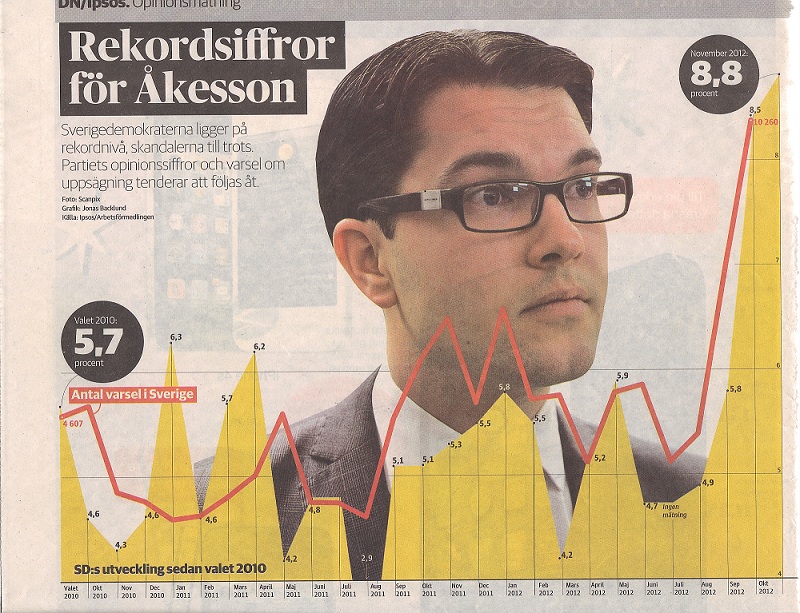
(A
warning should be issued about the method: its not scientifically quite
correct. But in substance the diagram probably says a lot.)
For those who don’t want to appear silly from not knowing anything, the
world offers more explanations than ever before. Extreme right-wing
political parties are growing like mushrooms in most countries that have
suffered the severe economic problems initiated by the financial crash.
The mechanism is well-known, has been demonstrated before and is not a
mystery. On one earlier occasion it had disastrous consequences that we
will never forget.
In the late 1920s Germany the economy was collapsing causing severe
suffering not just for the poor but also for the middle class. The
communist alternative was not an option, so there were no answers given or
solutions suggested, until there came a charismatic man from Austria who
delivered both. According to him the causes of the problems were the Jews
and the Bolsheviks, and the solution was to get rid of them or as it
turned out: exterminate them.
The Sweden Democrats have just one explanation to the growing economic
problems: the immigrants, who take all the money and all the jobs. And the
solution is consequently to stop immigration. This is the only answer that
ordinary people hear, since our established intellectuals are unable to
give the correct answers, which are about the economic system and its way
of functioning.
Though the role of the uninhibited financial system and its unscrupulous
actors in crashing economies around the world is crystal clear, and once
in a while even mentioned, there is no workable solution even proposed to
cope with the problem. It seems like the masters of mankind and their
political mercenaries just wait for the catastrophe to come (when they not
worsen things by forcing austerity on countries already on the brink of
economic collapse).
To pass the time, it seems, the intellectuals conjure up stories to
“explain” the basis for events, stories that couldn’t fool a bright child.
Could it be that the role of intellectuals in our power system is to bring
consolation to confused people who wait for something inevitable to
happen? Or why else do they deliberately restrict their ability to analyze
such obvious casual relationships as those we see today?
Questions!
2012-12-01 Saturday
The struggle for a welfare state against opposing forces like the
economically powerful has never been an easy matter. Olof Palme, for one,
experienced the hostility on a very personal level. During his whole
political life he was constantly under attack through slander, vicious
rumors and extremely intimidating arguments delivered by the fancier
people in society.
Born in a relatively wealthy family – both his mother and grandmother were
of noble ancestry - Olof grew up in a privileged milieu in the most
prestigious neighborhood in Stockholm. He spent the high school years in
the Sigtuna boarding school (later known for also harboring the present
Swedish king). He was in other words brought up in a solid bourgeois
environment. But he was a bright young man who early acquired the habit of
thinking independently.
At the age of 20 he spent a decisive year in USA (1947-48), first at
Kenyon College in Ohio, then backpacking through 34 of the country's then
48 states. The year in the US gave him firm ties to America and formed his
future thinking. Teachers with strong integrity at Kenyon College gave him
a broad perspective on economics and political science. Only years later,
though, his world view turned in a socialist direction. (His later
protests against the Indochina war probably were accompanied by as much
sorrow as anger.)
Two decades after his stay in America he became chairman of the Social
Democrats, Prime Minister and eventually the internationally most well
known and admired Swedish politician. Streets in cities around the world
bear his name. But in Sweden his was vilified by the “fine” people in a
grotesque way never experienced by any other politician in our history.
One popular notion is that the upper classes regarded him a class traitor
and therefore couldn’t forgive him. A more natural view may be that he was
a too clever adversary. Whatever the reasons he was certainly persecuted
beyond any limit. It was a common “truth” in the fashionable parts of
Stockholm that Palme was a drug addict and a mental patient. An urban myth
of the format: “my wife knows a doctor that treats Palme…” was circulated
frequently among the prosperous and noble people. Others “knew” that he
was a Russian agent and that he had abandoned his children, just to
mention some of the absurdities.
One specific accusation has become topical through a recent Swedish film,
Call girl. The situation has an interesting similarity to the
Assange-case in that it concerns a sex allegation. The film was per se
based on a real incident, including a Minister who was involved with
prostitutes, even under-aged girls. The events were reported as a security
risk by the highest police authority to the government in a secret
document (which later was leaked). Palme saved his minister by denying the
very existence of the document, which the subservient media in those days
accepted (it was in 1977), an act for which Palme later was rightly
criticized.
In the aftermath of the affaire an under-aged girl had loosely mentioned
the two most prominent politicians as costumers, one of which was Palme,
both highly improbable participants in such actions and neither of course
verified as such by any other indications or witnesses whatsoever. In the
film Call girl Palme is in spite of that singled out as a man
ordering sex services from a young girl. That is: his name isn’t mentioned
in the film, but the character bears enough features for the viewer not to
miss the identification. So, the denigration of Olof Palme goes on till
this day.
Palme’s destiny simply confirms that the powerful
doesn't bear
their swords
in vain (and they have other, more subtle weapons as well). The most
dangerous contenders must be crushed the hardest. This is what Julian
Assange now experiences, meeting partly similar weapons as Palme, though
of course much rougher.
2012-11-29 Thursday
Once upon a time we had in this country a Prime Minister who suffered from
righteousness to such a high degree that he openly protested against the
United States’ war of aggression in Indochina. In this regard he was a solitary
head of government in the western world, and his strong moral standpoint
brought about a serious diplomatic crisis between Sweden and the US. The
PM’s name was Olof Palme, and the history has absolved him, even in
established circles. Among ordinary Americans he was absolved long ago,
proved by polls showing that a large majority considered the Vietnam War
“fundamentally wrong and immoral”.
These days Palme would have been 85 years old, had he lived. But he was
murdered walking home at night with his wife from a movie theatre on
February 28, 1986. The killer was probably a local thug and drug addict
without deeper political motives (acquitted on insufficient evidence by a
higher court, and now dead). The following day, when the news spread,
became a day that many Swedes will remember forever (our Kennedy moment,
to borrow a parable from a tweet).
What Palme’s view on the Iraq War would have been is no hard guess. On his
watch there wouldn’t have been any Swedish troops in Afghanistan engaged
in military actions, breaking the 200 years of peace in this country. And
there would certainly not have been such a disdainful circus as the one we
now expose Julian Assange for.
So, Sweden has transformed quite significantly since Palme’s days. To
examine how this came about, we could briefly look at the process that
made the country a leading welfare state in the first place.
Relatively late in history Sweden was to a large extent an agricultural
society, in many respects somewhat backward compared to continental Europe
and England. But it turned out that Swedes were fairly industrious and had
a potential for rationality, so when industrialization spread northwards
during the 19th century things started to happen rather
rapidly. After (deserting from) the Second World War, with an undamaged
productive capacity, Sweden soon reached a top position in per capita
income in the world and a definite lead in welfare politics.
The basis for the achievements, in both aspects, was laid by the strong
worker’s organizations. Capital owners and the business community met this
strength with reasonable willingness to compromise. Already in 1938 a
fundamental agreement was reached between the two sides, setting a
benchmark for decades to come. The unions thus accepted employer’s
absolute authority over businesses in exchange for a fair share of the
production result.
In accordance with its relative strength the workers movement could also
place its representatives – the Social Democrats - in the government for
more than forty years. But the strength was just relative. With the
tradition of farmers only one generation away the industrial culture was
not very deeply rooted in the society as a whole. In addition the rising
prosperity nurtured a growing middle class of white collar workers with
bourgeoisie views. As a consequence the majority for workers opinions and
the Social Democrats was never overwhelming, in fact sometimes quite weak.
So when the center-right parties in 1976 won their first election in
decades it was not a great surprise.
The 1970s also meant the beginning of neoliberalism. After a seemingly
considerable backlash for capitalism during the 60s and early 70s the
economic powerful, who through their ownership of the worlds wealth still
were in command, started to roll back all bothering interference from
ordinary people, such as workers and students demanding economic
democracy. One might perhaps say that the consequences of neoliberalism
were not as severe in Sweden as in many other countries, thanks to the still
comparatively strong unions. But the process has kept going in the
anticipated direction, and the Swedish welfare state is now deteriorating.
Since 2006 our country has had a hard-core bourgeoisie government lead by
the conservatives. Its actions are too deploring to list, but it suffices
to say that Sweden no longer is the role model for solidarity and welfare
it used to be, at that time feared and despised by reactionaries around
the globe. In this process the leaders of the Social Democrats have
drifted to the right, out of the silly imagination that their members and
voters have forgotten the party’s fundamental values.
It has been said that Sweden culturally is one of the most Americanized
countries in Europe. Now we are following suit also in dominant views on
political issues. Accordingly the subservience to US interests by Swedish
decision makers in their persecution of Julian Assange should be no
surprise.
2012-11-26 Monday
Have just read through
102 pages of letters to Foreign Minister Carl Bildt released by
Wikileaks. People from many countries are outraged by the maltreatment
that the Swedish judicial system subjects Julian Assange to. They also
disapprove of the aversion showed by leading politicians to do anything
constructive to solve the “problem”. What puzzles writers of the letters
the most is why the prosecutor’s office cannot send somebody to London to
ask the questions needed. Some have found out that Swedish investigators
have gone to foreign countries before to do just the same.
The answer the prosecutor gives to the question is too ludicrous to
repeat, and the silliness is enforce by the fact that no sane legal expert
thinks that there is enough substance in the case even for a charge, let
alone that it will reach a court. To the question about the role of
politicians we have had an interesting reply by Carl Bildt himself.
When Ecuador asked for guaranties that Julian Assange would not be
extradited to the US, Carl Bildt answered (cited in Dagens Nyheter 8/18):
“I cannot make any statements that constrain the judicial system in any
way”, adding somewhat contemptuously: “and that I don’t think they
[Ecuador] understand, if I shall be quite honest”, explained by the fact
that “the principle of judicial independence is not that firmly rooted in
Ecuador”.
Now Bildt is famous for his arrogance, but in this case he also relied
heavily on the reader’s complete lack of memory. It so happened that only
a short while before uttering his contempt for Ecuadorian principles, he
had in the highest degree possible interfered as Foreign Minister in a
legal issue, a civil matter at that. The case involved a German citizen
who had a claim against the Russian state, a claim approved by a Swedish
court. Russia refused to pay, and following the rules the Enforcement
service decided to seize some real estate in Stockholm, owned by Russia.
In this delicate situation Carl Bildt writes an official letter to the
Enforcement service demanding that they stop the seizure! This is the man
who speaks about other countries not understanding fundamental principles!
Well, as many of the letters regret: Sweden is no longer the role model it
once was. In the past a modern and egalitarian welfare state, during Olof
Palme’s era as well concerned with suffering and war-torn people in other
countries, now deteriorated to a neoliberal dustbin. How this came about
is something to reflect upon in a coming note.
2012-11-23 Friday
As readers of this webpage already know: Sweden’s leading daily newspaper
is Dagens Nyheter (DN), published in Stockholm. It has a proud
declaration printed every day in the page header:
DN is independent from all parties and organizations and acts in a
humanistic tradition of enlightenment – for tolerance, democracy and a free
economy.
In the European meaning of the word DN is a liberal paper. (By liberal we
mean here roughly what John Stuart Mill formulated. A bourgeoisie view, but
not conservative; some social awareness, but anti-socialist; in political
terms: parties aiming at the middle class/white collar workers.)
Following the liberal tradition DN is a strong advocate of freedom of
expression. Every dissident from the former Soviet bloc was unconditionally
supported, as well on the editorial pages as in the newsroom. In these days
important figures like Ai Weiwei,
Liu Xiaobo,
Chen Guangcheng,
Masha Gessen, the women in Pussy Riot and others with similar CVs are
treated (rightly) with much publicity and respect.
It’s quite different with
dissidents like the 38 years old
Luz Marina Paz, a journalist opposing the coup in 2009 that overthrew the
democratically elected president in Honduras. She were among those on the
“wrong” side, so when she was murdered on her way to work less than a year
ago it was over and done with by a small note in DN. Luz Marina was just one
of dozens of journalists murdered in Latin America only the last decade. Few
of them even have a name in our media. Another dissident not worthy of DN's
sympathy is Julian Assange.
Erik Helmerson is one of the enlightened guys who write editorials in DN.
Two days ago he published a tweet saying:
“Chomsky: ‘Julian
Assange shouldn’t be the subject of a grand jury hearing, he should be given
a medal.’”
And
yesterday the same tweet appeared in the page header in his paper’s
editorial section. Since DN for years has run a harsh campaign against
Assange, my first thought was that the editors suddenly had come to senses
and had changed position. But to be sure I emailed Helmerson to find out if
the citation was honestly meant. His answer was: “No, it should not be read
without irony”. (I answered him somewhat cheeky: “OK. Now I have not read it
without irony”.)
Well, DN has now vilified Julian Assange so thoroughly for years that they
think such a blunt irony will be understood. I think they are mistaken.
Apart from a few gender fanatics and some right wing extremists I believe a
majority of Swedes support Assange. They are namely too familiar with “the
humanistic tradition of enlightenment” not to welcome the courageous
disclosures of the horrifying war crimes committed by the world's super
power, disclosures that may have helped to shorten the war of aggression.
But Dagens Nyheter’s “tolerance” is reserved for the aggressor, not for the
brave whistleblowers. The reverse is true only for specific kinds of
governments and dissidents.
2012-11-22 Thursday
It
seems that nowadays “everybody” - apart from some neoliberal economists
and subservient politicians - is aware of the main mechanisms behind the
financial crisis and its devastating effect on world economy. One
fundamental basis for the latest crash, as well as all the others since
the early 1970s, is the permission of banks to create money out of thin
air. To produce money in your own garage is a serious crime, but to do the
same thing in an even more simple way in a private bank is perfectly
legitimate, indeed laudable and mainstream.
When banks grant loans they don’t have to be in real possession of the
money they give away, it suffices to type some figures on a keyboard, and
- presto - new money is born. As long as people have confidence in
this imaginary process the banks make large profits, and when the
inevitable crash comes the banks are saved by the taxpayers, who thus have
to pay in both ends. Anyone with his head screwed on realizes that a
system like this makes whole economies unstable. The others though, like
the Chicago boys and their disciples around the world, prefer to believe
in a dogmatic market religion and to blind themselves before the all too
obvious reality.
As long as the Bretton Woods system was operative all industrial economies
maintained mechanisms regulating the financial sector. This period is
called the Golden Age since it coincided with high and egalitarian
economic growth protected from financial crisis. From 1971 and on the
relatively firm structure rusted away leaving increasing space to the
financial sector, which has turned money away from productive use and into
gambling activities. As expected, the world has since witnessed a number
of economic collapses, one graver than the other.
As I began by saying it seems today common knowledge that the financial
economy easily causes disaster for societies as a whole. So for instance
could we watch
this film (narration in English) on our Swedish public service
television the other day (albeit not on a prime channel). Not long ago it
would have been considered too much of a dissident film to display to the
public. (We have to go back to the 1970s to find nonconformist films like
this one in the public output.)
Renowned figures such as George Soros, Joseph Stiglitz and numerous others
are warning the politicians of the world for a gruesome future unless
serious actions are taken. In this country our leading editorial writer in
the main paper has converted from strict neoliberalism and is now joining
a majority of intellectuals in denouncing for instance the strangulation
that EU is torturing Greece with. So it goes on, but without anything
substantial happening to stop the march towards the cliff. For a Martian
observer we all must look liked a herd of lemmings on our way to self
destruction. Let’s ponder over this some coming day.
2012-11-20 Tuesday
Speaking of phony politics, the situation is not at all brilliant in this
country either. Once upon a time we had a government by the people, using
politics to create a civilized society with elementary welfare and
societal cooperation. With the introduction of neoliberalism some thirty
years ago the very notion of social care started to erode. Today the
deconstruction of the Swedish welfare state is in full swing, together
with deregulation and privatization of schools, health care, and a range
of other activities which up till now had stayed in the public sector for
generations (for the most part successfully, by the way).
A renowned research institute found some time ago that no evaluations of
the effects of the privatizations had been conducted (that some of the
privatizations had been failures was obvious for the naked eye). Already
the simple observation that no studies of the effects were even carried
out (implying that there perhaps were no positive effects) caused furor
among the conservative elites, and the CEO of the institute got nervous.
He muzzled the researcher who had presented the findings, which in turn
fuelled an intense debate, ending with the CEO’s resignation.
What seems evident is that our right-wing government has no interest in
the effects of their neoliberal politics, certainly not in the negative
effects. The purpose of the total system change is simply to allocate as
much of the society’s production result as possible at the top of the
pyramid where the rich and the super rich are to be found. That such
tricks are no vote-winners is nothing they are bothered by. They’ve got
their time in the driver’s seat and the goal is to enforce as much of the
system change as possible, with the hope that privatizations may be
irreversible.
The reactionaries of the world may soon unite and hail the disappearance
of the extreme Swedish welfare state which has frightened them for so
long. Unless we - the others - wake up and do something about it. And
there is a lot to do! The people of Europe are on the alert and the quite
bizarre neoliberalism can’t survive forever.
2012-11-19 Monday
Another important event has occurred here in Sweden since last summer: the
presidential election in the US. My newspaper was overflowing with
articles about the event from the very beginning. One could believe that a
very significant domestic election were to take place. Much interest was
of course focused on the superficial phenomenon, like Romney’s blunders,
Obama’s rhetoric promises, evil TV ads and things like that.
One observation an outside viewer could make was the frequent change of
opinions accounted for by Mitt Romney, of which some views not
corresponded very well with the traditional ones of his party. Another
observation was that Barack Obama reiterated roughly the same luminous
promises that he didn’t fulfill during his first term. Thus it all seemed
like a charade aimed at winning an election, not a truthful declaration of
political goals to achieve if the election was won.
In summary, old prejudices about US elections were reinforced. Two guys
with similar educational background representing two fractions of the same
business party were fighting for the presidency. Both financed by the same
economic powers who naturally expect to be paid back in due time
(something that we call crude corruption when it takes place in for
instance China). It is therefore not surprising that actual politics
really implemented by the candidates, regardless of which one of the
fractions they represent, will show only marginal differences.
On the other hand it’s heartwarming to see the enormous efforts made by
volunteers spending all their spare time on unpaid work, just for the wish
to see their candidate win the presidency. This gives hope that they
someday will be able to work for a candidate really of there own, a
candidate who is primarily responsible to his or her constituency and only
secondarily reporting to the rulers of the business world.
2012-11-18 Sunday
Let’s see what has happened in Sweden since August. For one thing the
debate on the Assange case has faded out. Indirectly though, some
repercussions on the case can be registered in that a key figure has been
profoundly compromised in another affair. The man in question is Claes
Borgstrom, a legal adviser to the women in center of the accusations
against Julian Assange. Borgstrom had a central role also in the Quick
scandal, which we have mentioned earlier. (To top it all he has been the
Ombudsman for Gender Equality in this country!)
A journalist named Hannes Raastam had done a thorough and profound study
of the whole legal procedure leading to eight murder sentences for Thomas
Quick (who had confessed some twenty additional murders). Raastam found
the most unbelievable defects in the criminal investigations, including
manipulations by the police, hided interrogation reports and outright
fraud. Quick was a mental patient, obviously confessing to become a more
interesting patient and, according to himself, because the therapists
provided him with unrestricted amounts of psychotropic drugs as long as he
confessed.
Referring to the distrust Quick had experienced regarding his confessions,
which many people already very early had started to dispute, he decided to
stop cooperating with the investigators (and nothing was ever known about
the remaining twenty “murders” he had confessed). Having been silent for
seven years he was approached by Raastam for an interview. After some time
of dialogue with Raastam Quick decided to withdraw his confessions.
Raastam first produced a TV-film on the scam and then wrote a book which
was released this year, after Raastam’s death from cancer. The book
discloses a mindboggling legal scandal, probably without comparison in
Swedish modern history. In this scandal Claes Borgstrom plays the role of
Quick’s lawyer, billing the tax payers almost one million dollar for doing
nothing. His excuse is that he as a lawyer had to follow his client’s
wiches. But he still claims that Quick was convicted quite correctly.
The proportions of the scandal have brought attention to the book
internationally, and publication in ten different countries is underway. A
film based on the book is also discussed. Together with the Assange case
it gives the Swedish legal system a devastating blow to its credibility
and sanity.
2012-11-17 Saturday
This page has been slumbering for a while, but was awaken by a thousand
more visitors yesterday, all of a sudden. It turned out that the twitter
account @wikileaks had linked to this page due to its coverage of the
Assange-affaire. Such encouraging interest must be properly met, and I shall
restart to write my postcard notes tomorrow.
By till then!
2012-08-17 Friday
The
looong Swedish holiday has passed, and we were awaken by a news report.
Yesterday the Chinese news channel CCTV reported extensively on the
Assange story and the asylum granted to him by the Ecuadorian government.
Among the reasons for the asylum Ecuadorian officials declared that Sweden
on explicit request refused to offer any guarantee that Assange will be safe
from extradition to the US, and that there are doubts about the
possibility for a fair trial in Sweden on the sex charges.
This widespread coverage places Sweden in focus of world attention in a
rather uncomfortable manner. Naturally our right wing media fights off
insinuating doubts about the magnificence of our legal system and our
moral standards. In that process they happen to sacrifice any concern for
Julian Assange and his personal safety. The demand for guarantees
regarding the possible extradition is called “irrelevant” by our most
important paper, Dagens Nyheter.
Self adulation is of course an epidemic among leaders (and leading newspapers) of most nations, but the Swedish variant is as usual among the
more naïve. Not many years ago our government, Social democratic at that,
helped CIA secretly deliver two innocent (i.e. not tried in a
court) alleged terrorists in an airplane from a Swedish airport to torture
chambers in Egypt. This was of course a crime according to our law, and
completely immoral. The operation leaked afterwards and caused some
indignation, but was soon buried without any sanctions.
One could argue that it would be politically impossible for Sweden to
extradite Assange given the turmoil it would cause. But a man who is
explicitly threatened with a death penalty by prominent and empowered
Americans can’t possibly be expected to rely on such weak assurances. As
for his likely destiny in the US we may just contemplate the enduring
torture that Bradley Manning was treated with.
There happen to be two more dissident affaires engaging Dagens Nyheter
these very days: The Pussy Riots in Russia and Ai Weiwei in China, both
charged by courts in their respective countries. That the charges are
politically motivated holds without doubt in our media, for good reasons.
Our love for democracy and freedom of expression compels us to vigorously
defend the accused and condemn the evil politicians that certainly lay
behind the charges. But a dissident like Assange, who has disclosed war
crimes committed by the US, is viewed in a totally different way. In
regarding his case all the important freedoms suddenly evaporates and the
dubious sex charges becomes sacrosanct.
It should be remembered that the first prosecutor who evaluated the facts
in the Assange sex affair, a female prosecutor by the way, immediately
dropped the case as insignificant. But when some “gender specialists”
hooked their claws into the case things started to happen. Among the
“specialists” were a lawyer named Claes Borgstrom. In these very days this
man is revealed in a book as one of the main responsible figures in the
probably worst legal scandal in the country’s history. (He represented as
a lawyer a man convicted of eight murders and confessing many more. It
turned out that the “murderer” was a drugged mental patient, who was
manipulated by the investigators to confirm his "deeds", assisted in this
self-accusation by Borgstrom. In retrospect the whole operation gives the
impression of occult séances.)
Freedom of expression is by many considered to be the jewel in the crown
in our political system. When this jewel so easily can be sacrificed for
ideological submission to the super power, what then is left of our
worshipped system?
2012-07-04 Wednesday
Mainstream newspapers here have a remarkably high interest in China.
Editorials and other articles occur frequently, all presenting
approximately the same and anticipated picture of the world’s most
populated country. What interest them are primarily the deficiencies in
human rights and the authoritarian actions by the monolithic ruling party.
To some extent there is also a reluctant admiration for the remarkable
economic development.
My paper reviewed the other day two new books (with old content) on the
subject, this time the historical misdeeds and serious errors for which
Mao Zedong was responsible. Much research in the West has been dedicated
to determine how many millions died from famine and terror under Mao’s
rule. But is this profound interest really based on honest sympathy for
the Chinese poor masses?
One well respected economist and Nobel laureate, Amartya Sen, has shown
that the consequences of the political and economical system in India are
far more lethal than that in China. Since 1950 some 100 million people
more have died unnecessarily in India compared with China, due to
differences in political systems. This fact is never even mentioned in our
media and the situation for the poor in India is over all scarcely
considered. It’s ingeniously arranged so that the billions of victims of
capitalism have no one to make responsible.
This simple comparison reveals what’s obvious for any undisturbed person:
our right wing media’s “interest” in China is based purely on politics and
propaganda, not on considerations for the poor Chinese. In fact, they
couldn’t care less about suffering people in poor countries. The very
suggestion to care about others is something that should be driven out of
people’s heads. That’s the firm foundation for their big “interest” in
China. (Benevolence is designated to specific social sectors such as
churches and charities, but must be fiercely fought in politics.)
Of course there is no excuse for the unnecessary victims of Mao Zedong’s
brutal and ludicrous ideas. Without them China probably would have been an
even more luminous role model for the developing world, and thus an even
larger threat to the west’s ambitions to dominate the globe.
Constantly reiterated are discussions on the massacre in
Tiananmen
Square
in 1989, after 23 years still in centre of the discourse on China. Is this
an indication that we have compassion for students and other people
fighting for democracy and human rights against a dictatorial regime?
Again there is a simple test for the possible truth of this self
admiration.
Just nine years before the occurrences in Tiananmen Square there was a
completely equivalent uproar in a place called Gwangju. Young people
protested against a harsh military dictatorship, demanding democracy and
human rights. The protests spread and ended with a massacre in which
between 1000 and 2000 people were killed by the dictator’s armed henchmen.
In proportionate comparison these killings were maybe 10 000 times more
bloody than those in Tiananmen Square. But in my country at least, no one
has ever heard of a place called Gwangju.
That place is namely situated in South Korea, whose military dictatorship
was heavily supported by western powers in all ways: diplomatic, economic
and military. USA had a large military contingent in that country, and
still has. Thus we can conclude one important circumstance: we are mainly
interested in misdeeds performed by governments who try to include some
kind of egalitarian elements into their politics.
The Gwangju massacres, by the way, are considered to be the starting point
for the democratic development in South Korea, a process that obviously
could have been commenced many years earlier. But as usual the western
powers preferred a stable dictatorship which obeyed orders, instead of a
risky democracy.
But let’s leave it for today and go back to the simple and stupidified
world our media creates for us. We, the most effectively propagandized
creatures in human history.
2012-06-20 Wednesday
Coming Friday is Midsummer's Night, the real National Day in Sweden. In
this secular country it's also the most important holiday. If you have to
work on Christmas Eve it's bad enough, but to work on Midsummer's Eve is a
catastrophe. After this holy day comes the sacrosanct Swedish vacation
period, the short summer for which we endure the sinister winter
time.
The writings on this site will probably be even more sporadic then before
during the summer. Time and inspiration will decide the frequency of new
texts. On Twitter (@LarsSchaff) I'll give a hint when there is something
new on the page.
Have a nice summer! (To those in the northern hemisphere, of course.)
2012-06-12 Tuesday
I
haven’t yet mentioned a recent domestic mega story with no real
significance, namely that Sweden has been enriched with a new heir to the
throne, a girl christened Estelle, the name traceable to a bright American
girl, a daughter of the millionaire Edward Manville. The Manville daughter
Estelle was a slender, handsome and dark haired young girl 23 years old
when she met the Swedish Count Folke Bernadotte, 10 years older. They fell
in love and married after just a short time.
Folke was a nephew to the Swedish King Gustav V, but not an heir to the
throne. He and Estelle lived for a while in the US, but then moved to
Sweden. They had four sons, of which two died at a young age, tragedies
that struck Estelle heavily. But she strived on in her new cold homeland,
took care of the family and supported her husband in his different
engagements.
The so called “White buses” made Folke Bernadotte renowned even outside
his home country for a few years. He inspired and led an operation in
which almost 20 000 Scandinavian prisoners in Nazi concentration camps
were saved in early 1945, many of them Jews. His achievement was thus
comparable to that attained by Raoul Wallenberg, but his reputation has no
similarity at all to the Wallenberg sainthood. The two were namely killed
by different types of criminals. Today Bernadotte is almost forgotten,
while Wallenberg is the eternal hero, repeatedly praised, just recently by
Barack Obama.
In the spring of 1948 Bernadotte accepted a proposal from the United
Nations to become mediator to the conflict between Israel and the
Palestinians. He was soon considered too dangerous by Zionist extremists
and on September 17th 1948 he was murdered by the Stern Gang in
Jerusalem. One of the terrorists that approved of the murder – Yitzhak
Shamir - later became Prime Minister of Israel. The man who fired the gun
– Yehoshua Cohen – became lifeguard and friend of the renowned David
Ben-Gurion.
Sweden never seriously confronted Israel with responsibility for the
murder; the affair was buried in the memory hole. In contrast the
Wallenberg destiny of being killed in a Soviet prison in 1947 has never
ceased to engage media and politicians here and in many other parts of the
world. (So, for the sake of your reputation after death, remember to be
killed by the right kind of assassins.)
The new Estelle Bernadotte’s father, Daniel Westling, is a commoner raised
in the small village of Ockelbo and a former personal trainer to the Crown
princess. Estelle will eventually succeed her mother Victoria, who will
become Queen when her father, Carl XVI Gustaf, 66, dies or resigns. The
Bernadottes are famous for becoming very old, and a growing number of
people want to free Estelle from the silly job by reshaping the country
into a republic before that question is relevant. Anyhow, the odds that
the world will look very different when that day comes are very low.
In the meantime let’s remember the admirable Estelle Manville/Bernadotte,
and through her the unjustly forgotten Folke, the only male member of the
Bernadotte family who has done something substantial for the good of
mankind.
2012-06-06 Wednesday
This happens to be the Swedish National Day, but
it became a holiday just a few years ago. There is not much celebration
and the theme for today will be something else.
The
Julian Assange case has now been decided by the Supreme Court in Britain,
with the verdict that he shall be extradited to Sweden at the request of a
Swedish prosecutor. Here a layer, yearning for fame, together with a
feminist prosecutor, succeeded in finding some kind of sex crimes,
including rape, allegedly committed by Assange against two women who
kindly invited him to bed, and bragged about it afterwards. The world is
probably puzzled by the Swedish sex legislation, if not laughing with
disdain.
Assange has been restricted by house arrest in Britain for a year and a
half now, and even more delay is expected. His attorneys have pointed at a
passage in the verdict where the court bases parts of its decision on
conditions in the Vienna Convention, which hadn’t been subject to
deliberations during the procedures. The Court has given the attorneys two
weeks to elaborate on their objection, during which time there will be no
extradition.
The new development is obviously very unusual, and a legal expert on BBC
comments that it would be embarrassing if the Supreme Court should be
forced to reopen the case. Since the objection is more procedural than
substantial, the hope for a different outcome is reasonably miniscule,
though.
About the outcome of the legal procedure here in Sweden most commentators
agree. Regardless of the unique laws it’s a weak case, and it will
probably not even reach the court. The important question is what then
follows. Here all kinds of experts are speculating about whether Assange
will be extradited to USA, and most of them reject that possibility. First
of all such action requires consent from the UK, since he will be sent
from there to Sweden for very specific purposes. Others argue that USA
would have demanded extradition already from UK, if they had had such
interests.
Much speculation, but no one poses any question. The US Secretary of
State, Hillary Clinton, visited Sweden this week, but she was (to my
knowledge) spared any questions on this high profile issue. Nor have our
Prime minister been bothered by such inconveniences. Journalists in the
right wing papers have adopted a cool and critical attitude to their
colleague Assange, not adhering to their usual professional loyalty.
Politics before trade, one may suppose.
The outcome will one day be evident. What we know for a fact is that high
officials in the US have accused Julian Assange of serious crimes,
threatening life sentence or worse. This background makes the attitudes by
journalists and others here utterly cynical and inhuman. Not to speak of
their disregard for freedom of expression.
2012-06-04 Monday
Back from a trip to Paris the reservoir of continental experiences and
emotions has been refilled again. For a tourist, life in Paris is like a
film written and directed by Woody Allen. Restaurants in the back streets
down in La Butte aux Cailles, for instance, with their small chairs
and tables all in different shapes, and food with the incomparable French
goût. It’s a set made for the most romantic tourism…
That is, tourism for the world’s middle classes (those of us that came out
safe from the finance crash, nota bene). In Paris the class divide
is flagrant, with people everywhere trying to make a living from begging,
playing street music, selling tourist crap, trying outright tricks
etcetera. In a way it reminded me of a visit as a sailor to Port-au-Prince
in 1959, where young men dived from small boats to pick up coins tossed
into the water by laughing passengers from the aft deck 15 meters up. In
Haiti not much has changed, and in Paris the situation looked on surface
worse than on all my previous visits there since the 1970s.
The world as a whole produces probably twice as much as 30-40 years ago,
but the problem of poverty is yet not solved. There is progress in some
areas, but where neoliberalism has ruled, the misery has spread among the
poorest, as expected. Since production no longer is the critical
obstruction, economy is to a large extent a matter of distribution. This
would seem to be a minor problem to solve in a functioning democracy, yet
no one dares even to make the right proposals. It’s a wonderful world…for
us! And even more wonderful for a miniscule part of the richest one
percent who takes care of the main part of the worlds growing wealth. So
far wonderful, but it will probably change due to the law of rational
gravity.
2012-05-27 Sunday
A longer break than usual is planned on this site. Back Monday 4th of
June.
2012-05-23 Wednesday
As
I’ve mentioned earlier we are blessed here with David Brooks’ columns now
and then in our No 1 newspaper, Dagens Nyheter (our tiny analogue
to The New York Times). It’s very educational to read his columns,
among other things because it makes the cultural differences between the
Old and the New world rather clear (and in a dystopian sense it sometimes
gives a hint of what kind of future we may expect here in the Old world).
In his column this Monday Brooks makes a neatly designed description of
the birth of democracy in which he ignores some of the more simple and
important facts. For instance that in those days the rich and powerful
(and their philosophers) took it for granted that ordinary people, in case
of real democracy, would vote to confiscate property and land and divide
it among themselves. Therefore the powerful tried to restrict democracy as
much as possible with all kinds of limitations, but had to retreat step by
step due to popular struggle, in a process that took many years.
When democracy finally gave everybody the right to vote (at least
formally) it turned out that people wasn’t as greedy as the rich and
powerful had thought (judging from their own greed probably). Or rather,
they were susceptible for all kinds of propaganda that made them believe
that they lived in the best world possible, and therefore made them
passive and obedient.
Although this background is distorted by Brooks, he goes on to claim that
people now have been spoiled by politicians and regard their wishes as
rights. They therefore live beyond their means. This, he says, is the very
basis for the economic problems in Europe and USA. And that’s just
wonderful!
After almost four decades of neoliberal rule in both USA and Europe the
number of poor has multiplied, the living standard for ordinary workers
has stagnated or declined, while the rich have enriched themselves
enormously, and the super rich have hit the stratosphere in terms of
wealth. To be blaming the hardworking people for today’s situation is
worse than embarrassing.
As for people living beyond their means there are a few “minor” factors to
consider. For instance that banks are shoveling out loans to people who
obviously cannot pay the costs, because the banks can’t lose. The
taxpayers take care of the inevitable losses when that day comes, and
until then the banks make tons of money for profit. Another factor is the
almost insane propaganda machinery that hammers into people’s heads that
they must buy, buy and buy. In an atmosphere created by such overwhelming
forces people certainly have few options.
Today's situation was crucially catalyzed by the financial crisis,
entirely created by an unscrupulous finance industry fully controlled by
the rich and powerful. Brooks is right in blaming politicians for handing
out to much money for different purposes. What governments instead should
have been doing is to restrict and regulate the completely immoral finance
sector of the economy. And a number of other kind deeds of the same sort.
For David Brooks the problem is simply a question of private moral. People
should restrain their wishes and stop demanding benefits from the
politicians. “Moral” is a perfect concept for the flatterers of the court,
since it can be directed towards the harmless people who loses their jobs,
homes, insurances and pensions. The rich cannot live beyond their means;
it is by definition impossible.
2012-05-17 Thursday
Judging from the coverage by our media one of the most interesting
individuals nowadays is Ai Weiwei. Since my dear readers cannot have
missed him it should be superfluous to mention that he is a Chinese artist
and dissident, well-known in all of the “free world”. My newspaper has
frequent articles and editorials about him, all of them of course
sympathetic. He is after all a dissident working for democracy in a
dictatorship.
We learn that Ai Weiwei is subjected to all kinds of harassments by
Chinese authorities: imprisonment, house arrest, censorship and other
atrocities. He meets these persecutions with non-violent actions, and is
naturally worth all our support.
But could it be true that we champion him because he is a dissident
against an unpleasant regime? Are we that noble? Well, already on the
surface it is obviously logically impossible. In our part of the world,
say for instance in Latin America, dissident have been shot dead in
multitudes for decades, often by troops armed and trained by democratic
states, without as much as a raised eyebrow among our journalists. This is
in fact still going on. In Honduras, for example, almost twenty
journalists have been murdered since the undemocratic coup in 2009, many
of them for political reasons (in addition to the democratic activists
shot during the coup).
The conclusion must be that we support some dissidents but not all, and
not those that are treated most brutally. Then our interest could have to
do with China being a particularly horrible place and hence deserving our
full attention. China is a dictatorship, no doubt, but what about the
other horrors? It turns out that the well-known economist and Nobel
laureate Amartya Sen has made a comparison between democratic India and
communist China with regard to economic policy and the consequences
thereof for the populations.
Amartya Sen concludes that the differences in economic distribution
between the two countries account for a substantial divergence in survival
rate. For the period since 1949 it means that India has suffered about 100
million premature deaths which wouldn’t have occurred had India had the
same economic policy as China, and the same distribution of the country’s
production. Now the question arises whether the superior Chinese way of
caring for the people has required a communist dictatorship with its lack
of freedom for the people. Hopefully it would be possible to create a
state that cares about its citizens even in a democratic world. This must
be our strong conviction.
But let’s for a moment adopt the Chinese view and treat the reality as it
happens to be. If the Chinese way of doing things saves a hundred million
lives, is there a moral dilemma when people try to change the system and
possibly risk some of those lives? There’s obviously a menace that Ai
Weiwei’s right to express himself without fearing house arrest or worse
things, may in the other end cause premature deaths among poor people.
What is in that case the acceptable moral trade-off between the two cases?
Since this is a distasteful question we usually solve it by totally
neglecting the survival rate in our economic system and consider it a
non-question.
We must hope and strive for a world where poor people will survive without
the help of a dictatorship, just as we must work in our own democratic
societies for the deconstruction of an inhuman system that doesn’t care
much about poor people at all.
2012-05-14 Monday
This day a century ago the most brilliant Swedish author in all history
died. His dramas are still played all over the world. In his own country
his novels, essays and other writings are just as important as his dramas.
He created sole handedly the modern Swedish written language, up till then
laden with a German heritage of long sentences and complicated structures.
The author in question simply transformed - though in a genius manner -
the more casual, verbal Swedish into its written variant, and that
immediately became the norm.
His name was August Strindberg, apart from being an outstanding writer
also a controversial and rabid radical in his younger years. The opinion
about him was therefore split between political positions, and still is to
a large extent. But his superiority on the whole cannot be questioned.
When kids are studying literature in school they are usually handed his
more uncontroversial literary work.
Strindberg became the workers’ author, a man of the people. The day of his
funeral some 60 000 men and women followed his coffin to the cemetery in
Stockholm. Considering that the total population in the capital in those
days was 370 000, it was an impressing manifestation, showing the coming
strength of the really democratic movement that after some decades
resulted in the welfare state, admired by many.
The favorite plays by Strindberg on international stages are Miss Julie,
The Father and The Dream play. If one of them turns up in
your neighborhood, I recommend a visit to the theatre!
By the way, Strindberg was also a prominent painter, an expressionist
forerunner, with his painting nowadays sold for millions of dollars.
2012-05-13 Sunday
We’ve recently had our own light version of the Norwegian murderer in
Malmoe, in the south of Sweden. His case is on trial now, and the evidence
seems convincing. He is charged with the killing of three people and with
ten attempted murders in a number of shootings with handguns. He is also
investigated for earlier shootings where the perpetrator wasn’t found.
Almost all his victims were people with foreign descent, and he has
consequently been openly praised by the Norwegian mass murderer (we treat
our monsters with dignity here in the Nordic countries; they are provided
with a courtroom and an audience to propagate their lunatic ideas).
Bullets found on the crime scene match the many different weapons the
suspected killer possessed, thus it seems a clear case.
The suspected man is a 38 year old Swede. On searching his home the police
found printed material indicating his hatred for immigrants. They also
found references to a former murderer of the same kind, called “the Laser
Man” since he used a laser sight on his shotgun. This man created fear in
Stockholm for a couple of years in the beginning of the 1990s. He
succeeded in killing one and wounding ten people before he was caught; all
his victims were immigrants.
We live in an atomized society where all forms of solidarity are
deliberately dismantled by the power structure as a whole. The weapon is
called neoliberalism and it is enforced in the one single purpose to
enrich the really rich and empower the mercenaries who conduct the war
against people in need. Everyone is left on there own; thus only the
strong, healthy, well educated and employed can expect decent survival, as
long as they incidentally keep lucky in all these respects. The rest are
left with their grievances and misery, susceptible for all kinds of simple
suggestions, like “we should get rid of all the immigrants” and other
non-solutions gladly provided by the ultra right movements.
Well, there are important things to work for, no doubt! If we have come
this far in the “paradise” called Sweden, it doesn’t look good for the
world. But, the fight is going on, and there are no reasons for the people
ever to give up!
2012-05-11 Friday
The case against the Norwegian terrorist has been on for a while in an
Oslo court. Shocking testimonies and autopsy reports have awaken the
horrendous memories that relatives and friends of the 77 victims, who
mostly were young boys and girl, have to live with for the rest of their
lives. The perpetrator appears cool and conscious and still thinks he’s
heading a war against Islam and Marxism, and those countrymen he thinks
are promoting these “enemies”. There is no sign of mental illness in his
behavior, not more than in Hitler who had the same kind of obsession about
Jews and Marxists.
Here in Sweden the court case has initiated a debate about the connection
between descent right-wing politics and Breivik’s manifesto. Our
conservative pundits are appalled by the insinuations that their political
ideals could have anything to do with the manifesto and they are
desperately fighting off any such accusation. This is an interesting
situation since “guilt by association” is a weapon the right-wingers have
used for decades against their political opponents.
So, for instance, the former leader of the small Left wing party in the
Parliament, Lars Ohly, insisted for some time to call himself a communist.
By that he referred to Marx’ ideas of solidarity and a kind of democracy
that also included the economic sphere, and things like that. But for
people to the right he had tied himself to Stalin’s terror and other
atrocities which automatically connected to the word “communist” for them.
Finally Ohly had to skip the communist label.
Now the conservatives have to face a mass murderer who testifies that he
committed the murders in the name of militant conservatism (and calls
himself a Christian at that). In a thought-provoking article our most
well-known left wing intellectual, Göran Greider, pointed at the fact that
ideologies tend to “leak into extremism”, and that this goes for
conservatism as well. We should also be aware of the role neoliberalism
plays in this radicalization of right-wing politics.
Of course people on the right side are trying to defend themselves. In a
weak case arguments tend to be somewhat frantic and thus not very well
thought through. We'll see if there will be some kind of awakening and any
reflections about the responsibility we all have for creating a social
atmosphere in which terrorists like Breivik will find no air to breathe.
2012-05-09 Wednesday
The two
main figures in Swedish politics had their first public debate on
television the other day. On the one side we had the chairman of the
Social Democratic Party, Stefan Löfven (Lofven for those who lack “ö” on
their screen), a man who really started his career from scratch as a
postman and then as a welder for sixteen years. On the other side the
Prime Minister, Fredrik Reinfeldt, a political broiler who never had a
descent job in his life.
Löfven’s talent as a leader was picked up early by the union where he
worked as a welder. After ten years of union work Löfven was elected
chairman of one of the country’s most important worker’s organization, the
Metalworker’s Union. This was in 2005, and today he is the leader of the
largest political party in the country.
In the debate Löfven was prudent, a bit slow, calm and quite uninspiring.
From Reinfeldt’s mouth, on the other hand, words dripped like peas in an
endless row. We saw an amateur against a full-fledged politician. A high
official in Reinfeldt’s party twittered in triumph and collected the
victory in advance.
Then came the poll among viewers. It turned out that Löfven had an easy
victory by some 60 percent. What is the lesson to learn from that? Well,
first of all that politicians often underestimate ordinary people. The
smooth talk that flows without resistance just reminds people of TV ads
and all these salesmen; it just lacks reliability. A person, who gives you
the impression of a real human being with normal shortcomings but with a
real message, is far more credible.
I believe that a politician like Stefan Löfven is unthinkable in
high-level politics in the US. The pitching mentality there is so deeply
rooted that anything diverging from the advertising style is disqualified.
That’s probably one reason why people feel alienated and to a large degree
doesn’t care about elections. We have been heading in the same direction
here too for some years, and Löfven therefore stands for a promising break
of trends. We’ll see how long it prevails.
2012-05-05 Saturday
A former
prominent Minister in a previous Social Democratic government has deserted
and joined the enemy as new CEO of the Swedish Bank Association, a
certainly well-paid job. Such transformations are no big deal in the US,
where politics more or less is a part of the business community, but in
Sweden it has been routine only among right-wing politicians. Social
Democrats have traditionally kept to the public sector after their
political career, probably because their political beliefs were too deeply
rooted as convictions. Business people probably thought the same, and had
no demand for them.
The former minister’s name is Thomas Östros, and he belonged to the so
called “renewers” within the party, those who tried to steer politics
towards the center, that is to the right. He has now in his personal
choice revealed his true sentiments and these where not of a social
democratic kind.
The strategic failure these “renewers” fell victims of, was the idea that there
could be space for another bourgeoisie party with some socially conscious
decorations in the fringe. There are already (at least) three of that
kind, none of them very successful. The fundamental flaw was that the
Stockholm based group of “renewers” had insufficient knowledge about the
feelings of Social democrats around the vast country.
The new chairman Stefan Löfven is tactically more experienced, and he will
not make the same detrimental mistakes his predecessors did. We are
looking forward to a bright summer, and are now enjoying sharply rising
numbers in the polls for the Soc.Dems.
2012-05-02 Wednesday
Yesterday
we suddenly had descent temperature and a shining sun in this little
town called Lysekil on the Swedish west coast. Thus the tougher half of
the year has passed and we’ll be living on the bright side of life for a
couple of months.
The warmth came on the right day at that, May 1st, the
International Worker’s Day, which most of the world celebrates, with the
exception of USA where it all started. It was after the Haymarket
massacres in Chicago in 1886 that May Day became the Worker’s Day. Then,
in fear of riots and uproar, demonstrations on that day was banned by US
authorities, and May 1st was turned into Law Day instead. But
in the rest of the world the Worker’s Day is celebrated almost everywhere,
regardless of social and religious differences.
Here May 1st is a holiday and the Social Democrats and other
left wing parties arrange marches and speeches in almost every city and
municipality. This year there was a go-ahead spirit and many participants
in the demonstrations, in some part probably due to the grievances created
by the right-winger’s unbelievable blunders and all the scandals
surrounding the privatizations of healthcare and schools.
There is a definite feeling that even those who voted for this government
more or less have had it. The bourgeois papers are joining the hunt and
gladly expose the horrible consequences of the present policy. But we have
to wait until 2014 to see a new government, and how long we have to wait
for a real change in politics nobody knows.
2012-05-01 Tuesday
Soup kitchens are appearing in Sweden. This picture (from Aftonbladet
2012-03-17) shows a line-up to a soup kitchen outside the Sancta Clara
Church in Stockholm.
- Soup kitchens in “The
most successful society the world has ever known” (Polly Toynbee)!
- Soup kitchens in a country admired by many progressives around the world.
- Soup kitchens in a country despised by many reactionaries around the
world.
- Soup kitchens in the Paradise or in Hell, a paradox in both cases.
And all this achieved mainly by one right-wing government in less than six
years; at a time when the country as a whole is richer than it has ever
been.
Forty years ago there where no soup kitchens in Sweden, and we were then
convinced that such symbols of poverty were forever consigned to history.
But now it’s reality, a really sad reality.
“Interesting if rather depressing tale”, Noam Chomsky wrote me when I had
described the destruction carried out by the present government. But he also
wrote “… the game is never over. Have to just keep trying. Things can
change.”
Yes, it certainly will!
2012-04-30 Monday
The scandals perpetually popping up from the actions by our right-wing
party (“The Moderates”) have reached a level and frequency that even our
center-right newspapers obviously think has passed the limit, and
therefore have taken initiative to expose. They may have given up hope
about the future of the present government, and therefore are taking the
opportunity to sell some extra copies of their papers instead.
One old but renewed scandal is about the selling of a publicly owned health center in
Stockholm a few years ago. The whole center, lock, stock and barrel, was
given away to some of the doctors for the symbolic sum of § 0.1 million,
allegedly covering the inventories. Profits already the first year
amounted to three times as much as the purchase price, and after a couple
of years the clinic was sold for § 7 million.
Money is a sensitive issue in Sweden (sex is not, in total contrast to
USA). The renewed interest in the matter arose when the purchase price
became public. Journalists tried to get comments from politicians
responsible for the original deal, but that only created new heat. It turned out
that nobody wanted to comment on anything. Some simply referred to the
fact that they had left politics, some made themselves unavailable, and
some still just hung up the phone. Recordings of the phone calls,
broadcasted one after the other displayed a comic tragedy performed by the
politicians.
Sweden has had center-right governments for just five terms during the
whole post-war period. The first two ended in self-destruction, the third
in paralysis after complete incompetence in dealing with a recession. The
present one is the first to survive a full term with dignity, and thus win
an election for a second term. But now we see the usual signs in the sky.
The Prime Minister is mostly silent, the government is without ideas. The
only reform they could agree on lately was a VAT reduction for
restaurants!
The opposition has a lead in opinion polls. This time most people believe
that the lead will last onto and beyond the next election in 2014. We’ll
see!
2012-04-15 Sunday
The killing of
Trayvon Martin has
brought much attention here, too. In a way it’s a sign of growing moral
awareness that so many people in USA and in the world have reacted towards
such a senseless act. Not many years ago the shooting of a black
youngster, even if he was totally innocent, hadn’t raised an eyebrow in
USA, and mostly not reported here. By each year the world gradually gets
more civilized, the speed varying from place to place. There are certainly
also setbacks, and the threat of a major crash is always present. But the
progress calls for optimism and gives more energy to the struggle for
further improvement.
The number of deaths as a result of external violent actions of some kind
has steadily decreased in Sweden (probably since the time of the Vikings,
when manslaughter was an epidemic). Last year 80 people were killed by
violence here. Relative to population that would amount to 1 030 deaths in
USA, where the actual figure for homicide alone is more than 18 000.
Still there are positive signs and ongoing civilizing advances. It’s a
political process, though, and requires engagement and organization. If
you have a computer: listen to Noam Chomsky and get inspired!
2012-04-12 Thursday
My regular paper had tragic news on Wednesday last week. It was another
school shooting, this time in California, with seven people killed and
three seriously injured. Many of the similar tragedies have taken place in
USA, but have anyhow attracted much attention here because of the dreadful
consequences and the significance for the future development of our
societies.
Thus this kind of news used to appear on the front pages, and lead to
discussion and follow-ups. Surprisingly the article this time was found
just on page 16, and hasn’t led to further debate so far.
We thought perhaps that these tragedies were a specific US type of events,
due in large part to liberal gun laws. Then we got the most horrible
killings one can imagine… in peaceful Norway, and all prejudices had to be
completely revised.
Could it be that a kind of “inflation” in dreadfulness have distorted our
perspectives after the Norwegian horrors, and made us less indignant than
before as we learn about these shootings? That would be a deplorable
development, since these catastrophes tell us a lot of the defects in the
society’s most important functions.
We must realize that the western style capitalist societies produce
these atomized and alienated individuals as part of its regular way of
functioning. If we cannot transform our societies in the direction towards
more cooperation and less atomization the shootings and other anti-social
deeds will go on.
2012-04-05 Thursday
There is a man called Stephen Sackur, “guilty” of some notorious
interviews on BBC in a show with the congenial name Hard Talk. Surfing on
the Internet the other day I stumbled upon one of these shows, in which he
was supposed to steamroll over Hugo Chávez. It’s a question, though, which
of the two hit the hardest.
Sackur was a guest at Venezuela’s presidential palace, yet he started the
conversations saying: “Welcome to Hard Talk”, as if he was the actual
host. Chávez replied with a friendly smile: “Welcome to Casa Fuerte!”.
From then on Sackur continued, not just in the aggressive style normal to
such interviews, but in a patronizing tone signaling that he really didn’t
take Chávez quite seriously.
The question of democracy turned up, and Chávez got the opportunity to
point out that he had been elected president three times (in undisputedly
fair elections, by the way), and even once reinstated by the people after a military
coup. To this Sackur replied in a somewhat demeaning way that “democracy
is more than about just winning elections”, and brought up some of the
standard cases of alleged violations of human rights, cherished by the
local elite and the right-wing western media.
(It’s certainly probable that there might be real facts behind these
accusations, but the actual truths are not easy to find out in a heated
media atmosphere as that in Venezuela today. And those western media and
politicians now hypercritical towards Chávez had (oddly enough) not much to say about the
far more outrageous oppression practiced by former governments in the same
country.)
Without saying that democracy is more than just winning public relation
contests, Chávez took the opportunity to declare what democracy above all
shouldn’t be, namely waging wars, illegitimate and immoral wars, killing
hundreds of thousands of people, foremost innocent human beings. And he
didn’t hesitate to name the guilty offenders. Sackur listened with a
controlled expression on his face, probably confident that his viewers
would regard this as ordinary socialist tantrum, thus not very dangerous
to broadcast.
But for anybody really listening seriously to this interview, our
ineradicable western
colonial underbrush was really exposed by Sackur in a thought-provoking
way. So, if the liberating, popular and democratic wave we now see
sweeping Latin America, northern Africa and other countries here and
there, is giving us a glimpse of the future, what will Stephen Sackur do
for his next job? And what will we do?
2012-04-02 Monday
Rumors have it that some English politicians have shown interest in the
Swedish way of financing private schools. Here the schools are entitled to
a specific sum of (taxpayers) money for each pupil they succeed in tying
up. This principle has stimulated the development of some interesting
competitive tools.
First and foremost among these is inflation in grades. It’s become a
widespread habit to reward the students with higher grades than they
deserve, judged after their results in national tests. Thus headmasters
and teachers with the worst ethics in this respect create the most
“successful” schools. The students naturally prefer higher grades, and
lower strains in the studies themselves. This is a recipe for learning
disaster and may have been a factor in the sharply declining performance
by Swedish pupils in the PISA-tests.
Other tools for higher competitiveness are: free and personal computers,
free training for drivers licenses, fancy study tours and other things not
directly related to enhancing acquisition of knowledge. In short we have
learned all the shortcomings of market principles applied to the wrong
activity. And we were not at all prepared for this.
So, you English politicians, if you want to celebrate Margaret Thatcher’s
great contribution to the capitalist society it’s OK to copy the Swedish
model. But if you want a better school, you should look elsewhere. It so
happens that you
have to go just one step eastwards, to Finland, which ranks among the very elite
in PISA-tests. They keep their schools as far from neoliberalism as
possible. Subsequently they stick to public schools, monitored nationally
by a centralized authority. Their teacher’s salaries are centrally
negotiated and not dependent on performance. And their schools are among
the most equal in the world. That's how to create the best schools - and
maybe the most unhappy capitalists - in the world.
The radical rethinking is just around the corner…
2012-03-30 Friday
On this page we have
reported
the scandal revealed by our public radio about Sweden’s cooperation with
the notorious dictatorship Saudi Arabia to build a weapons factory in that
explosive region. Nothing of the kind has ever happened before, and the
question as to who had lost the largest part of his brain capacity arose
immediately. The Defense Minister gave his first explanations, which he
soon had to revise in consecutive versions. Others tried to cover for the
minister, and a number of different “memories” were displayed.
Of course the media didn’t let go, and yesterday came the inevitable
resignation by the minister Sten Tolgfors. (He is by the way a spitting
image of Julian Assange):
The problem for the Prime Minister Fredrik Reinfeldt is that the shield
between him and the really embarrassing scandal now has disappeared. There
is no way the government can claim they didn’t know. If this really had
been the case the matter would be even more outrageous since no inferior
officials are supposed to take decisions in such a high profile foreign
affair as this one.
Perhaps some kind of hubris has spread in ruling strata as they got away
with all kinds of other right-wing excesses without creating uproar among
the public. We have assumed earlier that this “system change” became
possible because of the “alignment to the center” by the former leadership
of the Social Democrats, who therefore didn't oppose the government's
actions with sufficient force. (The party has representatives in a
parliamentary committee monitoring the arms trade and should have been
more active in gaining access to relevant information.) This subservience proved to be a total failure, which
resulted in back to back defeats in two elections, making the Social
Democrats a second class party for the first time in 70 years.
At that, these fifth columnists in the party called themselves “revivers”.
Since their departure two months ago the party has consequently been
reborn in opinion polls. The marginalized “revivers” persist in there
confusion, but the party experiences a new spring.
(The man to the left is Tolgfors.)
2012-03-23 Friday
Our Foreign
Minister Carl Bildt posed as a real dove in an op-ed
in New York
Times this Tuesday (3/20), which he wrote together
with his Finnish colleague
Erkki Tuomioja.
They there forcefully argued against war with Iran, even against “lose
talk” about war, by describing the horrific consequences that such a war
would have. Instead they vigorously advocated peaceful and diplomatic
measures in dealing with the Iranian leadership.
The interesting thing is that Bildt in his home country usually is
considered a hawk in foreign affairs, very rarely opposing steps taken by
the leadership in USA, for instance. When his main adversary in the old
days, Olof Palme, took a strong stand against immoral wars and other
atrocities around the world, Bildt usually opposed him, or at best choose
to keep silent. So we do not recognize our Bildt at all. Maybe he is
getting old, and is cultivating some kind of conscience, who knows?
2012-03-19 Monday
In just two
months the support for the Social Democrats has increased by a record 10
percent (units) in polls. The success is assigned to the new leader,
Stefan Löfven, who sounds like a real social democrat, and looks like one.
He radiates confidence and safety, and is seemingly incorruptible. It
appears that people have been waiting for someone like him to launch some
real social democratic politics.
The ordinary Swede is sick and tired of the scandals which naturally
followed the privatizations in health care and schools, those we have
reported on here. The development since the 2006 elections when a
center-right government took over is so extremely un-Swedish. This is a
country with some 55 percent social democrats and other leftists and 45
percent bourgeoisie, and has been for at least 80 years now. On rare
occasions the parties on the left side have made some mistakes, and thus
given the center-right a short period at the government table, usually
ending in one or other fiasco.
The current government is the first one that earned a second period on
some merits. But now they’ve run short of gas, and a shift in 2014 is in
the pipeline. What has been needed for that change is some real social
democratic politics and a confident leader that guaranties such a policy,
and that is what we have got now. On the other hand a lot can happen in
2.5 years. For one thing our dominantly right-wing media will spare no
efforts to whip up any possible fallacy from Löfven’s personal history,
operations they are very good at. So nothing can be taken for granted, of
course, but there is some basis for hopeful expectations.
2012-03-16 Friday
Financial
Times’ most distinguished commentator, Martin Wolf, has been quoted
saying:
”An out-of-control
financial sector is eating out the modern market economy from inside, just
as the larva of the spider wasp eats out the host in which it has been
laid.”
Apart from creating financial catastrophes resulting in
devastating, global economic problems, it’s questionable whether the
financial sector benefits the real and productive economy in a substantial
way at all. Mostly it functions as a great casino giving those who control
the bulk of the money large profit opportunities, leaving the losses to be
paid by the minor investors and ultimately by the tax payers.
When the chief commentator in the world’s most important financial
newspaper speaks out on a subject like this, you would expect the debate
to spread to other media in our market economies. Well, here it doesn’t.
In the midst of a religious crowd you don’t say that there is no God. And
you know what you don’t say among true believers of the market economy
religion. That's namely the same pundits who serve as watch dogs for those
who run the casino and tamper the roulette.
2012-03-14 Wednesday
Our Social Democrats are making considerable headway. According to the
latest poll the support for the party has increased from 26 % to 32,5 % in
just the last month. Thus it has regained the position as the country’s
largest party, and the left wing parties together now have the edge.
The success is attributed to the new chairman, Stefan Löfven, a
traditional and confident Social democrat with his roots in the labor
movement. He was head of the Metal Workers Union for many years, a very
influential organization in Sweden. Since he’s held his new position for
just 45 days, the confidence in him doesn’t come from what he has achieved
so far, but probably from the expectations that he will bring back the
party to its traditional positions regarding jobs and welfare, away from
the neoliberal excesses we have suffered during the present government.
For two days we’ve had sunshine, 10o C and a strong sense of
spring. It’s easier to breathe in more than one sense.
2012-03-11 Sunday
This day one year ago Japan suffered a horrible disaster, one of many in
this vulnerable land. Almost 20 000 people died from direct effects of the
tsunami, more than 300 000 people lost their homes and everything else and
the material destruction was almost incalculable.
For media the effects on the nuclear plant in Fukushima were the most
interesting, although luckily no person has died from that part of the
catastrophe. My newspaper today is obsessed by this one single question,
the nuclear accident, as if the thousands really dead human beings meant
nothing. (It almost makes you lose your hope in democratic mass media).
A few hundred people are still living in evacuation centers, some 17
thousand with relatives or in hotels, but the large majority has moved to
permanent replacement buildings. The enormous restoration efforts needed
has thus taken large steps ahead. And nothing of this is reported in our
media, of course. You have to search for positive news like these on the
Internet, on your own.
Our compassion is with the Japanese a day like this. And at the same time
we are pleased with the great progress in the gigantic work they were
faced with one year ago, on this very day.
2012-03-09 Friday
The Prime Minister Fredrik Reinfeldt and his wife Filippa have decided to
separate, as news media announced yesterday. They have three children, age
11, 16 and 18. The Prime Minister has an official residence in the heart
of Stockholm at his disposal, but the family residence has been in Täby,
north of Stockholm.
Today we just feel personal sympathy for the two parents and the children.
For the time being we will postpone political attacks on Fredrik or
Filippa on this site. After all, there are human beings with human feeling
also behind politics you dislike.
2012-03-08 Thursday
An embarrassing scandal has been revealed by our public radio. It was
known earlier that Sweden is exporting military equipment to the Saudi
Arabian dictatorship. This was bad enough, but was kept under the rug. Now
it turns out that a governmental research body, FOI, has engaged in
cooperation with the Saudis to build a weapons factory on Saudi Arabian
soil. And by that the limit was reached.
“Peace loving” Sweden, with its rather advanced weapons industry, has had
many similar problems earlier. In principle there are rigorous regulations
restricting exports of this kind of goods. It’s often said that we may
sell weapons only to countries that promise not to use them. In practice
though we have sold to India, Pakistan, Libya and other such countries
where the weapons certainly have proved their capability in real action.
Apart from that, Swedish guns have popped up at different war scenes all
around the world, sold second hand (which we also formally forbid). We
live with double standards, and the solution has been to quietly accept
that this is the case, and that we don’t talk so much about it.
Would it not be for the Arabian spring, this little affair could very well
have been disregarded. But now everyone is focused on (the surprising)
fact that there have been a number of dictatorships in the region which we
earlier didn’t bother with any inquiries. A naïve person should be puzzled
by this negligence since dictatorial governance is the main accusation
that we direct at our “enemies” like China, North Korea, Cuba and the
rest.
But last year people got to learn that there are good dictatorships and
bad ones. The good dictatorships are those who obey orders from western
countries, primarily the United States. And the bad ones are the rest.
“Good” or “bad” has subsequently nothing to do with how the dictators
treat their subjects, or other insignificant things like that.
The Swedish Radio tries hard to keep the scandal alive, but no one will be
surprised if the whole thing evaporates in a week or two.
2012-03-06 Tuesday
The Russian presidential election is completed, with the expected result.
Our mainstream media has been obsessed with the one single question:
fraud. We have been given the impression that the overwhelming majority of
votes that Putin gets is a result of this scam, staged by his supporters.
The fact that three or four million people died as a direct result of the
capitalist revolution during the 1990s is never mentioned here, and the
detail that Putin put an end to the worst atrocities are seldom touched
upon. Thus the obvious reason for Russians to vote for Putin is completely
neglected, namely that people simply don’t want to live through the same
disaster again.
Candidates representing the middle class opposition got 13 percent of the
votes. (It’s even less than the 17 percent of the population that want to
return to the oppressive communist Russia.) But in our media this small
fraction is presented as a kind of majority, or at least as the moral
majority. It’s wishful thinking, as long as the ordinary Russians remember
the horrifying 1990s. And as long as Putin’s administration is the only
force that can remedy the still harmful effects of that period the
elections will end the same way, fraud or not fraud.
The middle class opposition today represents the fraction of the people
that ended up on the golden side of the capitalist revolution, the brats
in Moscow and Petersburg. It should take some time before Russia has
recovered to the degree that a real and substantial middle class will
evolve organically and become a political force. First the widespread
poverty has to be overcome.
This is the real effect of a lively democracy, which we in the more
wealthy western countries sometimes don’t seem to fully understand: if a
majority of the people suffers from a catastrophic economic experiment,
they will vote for a candidate that has demonstrated that he will look to
their interests. Yes, that's what's called democracy!
2012-02-29 Wednesday
Rich people are
more dishonest, says my paper today in a short paragraph. A study made at
the Berkeley and Toronto Universities concludes that well off, upper class
people are more inclined to break traffic rules, steal candy from children
and lie to gain financial advantages, than people from lower social classes.
The conclusions are drawn from experimental studies of individual’s
behavior. (Source AFP.)
There should be nothing surprising about such findings. The sharp and
conflicting divide between right and left in politics indicates that the
difference is based on more fundamental factors than just education,
upbringing and similar soft aspects.
Let this be a forecast: one day a gene, or more likely a combination of
genes, determining left or right inclination on political issues will be
identified.
Already a single gene for social susceptibility is identified. This gene
makes its bearer more vulnerable for social pressure. And we are just in the
very beginning of genetic research which promises amazing results, for some
people frightening results.
2012-02-11 Saturday
Life for the homeless in Moscow is hard when the temperature falls below
minus 20 °C, which is has done lately, my daily paper reports. There are
30 000 of them in the city. “If they fall asleep they’re finished within
an hour”, one social worker says.
The journalist follows a charity bus on a nightly tour between railway
stations, where the homeless usually are found. A man from Turkmenistan,
sick from AIDS and with his leg in plaster is waiting for the bus. “I
broke my leg the day before yesterday” he said, “but when they had fixed
the plaster at the hospital, they threw me out again”. He is given a
painkiller and a cup of tea.
In the whole of Russia there are between 1.5 and 4.2 million homeless. As
far as one knows homelessness was not a problem in the Soviet Union. With
the capitalist revolution half the industrial capacity simply disappeared,
depriving masses of people the elementary means of subsistence. On top of
that a deep economic crisis occurred in 2008. The result was premature
deaths on a scale not seen since Stalin’s “agricultural policy” in the
1930s. Hence millions of people died and the life expectancy dropped
shockingly fast.
Media here are discretely surprised that many people in Russia embraces
Stalin and vote for a communist party. This attitude goes hand in hand
with the suppression of any information about the social catastrophe in
the country after the democratic and capitalist revolution. This is a
subject never touched upon. Our beloved freedom of expression doesn’t
allow information on such unwanted facts.
But is it really a necessary price for the transition to democracy and
capitalism that human beings freeze to death in the streets? Or for that
matter starve to death in a number of countries, or die in a scale of 20
thousand a day (that is: children alone)? If not, why don’t we do more to
solve problems like these? It would cost us close to nothing compared with
our total economies. After all, we do hail our way of life with its
freedom, democracy and "free markets", and obviously want to protect it.
Wouldn't it then be of highest priority to discharge the system of
properties that seem to show that it really doesn’t work very well?
2012-02-08 Wednesday
Another IAEA activity barely mentioned in our media are the meetings on
January 29-31 with authorities in Iran about nuclear issues.
IAEA’s concerns and priorities “focus on the clarification of possible
military dimensions to Iran's nuclear program”. Given that the threat of
Iran developing nuclear weapons is of the highest priority to our mass
media, with almost daily reminders, the silence about these talks is
astonishing. That is, astonishing if one didn’t suspect that the media
frenzy in fact is intended to raise fear and hostility towards Iran, not
to really solve the question of proliferation.
What we see is almost a blueprint of the build-up of the war against Iraq,
with the same alarm about weapons of mass destruction. In those days IAEA
was in the center of attention and Hans Blix constantly ridiculed in USA
for claiming that inspectors hadn’t found any WMD:s. This time the grounds
for suspicion against Iran are certainly more firm.
On the other hand Iran has relatively weak armed forces, with military
spending just a fraction of Saudi Arabia’s and, according to General
Petraeus, an air force not stronger that Qatar’s. If Iran had nuclear
weapons it couldn’t use them without itself being pulverized, thus just
restricted to keep them as a deterrent.
Of the Arab population in the region, according to polling agents such as
Brookings institution, only about 10 percent consider Iran a threat, while
90 percent give that role to USA. In Egypt (during Mubarak rule) as many
as 80 percent thought the security in the region would be better off if
Iran had nuclear weapons!
From the meetings January 29-31 IAEA has just a short press release
without any concrete statements. They announce though that a second
meeting will take place already on February 20-21 in Teheran. This may
very well be an attempt by the Iranian leaders to gain some time, but on
the other hand talking to each other is better than not doing so.
If our media had shown some interest in the meetings, it possibly had put
some pressure on the Iranians to produce something. The purity of the
motives for media to neglect the event must reasonably be questioned.
2012-02-06 Monday
There are no reports on the situation in Fukushima in our newspapers
nowadays. And there were certainly none the days after December 16 last
year when IAEA made the following statement:
“The IAEA welcomes the announcement by the Government of Japan that the
reactors at Fukushima Daiichi Nuclear Power Station have achieved a "cold
shutdown condition" and are in a stable state, and that the release of
radioactive materials is under control.
Overall TEPCO and the Japanese government have made significant progress
and have completed the second step of the TEPCO's roadmap by the end of
the year as they had planned.”
It should be noticed that IAEA by no means belongs to any “nuclear
mafia” (if there is one), rather the contrary. It’s a prerequisite for the
very existence of IAEA that radioactive radiation bears a potential risk
for human beings. Accordingly it’s not a threat to IAEA’s authority and
prestige that the risks with such radiation are grossly exaggerated by
media, politicians and subsequently among the public.
In fact IAEA contributes to the overestimation of risks by applying the so
called LNT principle, which is controversial, unrealistic and not
applicable to risk evaluations in any other field. This principle leads
IAEA to enforce harsh limits for radiation in habitable land, which in
turn has led to the evacuation of towns and villages in Japan where the
radiation dose exceeds 20 mSv/y.
The fact that people have lived, for instance, in Ramsar in Iran for centuries, where
natural radiation has given inhabitants up to 260 mSv/y without any
specific injuries, has not convinced IAEA to reconsider its position. High
doses are to be found in many other places around the world. In the county
where I live, called Bohuslan, there are large areas where the dose highly
exceeds 20 mSv/y and single spots giving more than 900 mSv/y.
If the IAEA radiation limits were to take seriously the authorities in
Sweden obviously should have considered to fence off the areas in question
and to evacuate many places permanently. The radiation here derives from
Uranium-238, which produces Radon, a radioactive gas penetrating homes and in turn creating
alpha-emitting daughters ending up in peoples lungs. This is after all a risk worth
mentioning, compared to the solid Cesium-137 in Japan, easily brushed or
washed away.
We can thus conclude that last year’s most horrible catastrophe (not the
30 thousand dead from the tsunami, but) in the Daiichi nuclear plant in
Fukushima, has the remarkable result that not a single person was injured from radiation, let
alone dead. And now the plant is in cold shutdown and the danger for
future damages eliminated. One would have expected this to give rise to
happy and relieving news all around the world, not least considering the
hysteria in reporting earlier. Instead there is no news at all! Sad to
say: very predictable!
2012-02-01 Wednesday
Our Foreign minister, Carl Bildt - built from Teflon that is - has made a
fool of himself again, this time on Twitter. On January 26 he delivered
the following amazing tweet:
“Leaving Stockholm and heading for Davos. Looking forward to World Food
Program dinner tonight. Global hunger is an urgent issue!”
According to Dagens Nyheter this remarkable insensitivity has elicited a
“Twitter storm” also abroad, with good reason one should add. But there
will certainly not be any further media reactions here; such things just
don’t happen when Bildt is involved.
In contrast the former leader of the Social Democrats, Håkan Juholt,
couldn’t put a single punctuation mark on the wrong place without
journalists losing their minds in wild tantrums. Accordingly he finally
had to resign. And we were thoroughly persuaded that there was nothing
political about the media attacks on Juholt, whatsoever!
It’s a wonderful world! And yet it has really progressed for a couple of
centuries. Which just shows how much there is left to do!
2012-01-24 Tuesday
We have an
overwhelming dominance of bourgeoisie newspapers in this country, in
addition to the right-wing government. But neither can get enough power,
so they have to control also the meager political opposition by chasing
every opportunity to attack the Social democrats and try to interfere with
its internal affairs. This time they succeeded to force the chairman of
the party, Håkan Juholt, to resign (it should be mentioned that he belongs
to the left wing of his party).
It started by an economic matter, of a kind that would give Americans
stomach ache from laughter. Parliamentarians here are entitled to
allowances for keeping an extra apartment in Stockholm (they are supposed
to maintain their residents in their home districts). It turned out that
Juholt had his fiancée living in the same apartment, and that he thus
should apply for only half the ordinary allowance. This caused furor in
the media and the hunt was started.
As a prosecutor investigated the case it turned out that there were no
provisions at all regulating the specific case and thus no ground for
prosecution. This didn’t satisfy populist journalists who claimed that
Juholt should have recognized that there should have been regulations…
After this starter every sentence Juholt uttered where scrutinized to the
smallest letter, and there was a lot to find, since the man is of a
talkative and impulsive nature. With each blunder the outrage from the
press become exponentially more insane, and finally there was no way out,
except Juholt's resignation.
Somehow I believe that this was a Pyrrhic victory. The common sentiments
in large parts of Sweden, away from Stockholm, have very little in common
with the thoughts that our government proclaims. And the supremacy of
bourgeoisie papers doesn’t reflect the readers’ preferences, but only the
economic strength of owners and advertisers.
As Noam Chomsky wrote me some time ago in response to a mail I sent him:
“…the game is never over. Have to just keep trying. Things can change.
It’s happened before.” With such inspiring words on the wall one tends to
see only possibilities in every small setback.
2012-01-22 Sunday
Today
163 years has passed since the birth of the greatest Swedish writer
through all times. His name was August Strindberg, and this year 2012, on
May 14th, we will commemorate the 100 years since he died. That
he was the greatest is of course a value judgment, not shared by everyone.
It’s mostly not shared by the wealthy, the conservatives, the neo-Nazis
and some others. A number of our liberals (European definition) will
probably put any of the other big names ahead of Strindberg, such as Selma
Lagerlöf, Hjalmar Söderberg or even Astrid Lindgren. It’s all a matter of
taste; not seldom political taste.
That’s why our right-wing politicians in the government and in the
municipality of Stockholm, Strindberg's home town, have allocated such
miniscule amounts to the celebration of his memory. It amounts to some
percent of what the Norwegian government spent on the commemoration of
their greatest author, Henrik Ibsen, famous for his dramas, like
Strindberg’s still played all over the world.
I’ve written about this earlier, and I will certainly be back on May 14th.
My intention is to focus on the politically motivated devaluation of the
memory of a man that still, a hundred years after his death, is spreading
our country’s best dramas to stages all over the world. It’s so damn
petty! If there was no other reason to despise right-wing politicians,
this would suffice (but there are many other reasons as well, which
readers of these pages easily will recognize).
2012-01-17 Tuesday
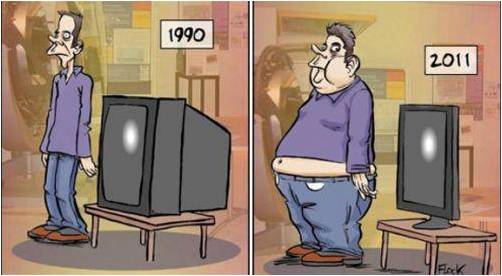
No comments!
2012-01-15 Sunday
In 1996 US
voters could see bumper stickers reading: “If God had intended us to vote,
he would have given us candidates”.
There seems to be an upcoming market for that kind of slogans yet again.
The already dominating prospect that Mitt Romney will become the GOP’s
candidate has taken the wind out of the campaign’s sails even in Swedish
mass media. On the other hand a less intense coverage will probably
correspond closer to the real importance of the presidential election,
with regard to the factual differences between Romney and Obama.
Barack Obama certainly created a great hope, not least in Europe, before
he was elected. Enough so that the somewhat naïve Norwegians handed him
the Nobel Peace Prize in blank. Then Obama has left many hearts bleeding
as he quite ruthlessly has abandoned his grand promises of peace. As Noam
Chomsky has said: where Bush number two just tortured his victims, Obama
kills them right off (referring to the targeted killings with drones).
We weep in silence.
2012-01-09 Monday
It has been
known for ages that a country like Afghanistan, consisting of mountains,
war lords and armed peasants, cannot be defeated militarily. All who tried
have failed. With death-wishing Taliban added to the picture the military
task has become even more ludicrous.
One can take for granted that US Intelligence experts had the full view of
the lean prospects for an invasion of Afghanistan, but there was an
important aspect that decided the war: retaliation.
Sweden, formerly a violent plague on Europe, had kept peace for 200 years
(cowardly so during WW2, according to many Europeans). Then, some years
ago, we suddenly found ourselves at war in Afghanistan, and no one seemed
to know how it happened. We had no retaliation to think of, just a wish to
please Big Brother who pinpointed peaceful Sweden as a particularly
valuable ally.
One can be quite certain that Swedes in general doesn’t know the main
difference between this war and peace-keeping operations under UN flag, in
which we have been engaged many times around the world. But this is a real
war, and we haven’t the slightest idea of what it means. If, for instance,
a unit of Taliban is airdropped on a military installation in Sweden,
killing hundreds of uniformed persons, they cannot be treated as
murderers. If captured, they should enjoy the rights of prisoners of war,
according to International Law (what actually would happen is another
question, since International Law is optional for certain powers). An
event like this is certainly incomprehensible for the common Swede, but
it's one of possible consequences of being at war.
Now our government has declared withdrawal from Afghanistan, beginning
this year and finishing in 2014 (exactly 200 years after our last actions
in a war). The withdrawal is unconditional, which is the same as to
acknowledge military defeat. That’s it. We are accomplices in the
destruction of a poor country, who’s only “crime” was that a foreign
terrorist had chosen its territory to reside on. To top it all, the hated
and anachronistic Taliban will obviously be back as a political force. The
same Taliban that came into being under the auspices of western powers,
and for a period was implicitly supported by USA during the Soviet war of
aggression.
How brain-dead isn’t all this?
2012-01-04 Wednesday
On page 20 in
my paper last Thursday there was a quite insignificant article about the
growing economic divide in Sweden, things we mostly read about when it
regards other countries, preferably USA. In the “perfect” Sweden
(according to some), or “socialist” Sweden (according to others), such
things are not expected to happen. But it turns out that it has done so.
Like in all other countries affected by neoliberal policies, inequality
has increased during the last 30 years, albeit less serious than in the
US, for instance. Return on capital is the main explanation for the
growing divide, as expected since neoliberalism is more or less defined by
the transfer of production outcome from labor to capital.
Ever since we got our right-wing government with its neoliberal finance
minister in 2006, this deplorable development has accelerated. Total
wealth has naturally increased (due mainly to technological progress), but
the poorest 10 percent of households lost none the less 5,5 percent of
their income, while the richest 10 percent could enjoy a 23 percent
increase of their earnings.
The finance minister, Anders Borg, was interviewed by the reporter and
shed crocodile tears over the growing divide. Its “troublesome” he says,
“we shall have a country that holds together”. His pretended amazement is
ludicrous after his five years of deliberate attacks on the unemployed,
the sick, the retired and other vulnerable groups.
In opinion polls a majority of Swedes rejects this policy, but at the same
time Anders Borg has high ratings when it comes to personal confidence. It
looks like a paradox, but may perhaps be explained by the fact that he is
well protected by the media. On the whole we’ve had an un-Swedish
government the last five years, but if that instead means that Sweden has
transformed is something we will find out eventually.
2012-01-03 Tuesday
Time to
remember to write "2012". This promises to be a “great” year for media,
with presidential elections in USA, China and Russia, and the Olympic
Games in London to top it all.
China and Russia can be put aside; those are not real elections, but the
US campaign is already intensely covered by our media. And in many ways
our journalists seem to copy their colleagues in the US. Just to pick one
tiny peculiarity, the handling of Ron Paul's case. In his home country
some prominent media mostly pretend he doesn’t run at all. Likewise he is
rarely mentioned in our media.
This must be explained shortly to Swedish readers, since they hardly see
the name Ron Paul in their papers. The man is a consistent Tea Partyist in
that he doesn’t want heavy government spending even in military
adventures. He goes so far as to say the obvious but forbidden, namely
that the US wars only create hostility and more terrorists around the
world. For this he is condemned by the “true” Republicans who reflexively
are ignorant patriots at any cost, and consequently the “true” media tries
to neglect him.
The legitimacy of elections is a current topic since the last Russian
election with its alleged rigging. Today we can read here that some
republican states in the US are rewriting the electoral rules, obviously
in order to make it more difficult for non-whites, students and poor
people to vote. Fraud or not, in a country where voters participation in
elections already is critically low, the prank is embarrassing. The low
participation of just above half the total number of voters, means that no president has
more than roughly one third of the voters behind him. Is that really a
functioning democracy even in just the formal sense?
Well, this election is like an interesting sports event, reminding of the
Olympics. Before and during the competition it may be exciting, but
afterwards it makes no real difference who won.
2011-12-29 Thursday
The traditional
Swedish Christmas ham is eaten and done with, so now we are looking
towards the coming New Year 2012. Two of the most notable and at the same
time least important events will be the presidential elections in Russia
and USA. In Russia the lack of importance is due to the lack of
alternatives. In USA it’s in a way the same thing.
The alternative to Putin in Russia is chaos, obviously; the same chaos
that followed from the capitalist and democratic revolution, when half the
industry was destroyed and millions of people died from pure misery. While
this happened a few energetic apparatchiks stole the country’s most
valuable assets, many of them bringing the fortunes abroad. Putin’s
KGB-toughness put an end to the most outlandish excesses and brought at
least some consistency to the poor country. For this he achieved a
considerable popularity, which now is eroding. But the alternatives to
Putin are zero, for the time being.
In the United States of America there will nominally be two alternatives
in the end. But in real terms the alternatives are practically identical.
Neither candidate will even try to fulfill the will of the American
people, as expressed in carefully performed opinion polls. Policy is
determined by the business community, which is paying the two parties and
candidates to execute it. The best marketing campaign will determine who's
to be given the determined task, and thereby
be awarded the
president's title.
Three years ago Barack Obama held the winners speech on the night of the
presidential election. It was a rhetorical masterpiece. What he promised
was a formidable reformation of the society, for the benefit of ordinary
people and for those in need. It was a touching and an uplifting speech,
intellectually miles above what his immediate predecessor could dream of
performing. Then came the ordinary workday…
We should not torment ourselves with details from the catalogue of
disappointments; just conclude that the government’s measures kept on
complying with the same business policy as always. A new president from
the competing party may promise a lot of things, in some ways even
deviating from Obama’s pledges, but the really existing policy will most
probably be fundamentally unaltered.
During 2012 the US election campaign will evoke enormous mass media
attention in most of the world, coverage out of every sane proportion,
leading to a result of minimal importance in real terms. It’s not much
more than a sports event, which should have been the most important
political election in the world.
2011-12-24 Saturday
Christmas Eve is the top ranked holiday in
Sweden (together with Midsummer's Eve). We don't hesitate to talk about
Christmas, although some 85 percent of Swedes see no religious connotation
in the day's name. It's just an old traditional term which doesn't bother
anybody, regardless of faith (we also hope). It's a day for uninhibited
eating, some drinking, and for the children the great day of Christmas
presents. And when we are heading home late at night we can thank our
Muslim taxi drivers who eagerly work this day. (In my childhood, before
there was any immigration, it was almost impossible to get a cab on
Christmas Eve.)
After this day of stuffing (food) we just digest and refill for a couple of days, like
the old Vikings. At best we also contemplate the situation for starving
and suffering people around the world and give some money for charity.
Now this computer will by shut off for a couple of days, and the author
will be contemplating without writing for a while. He will return when the
challenges are too tempting not to pick up.
I wish regular and occasional readers a nice and peaceful holiday,
regardless of faith or non-faith.
2011-12-21 Wednesday
SAAB has finally filed bankruptcy, which immediately
was granted by the court. An era in Swedish car manufacturing seems
definitely to be put to an end. Now Chinese companies and others probably
can pick up the valuable pieces for a cheap prize.
At the same time editors in numerous newspapers around the country can
uncork the champagne, aged and cooled during their tree years of brave
struggle to defeat and exterminate SAAB, an effort which has been as
surrealistic and sickening as anything possibly can be. They may invite
the government to the party, as accomplice to the murder by refusing to
give SAAB any substantial help (unlike their colleagues in USA and Germany
who wisely supported their car industries in hard times).
Neoliberalism and ignorance has celebrated triumph: a so called
non-profitable company has been crushed by a journalist lynch mob and a
right-wing government, neither with the slightest knowledge about advanced
car technology or (as it sadly seems) of the important role this kind of
industry plays for Swedish economy.
In the final phase of the struggle against SAAB one crucial contribution
was provided by General Motors, who denied the selling of SAAB to Chinese
companies on the grounds of license rights. According to my morning paper
someone has written on GM’s Facebook page the following:
You have
killed the most amazing car manufactor in the world. SHAME ON YOU! I will
never buy one of your cars, NEVER!
2011-12-15 Thursday
We’ve have
witnessed some very peculiar political scandals since we got the present
government with its ideologically motivated privatization, very poorly
prepared. I’ve touched upon the new private nursing homes that severely
mistreated their old patients, in at least one case leading to death. In
their effort to maximize profits, and in cold blood, they cut both
personnel and quality with disastrous consequences. On top of that they
tampered with their internal financial transactions so that their large
profits landed in tax havens, thus avoiding any tax payments in Sweden
whatsoever.
Carema is the company responsible for the most blatant misdeeds, and they
obviously ended up with huge PR problems. What happens then is most
incredible for people in this country. It turns out that politicians have
used tax payer’s money to cover cost for a PR firm helping Carema with its
problems. On top of that the PR firm which they engaged is Kreab, a
company closely intertwined with the Moderates, the leading party in the
government.
Well, this may be violating some laws, and is certainly challenging
elementary moral. But the media reaction is still fairly modest, and it
all seemed to die out after just one day. It’s almost as if people think
that right-wing politicians after all have quite low moral standards and
that we cannot demand something from them that they are not capable of.
If on the other hand the Social Democrats had been responsible for a
complex of outrageous scandals of this magnitude, the indignation in our
bourgeoisie newspapers had shown no limitations. So today they have their
hands full with important work, such as controlling Håkan Juholts taxi
receipts and other major possibilities of Social Democrat’s fallacies.
Never have the ground been better prepared for a new Jonathan Swift
ransacking Sweden, but such a person is nowhere in sight.
2011-12-12 Monday
A Swedish poet, Tomas Tranströmer, is this year’s Nobel
laureate in literature. According to experts in poetry worldwide he has
enough merits for the Prize. In other cases the Swedish Academy obviously
has awarded some countrymen and –women somewhat too easily through the
years. But the greatest Swedish author in all times never got the Prize,
never even came close.
I’m referring to August Strindberg, who’s dramas (such as “Miss Julie”,
“A Dream Play” and many others) are still played on stages all over
the world. His novels never reached international readers, but are very
important nationally. Strindberg single-handedly created the modern
Swedish written language. There is a sharp divide between the
heavy-footed, long and formalistic sentences (with some German influences)
before Strindberg, and the ones we can read with more easiness today.
Strindberg lived from 1849 till 1912, a lively period with some democratic
break-throws. He fought on the barricades alongside other revolutionary
youngsters to overthrow the old and depleted in politics as well as in art
and literature. Our hero was consequently a rabid radical and anarchist,
who’s first great novel (“The Red Room”) was a scandalous success.
As a master of satire he then wrote a collection of short stories (“The
New Country”) where he portrayed some contemporary celebrities under
thin disguise and with acid ink. The book aroused as much applause and
laughs on the one side, as it created extreme rage and hostility on the
other, and in the end it forced Strindberg to emigrate with his family.
(Today The New Country is considered a masterpiece in the satiric
genre.)
Strindberg not just repeatedly moved his residence (from France to
Switzerland, Denmark, Germany and Austria), he also changed his
philosophical and political positions, trying the most diverse world
views. On returning to Sweden after roughly 15 years abroad he was a
full-fledged Swedenborgian religious mystic, with inclination for alchemy
and occultism. In that shape he was denounced by most of his friends from
the Sturm und Drang-period in earlier years.
But with a few years left to live he returned to his radical base and
wrote almost daily articles in a Workers' newspaper, arguing against
warmongers, false patriotism, and other misdeeds by the upper-class. He
also took the opportunity to slap his literary enemies in the face with
some unforgettable formulations. By that he started a debate which soon
spread through newspapers all over the country and engaged all kinds of
people writing articles (most of the texts were later reprinted in two
volumes embracing 1 000 pages).
Thus Strindberg ultimately defined himself as a leftist,
anti-authoritarian writer, which in a way had been his real sentiment deep
down all his life. This explains why he never even had been considered as
a candidate for the Nobel Prize. He was also denounced forever as an enemy
by establishment in general and by right-wing people in particular. This
still determines the actions of reactionary politicians.
The literary work of Strindberg is by scope, importance and excellence
without comparison in Sweden. His letters alone, in a 22 volume edition,
is a literary gold mine in itself. In passing: Strindberg also was a
forerunner in expressionist painting; his works now being sold for
millions of dollars at international auctions.
Next year we will commemorate the 100 years since this grandmaster died.
But the class-conscious, insensitive and ignorant right-wing politicians
now ruling in Stockholm has allotted only an embarrassingly small amount
of money for the commemoration, so small that it must be construed as a
political demonstration. It’s an infamy towards Sweden’s greatest writer
and likewise towards those who admires him in that capacity, regardless of
political prejudices.
2011-12-07 Wednesday
Today is Noam Chomsky's 83rd birthday. He
represents the utmost excellence in different intellectual fields,
practical moral philosophy not the least of them. But he has also drawn
conclusions from his philosophy and acted courageously to influence the
development of the world and to improve conditions for the victims of not
so moral power centers. Like many great men and women who have chosen that
hard task he has been neglected by the carefully combed "intellectuals",
the flatterers of the court. Consequently he his nullified by the
mainstream society, while at the same time he is the most cited living
author in the world, and immensely appreciated among large groups of the
most conscious academics and among political activists.
Noam Chomsky, like many of the very eminent persons in world history who
were treated likewise in their lifetime, will some day be recognized as
the important character he actually is. Until then the world will have to
endure the demagogic stupidities delivered by the intellectual spear
carriers to those who have the real power and are challenged by Chomsky.
I've spend some time undressing one of these so called intellectuals and
the result will probably appear in my Swedish section. But I can imagine
what Noam's reaction would have been, had I asked him: "Don't waste your
energy on such nonsensical tasks".
Happy birthday Noam, and may you live till at least a hundred.
2011-12-05 Monday
Let’s today cite a few sentences from a speech held by
a prominent member of a party represented in the United States’ Congress:
“Wall Street owns the country. It is no longer a government of the
people, by the people, and for the people, but a government of Wall
Street, by Wall Street and for Wall Street… Our laws are the output of a
system which clothes rascals in robes and honesty in rags…
… We want the abolition of the National Banks, and we want the power
to make loans direct from the government. We want the accursed foreclosure
system wiped out…. We will stand by our homes and stay by our firesides by
force if necessary, and we will not pay our debts to the loan-shark
companies until the Government pays its debt to us.
The people are at bay, let the bloodhounds of money who have dogged
us so far beware.”
But is there today a party in the Congress with such a straightforward
view on central issues? No, the speaker was Mary Ellen Lease from the
People’s party. And the year was 1890.
Although a lot have changed for the better since 1890, it’s remarkable how
identical some key problems of capitalism are, and how much more optimism
and militancy there could be in the popular movements 120 years ago. “You
can learn from history” is something you often learn in school, it just
remains to be learned in life too.
A way to start is to read A People’s History of the United States
by Howard Zinn. That’s where I found the citations above (p. 288 in the
2003 HarperCollins’ hardcover edition).
2011-11-22 Tuesday
In the last
notation Sunday I left out the most prominent of our previous affaires,
the scandalous treatment of elderly in privately managed care centers.
More horror stories are popping up daily when people report to media about
their personal experiences as to their own relatives. This is accompanied
by a compact critique from experts in different fields about almost every
phase of the processes when these companies were engaged by the official
bodies, from amateurish
procurement
via inadequate contracts to non-existent follow-ups.
What should puzzle us is the lack of popular uproars against the
utterances of brain-dead neoliberalism, of which the privatizations are
only one aspect. One can’t recognize the good old Swede with his social
democratic mind. Our Occupy-movements tries to engage the young, but with
only moderate success. Groups of conscious and progressive leftists have
been active and appear to have grown in number, but they constitute a
small minority, and the media isn’t too keen to engage in their case.
Our media is busy with the definitive killing of the Social democrats, by
first beheading Hakan Juholt, the chairman. And they are indeed
successful. Juholt has made some not so good performances, but the main
battle that underlies the visible fight is between left and right, also
within Juholts own party. The defeated fraction leaning to the right has
started to attack Juholt quite openly, thus speeding up the breakdown.
It’s a depressing situation, but that’s when it can’t be worse that
possibilities usually turn up. In the meantime we just have to strive on.
2011-11-20 Sunday
I’ll just
drop by on this page to note that not much has changed here lately. Julian
Assange has appealed to an even higher court, probably the last one, to
avoid extradition to Sweden. Op-eds in the mainstream press usually deride
him for not coming here, and nobody seems the least concerned about the
risk for an extradition claim from the United States.
The SAAB-affaire is still in a never ending negotiation process, now some
years long. The debacle with GM blocking the two Chinese companies from
buying SAAB hasn’t stopped the discussions about the deal. In the meantime
SAAB is under bankruptcy protection and salaries are paid, but no cars are
produced.
Our Social democrat leader, Hakan Juholt, has become completely free game
for our mass media. Since all our large papers are supporting the
bourgeoisie side in politics and our public service TV and of course our
commercial channels just follow along, there is a unanimous attack on
Juholt for all his errors and flip-flaps. When the melt-down has begun
there is nothing that can stop journalists and reporters, other than the
final crushing of the victim. It’s a sickening performance to watch.
Our center-right parties in the government are now pleased with the fact
that they lost the referendum some years ago whether Sweden should enter
the euro-zone. They can also rely on our manufacturing industry and raw
materials making up the core of our economy and the vital basis for
successful export, although the Stockholm-centered punditry a long time
ago declared the end of the industrial economy and the beginning of the
service and informational society.
Lacking elementary science education the pundits of course haven’t the
slightest idea of what an advanced industrial society is about (it is
certainly shown in the SAAB-debacle). An interesting lesson is that they
obviously have no influence on the development of the economy, thank God.
The men and women in the material reality in the outskirts of Sweden are
forming the future with skills and knowledge, while the high-brow
intelligentsia, the finance manipulators and the rest, in their Armani
suits enjoy the Stockholm night-life. As long as they remain there they
are the least harmful for the development of the country and it may be
worth their high salaries to keep them from interfering in the reality.
2011-11-09 Wednesday
The SAAB
affaire now more and more takes the shape of an ordinarily formatted
American thriller movie. When the first problems are solved and everybody
relaxes, it’s still some time left. That’s when the real disaster emerges,
and nothing is settled until the last minute of the film.
When the two Chinese companies finally had decided to buy SAAB, and many
of us relaxed, it turned out that General Motors had the power to obstruct
the affair, and so they did. In the deal with Muller’s company, GM
claimed, and obtained, right of veto concerning three of SAAB’s car
models, which had some critical GM content.
I’m a little vague here from lack of knowledge since our media obviously
have missed this clause completely, in spite of their enormous coverage of
the story. They have been too busy trying to kill the poor car
manufacturer. So when the Chinese appeared on the stage, and apparently
solved the problem, journalists quailed for a while. With the new joyful
news from GM they subsequently regained their spirit.
This is for sure a bizarre story where everything is upside down. Now the
Chinese companies are expected to withdraw their bids, and the evil media
working for the Destroyer has the upper hand. Will some miracle in the
last minute save SAAB, the hero? Well, this is unfortunately not a movie,
and the real world doesn’t always provide happy endings. But the hope will
not evade us until the curtain has reached the floor!
2011-11-07 Monday
Any possible US reader to this page can comfort him- or herself with the
news that there now is another country trying to reach the same merits
when it comes to dysfunctional health care systems. And the reason is the
same: privatization.
We have gone through a number of scandals in private nursing homes here
the last few weeks. One old man maltreated till he died, patients sleeping
on the floor, the facilities short-staffed and nurses desperately
overworked; no diapers for the elderly, not even toilet paper. All for the
sacred purpose of maximizing profits for private companies, which usually
have their head-quarters in tax havens at that.
Complaint are also piling up regarding private preschools with ever
growing groups of children taken care of by the same or declining number
of personnel. Private schools are reported having too few qualified
teachers, also lacking proper equipment and school books. All these cases
have one thing in common: they produce record profits for the companies
and their owners each year.
There is one basis for the scandals, which anyone should have realized
from the beginning, namely that these businesses are fully financed by tax
payers’ money. Such a model opens a high-way to windfall profits for more
or less unscrupulous entrepreneurs. On this we share another property with
the US political system: to criticize privatizations as the main cause of
the problem is completely unthinkable. For the moment, that is. But there
will come other moments in the future!
2011-11-04 Friday
A High Court in England has finally ruled that Julian
Assange, the founder of Wikileaks, shall be extradited to Sweden to be
interrogated about possible sex-crimes, a charade you probably remember.
No one here expects the prosecutor to find enough substantial facts to
even bring Assange to a court, but a game once started must go on till
it’s finished.
After the legal procedure is put aside, the question of extradition to the
US can be expected. Journalists here usually pretend that there will be no
demands from the US of that kind, naively presuming that he, in such a
case, would have been sent over the Atlantic Ocean by England already.
Considering the grave effects, would he be tried in a US court, with a
long prison sentence to be expected, the attitude among media people here
is shockingly easygoing. After all, they share with Assange the dependence
of that sacred part of human rights that we call freedom of expression.
Swedes are indeed known to be naïve and unsuspecting, but in this case one
is tempted to believe a more cold-hearted intent. It seems that solidarity
with the United States is of higher priority than considerations for
Julian Assange. There is no normal scenario in which the Swedish
government can deny an extradition. That would imply that Sweden
classifies Assange as a political offender or something like that, which
the US government would regard as humiliating. So that alternative is
ruled out. What, then??
The whole affair is a disgrace for Sweden from the very start, and the end
can be even worse.
2011-11-02 Wednesday
For years now our
neoliberal editors, journalists and blogs have done their utmost to
promote the crushing of the respected car manufacturer SAAB. They have
shown an almost morbid satisfaction in explaining that the company is
completely beyond rescue. My paper (Dagens Nyheter) has intensified
the campaign the last year with just about daily demands for the
liquidation of SAAB. In this effort the whole editorial staff has been
engaged (including the entertainment section) in a giant mission which
simply has been incomprehensible for a normal brain.
I emailed a couple of questions to the editors with roughly the following
meaning: “Why do you engage in such an extreme campaign if the company
will crash anyhow? What’s the problem if SAAB against any odds will
survive?” The answer was a rhetorical “masterpiece” maintaining that the
paper cared for the employees, trying to save them from being deceived by
Muller, the previous owner. (For Dagens Nyheter it was obviously a better
and more humane solution for the employees that they were kicked out in
unemployment immediately.)
Now it is almost determined that SAAB will be bought by two Chinese
companies, Youngman and Pang Da. What remains is a formal sanction by the
Chinese government, which is expected to be granted. SAAB will obviously
be saved; the new owners declare that production in Trollhattan will
continue, and new factories will be built in China. Our neoliberal media
have spent enormous recourses in an insane campaign which anyhow ended in
fiasco.
Apart from the impenetrable motives behind the media campaign it was
obvious that those who performed it, with their presumptuous and cocksure
attitudes, had no clue as to the innovative and technological value SAAB represented. At best they had their educated incapacity acquired in
neoliberal economic courses. It’s a blessing that newly industrialized but
still developing countries, like China, can provide the technological
knowledge necessary to understand modern, productive societies.
2011-10-17 Monday
Since journalists are addicted to scandals - and now
after the cease fire in the Juholt affair - they have to turn to our
Foreign minister Carl Bildt, who is famous for getting away with all kinds
of oddities. His weapon is blunt arrogance with which he normally silences
reporters who confront him with impertinent questions. It has obviously
also helped that he belongs to the right-wing party, in a country where
media is dominantly bourgeoisie. But unlike Juholt, the Foreign minister
probably has real misdeeds on his list of merits.
This time he is targeted for a tricky situation in Ethiopia. Two Swedish
journalists, who had gone there to report on the situation in the Ogaden
province, have been jailed for alleged cooperation with the guerilla.
Bildt’s first rather sour reaction was that they shouldn’t have travelled
there in the first place, while others instead expected him to engage
fully in their release. A reporter then revealed that a Swedish oil
Company, Lundin Oil, had been active with oil exploration in the same
area.
Before Bildt became Foreign minister he had been a member of the board of
Lundin Oil, and there were insinuations made that old interests played a
role for his attitude. His integrity was put in question. The heat went up
when Bildt excelled in his usual arrogance in the country’s most popular
talk show, and many came to think that he this time had gone too far. And
one can really say that he has worked hard through many years to prepare
for a drive in media. We’ll see what happens.
2011-10-15 Saturday
Today the Juholt
affaire to everybody's surprise took a dramatically different path.
Yesterday night the executive inner circle of the Social Democratic Party
had a meeting, in which they decided to back their chairman, who since day
one had maintained his innocence, and all through the process had refused
to resign. Also yesterday a prosecutor made a statement that must have
slapped the witch-hunting journalists right in their faces.
A legal investigation concerning the apartment situation had started, and
was finished yesterday after a simple and rapid procedure. It obviously
turned out that there were no regulations about the apartments whatsoever!
Parliamentarians could live there with anyone they wanted, as is the
normal condition for anyone that rents an apartment. Everything else that
had been claimed by journalists was plainly pure fabrications, or lies, if
you prefer a more exact word.
So what I reported Thursday was mostly journalistic fantasies based on
rumors, which had been presented by the most prestigious papers and
TV-channels as pure truths. This is a monumental blowback for the news
media, and well deserved at that. So today’s paper looked completely
different compared with the last few days. Juholt is almost revered for
his strong attitude, even if no guilt is admitted by the editors. But
that’s just so boringly normal. Has anyone ever heard a journalist say the
dangerous words: “I was wrong”? Not to speak of the even worse: “I lied!”
2011-10-13 Thursday
Our media have been
rewarded an enormous scoop, filling every paper and news show to the brim
the past week. The background is this: parliamentarians who come from
other regions than Stockholm are allowed compensation for an apartment in
the capital. The state simply pays the rent. But if you have a partner who
also lives in the apartment, only half the rent should be paid for by the
state.
It turned out that the leader of the Social Democratic Party, Håkan
Juholt, has applied for full compensation, although his female partner
also has lived in the apartment. Thus he has through the years received in
total some 23.000 $ more than he was entitled to. “He has broken the
unambiguous rules!” media shouts. Now, Juholts lawyer claims that the
specific terms are not at all clear and not even explicit in the
instructions. But since media have created such an incredible storm Juholt
is considered to be finished anyway, by media at least. The "defendant"
himself says he will take the fight and not resign voluntarily.
It is said here that in the US it is detrimental for a politician to have
sex in a wrong circumstance, and to be caught, but that infidelity with
money isn’t a big deal. In Sweden it’s the other way around. If someone
here saw a politician humping a cow it’s some chance that a newspaper
wouldn’t even bother to make it a story. Sex is private, and that is
usually respected. But if a parliamentarian uses her credit card, issued
by the state, to buy a piece of chocolate, it is the end of story.
The latter actually happened in 1996 when Mona Sahlin was a candidate for
Chairman of the Social Democratic Party. The chocolate and some additional
minor negligence forced her to drop her candidacy after a witch hunt in
media. No one claimed that she had gained anything personally (she paid
the chocolate privately when she got the card invoice). But such trifles
didn’t matter; she had to go.
And now journalists gather at the parliament’s administrative office to
scrutinize every single one of the receipts Juholt has submitted through
the years. With all his travelling it’s a massive work, but the most
energetic rag has already found two occasions in 2007 (or something), when
Juholt seem to have receipts for taxi and a rent car on the same day.
Horror!
It seems that media consider this kind of hunting to be an interesting
sport. After just a couple of days one paper ordered a poll to be taken to
evaluate the effect of the hunting party so far. The ultimate aim is to
bring down the game, at any cost.
Needless to say it’s the Social Democrats who suffer the highest risk of
being victims of the most severe witch hunts in media. Needless to say,
because 90 percent of newspapers support their political enemies.
2011-10-12 Wednesday
In Dagens Nyheter, our
prime newspaper, one of New York Time’s star pundits - David Brooks - has
a regular column. It’s somewhat strange since his political views are a
bit exotic in our milieu, but he is also a master of nothingness, and in
that capacity he is arguably a very skilled writer, producing easily read
and journalistically effective texts.
This week he takes on the subject of innovation, partly in memory of Steve
Jobs. He points at the Iphone, and notes that in contrast to that magic
phone many other kinds of technical devices have developed quite slowly
since the 1970s. He mentions airplanes, cars, energy sources and houses
which all functions approximately in the same way as they did forty years
ago. There are no colonies on Mars, no flying cars, no nuclear driven
airplanes and things like that (namely what science fiction writers dreamt
of back then).
I remember even earlier fantasies of the same kind: in the year 2000
everyone was expected have his own helicopter; people would not have to
eat food, just to take a daily pill, etcetera. The obvious thing was that
the fantasies were created mostly by romanticizing fiction writers. My
impression is that true scientists and real technological experts
refrained from such wild forecasts. If so, it could be because
speculations about unknown things are irrational and thus meaningless,
something Cartesians usually avoid.
Brooks’ point is that the development of new great innovations suffers
from stagnation. And he is supported by a number of writers to whom he
refers. In their eyes, the creation of spectacular new technical devices,
which make a difference in our daily lives, decreases in number. It may be so, but
those “big” innovations are not necessarily the most important ones for
the material or economic development in society.
Actually, Brooks’ example, the Iphone, is an interesting illustration of
that claim. The Iphone in itself is not as much a technical innovation as
a conceptual one. But it hides under its shell a technological upsurge
created in hundreds of different places which we don’t contemplate at all,
probably because it is so utterly inconceivable for ordinary humans. The
incredible speed of this development is described by Moore’s law. And
these unbelievable technological advances are built on real innovations,
not a single one, but a chain of innovations creating an increasing body
of new knowledge.
This is how the important technological development takes place. Millions
of small innovations, improvements and adjustments are continuously
building new platforms on increasingly higher levels. For Brooks, a car
from 1970 looks like a car today. Obviously it has four tires and a
steering wheel, but that’s about it. In every detail, from the smallest
ball bearing to the computer managed motor, it’s a different product with
completely different performances.
These small but innumerous and daily innovations and improvements form
incidentally the most important basis for technological advancement
whatsoever. That fact is overshadowed by the greater interest for the
spectacular manifestations of new technology that naturally attracts
people like David Brooks, mainly because they don’t know much about the
fundamentals of science and technology.
Most importantly the small-scale and continual technical development lays
the foundation for increased productivity, which is the most dynamic
factor for economic development.
2011-10-06 Thursday
Tunis, Cairo, Damascus, Bahrain,
Sanaa, Tripoli, Madison, Athens, Birmingham, New York... What next?
2011-10-05 Wednesday
Long since
last annotation here! Also long since the last scandal in Sweden? Don’t
think so!
Sweden is a kingdom, one of these anachronistic remnants a modern society
at a pinch can afford. Not that people care about the kingdom as a
constitutional entity, but “it is nice to have a royal faaamily!” It turns
out that the royal family life hasn’t been so nice, though. After decades
of rather well-known secrets about the kings private escapades, the bubble
burst with a new book some time ago where many of the secrets where put in
print.
I will not dwell on the details here. First of all because it is his
private life and the only thing about him which is remotely interesting is
his public role. Secondly the whole affair is just depressing. Those
interested in filthy details can probably find them on the Internet.
A real scandal occurred however two days ago when the king, in his
capacity as honorary chairman of the World Scout Foundation, awarded his
colleague in Saudi Arabia the organizations highest Medal of Honor. It
compares with the Royal Blunder in 1980 when the king awarded the dictator
Ceausescu of Rumania the highest Swedish order, Serafimerordern.
Not that I wish king Abdullah the same fate as Ceausescu, but it would be
a blessing to see him tried for his dictatorial misdeeds before a really
impartial court of law in a genuinely democratic Saudi Arabia, sometime in
the near future.
We have just been condemning a number of Arab dictators, for whom we
recently had no objections; some of them we in fact supported actively.
When the oppressed people practiced active democracy and succeeded to
overthrow the dictators, our politicians immediately turned around and
started to praise the democratic revolution, and abandoned the dictators.
King Abdullah is one of the remaining ones, who not long ago rescued his
friend and colleague in Bahrain from the people's democratic threat by
letting his powerful military forces intervene in a foreign country,
without much criticism from the west..
The kingdom as such is an institution since long apt to be stored in
museums. To see the Swedish soap opera version of a king award a dictator
version such as Abdullah, who has decided that women should be punished
with lashes for driving a car, is just too much. I’ll quit!
2011-09-28 Wednesday
In the face of
compact critique the board of SNS was forced to fire their managing
director. It’s true that the man - Anders Vredin - lost his nerves when
the heavy guys from the business community raised their voices. But the
serious disrespect for academic principles was demonstrated by these
“honorable” representatives from the higher economic spheres when they
presumed as self-evident that results from research should fit their
taste, or otherwise be silenced.
The most vulgar and autocratic attack on the scientists was made by the
head of The Confederation of Swedish Enterprise, Urban Bäckström, a very
prominent figure in the Swedish corporate world. He criticized the
research manager and her presentation of the report, and demanded that the
study should have had other objectives than the ones set up. He implied
that the study was politically biased, which is standard demagogy when
things doesn’t fit one's own political opinions.
Bäckström ones left his graduate studies in political economy for a job as
an official in the government. His top position before the current one was
as Governor of the Bank of Sweden. He’s more known as a kind of political
figure than as an intellectual economist. In that capacity he couldn’t
restrain himself so much as to respect academic principles, which would
have been the wisest thing to do. Well, now he has experienced that the
academic world has its own kind of power, which even the otherwise
overwhelming economic might must respect.
2011-09-27 Tuesday
As for the
result of the study made by SNS, namely that no improvement in efficiency
or quality could be verified from 20 years of continuous privatization of
the social sector, it’s interesting in itself. There should be no doubt
that egoism in principle is a driving force, also in economics. We are
more productive when we own the product, and cherish it with more
interest. The problem is that one cannot simply transfer this driving
force into an organization where many people are engaged and only one of
them is the owner. Parts of the advantages are lost underway.
It seems that demand for profit is a main drawback for the private
alternatives in comparison with the public and non-profit ones. Each cost
reduces profits and it becomes a delicate balance to prevent cost
reductions from harming the quality of the product. Another temptation for
the private owner is to downplay the long-term view in favor of the
short-term.
A telling example in Sweden is the recent introduction of privately owned pharmacies
in a market that formerly was a state monopoly. Some of the public
pharmacies were sold to private companies, but a majority is still in the
hands of the old state corporation. The idea was that competition would
make everything better. It should be mentioned that the state pharmacies
often ranked highest when people’s confidence in corporations of all kinds
were measured, so there was actually no public demand for a change.
One thing that have struck me through the years is that every drug you
could need, even the most odd ones, was available on the shelf in the
state pharmacy. In the very rare cases when this high standard wasn’t met, the
staff could find on the computer screen which nearby store had the
product, and made it available the next day.
Since day one of the privatization I have not once got everything on the
list. Either the specific brand or the size of package prescribed is
missing. But now it takes almost a week to get it delivered. And this goes
for the public pharmacies as well. OK, there are costs associated with
storing expensive drugs, so it saves money to keep stores quite reduced.
Regrettably though, no one has discovered any lower prices for consumers,
so the benefit stays obviously with the company and its owners.
Apart from the inconvenience, there is an extra cost which is entirely
carried by the consumer, namely for time and transportation caused by the
additional trip to the shop. If, say, every second customer has to do
such a trip those costs surely exceeds the cost of keeping complete
stores. The profits from reduced storing are thus paid by others, and for society as a whole
the “economic rationality” in fact is a loss.
More important than the economic effects is that there already has been
cases where the absence of absolutely vital drugs has caused severe
problems for patients. All these factors explain why the state owned
pharmacies ranked high among the public. In those days there were no such
problems, and yet the prices were the same.
2011-09-25 Sunday
Social unrest
in academic circles continues after the SNS scandal. Some very prominent
professors in different social sciences, also members of the highest
academic board of SNS, wrote yesterday an indignant article on the
country’s number one debate forum in Dagens Nyheter (DN Debatt).
They openly imply that SNS’s managing director, Anders Vredin, should
resign for muzzling a scientist. (They don’t discuss the specific result
of the study.)
The professors find it remarkable that high representatives of the Swedish
corporate society, without blushing, expect “correct” scientific results
from institutes they finance. But who can blame them for that? They are of
course used to the fact that everything can be bought for money. Why not
also research findings?
Likewise, the professors find it chocking that Anders Vredin was so
intimidated by the reaction from the corporate leaders that he panicked,
and made his unforgivable blunder. Although Vredin offered a strong
apology as soon as he realized his mistake, the professors seem not to
think that his excuse is sufficient to regain confidence for SNS and its
scientific reputation.
This is a significant and interesting conflict, to be followed up.
2011-09-23 Friday
The report I mentioned 2011-09-20 has of course stirred up anger in
right-wing quarters. The research institute (SNS) is to a large extent
financed by corporations, and unashamed conservatives argue that the
scientific results should have been more ideologically correct. Affected
by that uproar SNS’s managing director muzzled the research
manager responsible for the report, Laura Hartman, who subsequently resigned. As a consequence of
that violation of academic freedom a prominent social sciences professor
also left the institute.
Well, the scientific study had in short shown that 20 years of
privatizations in the social sector had resulted in no visible increase in
efficiency and quality, the main pretexts for the private revolution in
the first place. No one is actually amazed by that result since most
people have personal experiences of those and similar failures. One
typical example of a total fiasco is the privatization in the energy
sector. People now have to choose between over 200 electricity suppliers,
and the only result has been a sharp increase in consumer costs, not
surprisingly.
Since the neoliberals certainly know that they have a weak case, they
instead criticize the researchers for not having studied something else,
such as freedom of choice and consumer satisfaction. One could cynically
note the sudden and unexpected interest for human values shown by the
otherwise anti-altruistic hardliners in the conservative bunker. But in
war and love everything is permitted!
2011-09-21 Wednesday
The conservative
government we have here started their attack on the unions as soon as they
came into power in 2006. In words they stated their loyalty to the Swedish
model, in which collective agreements and strong unions are core elements.
But in deeds they immediately and considerably raised the fee that
employees have to pay to the unemployment funds. Since the funds are
managed by the unions, and many people couldn’t afford the fees, the
result was a rapid departure from the unions by members, who at the same
time lost their unemployment insurance.
We hear that public employees in Wisconsin, USA, have been denied their
right to collective bargaining. We must conclude that representatives of
neoliberalism doesn’t give up so easily in its fight against the unions,
in spite of a demonstrated incapacity of the highest degree by that
economic religion, resulting in the most serious economic crisis in living
memory. And in busting the unions it doesn’t hesitate to violate human
rights.
Article 23 of United Nation’s Universal Declarations of Human Rights has
the following wording:
-
(1) Everyone has the right to work, to free choice of employment, to just
and favourable conditions of work and to protection against unemployment.
-
(2) Everyone, without any discrimination, has the right to equal pay for
equal work.
-
(3) Everyone who works has the right to just and favourable remuneration
ensuring for himself and his family an existence worthy of human dignity,
and supplemented, if necessary, by other means of social protection.
-
(4) Everyone has the right to form and to join trade unions for the
protection of his interests.
According to point 4 of
this article, unions are expected to protect workers interests, and
bargaining is a main tool without which unions are unable to protect any
interest. Reasonably, to deny unions the right of bargaining must therefore be a
violation of the Universal Declaration.
It’s all very interesting. Here our mainstream media maintain a constant and
frequent critique of China, Cuba, Iran and a few other countries (that don’t
obey western orders). Since these countries don’t engage in wars or even in
military support of other countries, we have to focus on other deficiencies,
notably in the field of the human rights. It’s true that these countries
violate at least four of the thirty articles in the Declaration, and they
rightly should be criticized for that. And so we do. Accordingly it has in
our societal discourse become a serious crime to violate Human Rights.
Regrettably most people are not aware of all the articles of the
Declaration, and those pundits who have some knowledge about them just
ignore the ones not appropriate. Here we have certainly not heard anybody
suggest that the governor of Wisconsin has violated the United Nation’s
Universal Declaration of Human Rights. And we will never hear that. For
sure.
2011-09-20 Tuesday
In the past, Swedish
welfare systems were almost entirely run by the state or municipalities.
But a right-wing government 20 years ago started to introduce private
alternatives for schools, health centers and institutions for elderly care
among other things. There was a dominant conception in bourgeois circles
that the publicly run operations were inefficient and lacked quality. The
idea was that private corporations would remediate those deficiencies and,
as a bonus, bring some freedom of choice into the system.
Today almost every fifth employee in the welfare sector works for a
private company. Since the tax payers pick up the bill, in full, nice
profits are more or less guaranteed for the corporations. In spite of the
pretext of increasing efficiency there have been no studies made in all
these 20 years to clarify the real effects of the privatizations, i.e. to
see whether they achieved the assumed goals. The right-wing parties
probably had no interest in any evaluations since they had rammed through
the reform mainly for ideological reasons anyway.
Now an important study has been done, finally. It is made by a serious
research institute mainly financed by the corporate society (and thus
certainly not a left-wing resort). First of all they find it unacceptable
that 20 years have passed without any evaluation of the privatizations.
The researchers consider it grave since the citizens that need welfare
services are in a vulnerable position and are depending on the best
possible care; as formulated by the report: “To achieve this it is not
sufficient with ideological faith as basis for decision”.
The conclusion from their research is draconic: there is no evidence whatsoever that privatization has led to any improvement of the welfare
services: “private alternatives have not been the ‘miracle medicine’ that
many had hoped for”.
My suspicion is that a possible increase in efficiency has been
counteracted by savings and downsizing, and that the whole apparatus just
has resulted in large private profits, with no benefits for the ordinary
citizen.
2011-09-18 Sunday
In Sweden we have a
strange kind of “socialism” that probably would puzzle most Americans. So
if for instance people are short of time and need help with domestic work
such as cleaning and gardening, they can hire a firm to do it, and the
government will pay half the bill. It’s called rutavdrag. The
pretexts for this reform given by the right-wing government included
favoring gender equality and hampering a traditional “black” enterprise.
Well, Swedes have never been used to keep servants; we live in a quite
egalitarian society when it comes to life style. The distribution of
wealth may be fairly unequal, but the rich are not supposed to show off
their opulence in public. And to do one’s own domestic work is considered a matter
of principle. So it’s not surprising that only some 5 percent of
households have taken advantage of the reform. (Nota bene: some x
percent of the upper classes certainly adhere to the discrete and completely
untaxed servants they have had for centuries.)
It’s natural to suppose that the 5 percent of households in question are
among the more well paid. We thus have a system where 95 percent of the
people simply hand over money to the richest 5 percent so that they can
buy some extra bottles of champagne each month. Obviously a majority must
oppose such a crazy principle?
Strangely enough even the Social Democrats hesitate to work against the
rutavdrag, calculating that there are no political points to gain by
such an opposition. And deplorably their gut-feeling may very well be
correct. With the help of an overwhelming propaganda, the reform has been
pitched as an increase in freedom and gender equality, so much so that the
simplest calculations aren't made by those who pay the whole bill but get
nothing at all of the benefit.
We can call it an illustrative example of how consent is manufactured in a
society with allegedly all freedoms of expression intact.
2011-09-14 Wednesday
Noam Chomsky
kindly sacrificed some of his arguably limited time to not just read, but
also to answer my email. With his, as always, sharp eye he found a weak
spot in my rather fuzzy remarks on the left-brainers. He finished his
answer with some very encouraging statements. Well, I’ve had a word
directly from the clearest mind in the known universe; a person who
furthermore dedicates his unmatched skills to work for the benefit of
mankind. Nothing could be more energizing for a man like me, who humbly
tries to work in Chomsky's spirit, although on a level a hundred floors
below. Thanks Noam, if I may address you in such a personal manner.
2011-09-12 Monday
Today Professor Chomsky is expected back from travel, so I try
again to send my e-mail, slightly edited, as follows:
Dear
Professor Chomsky,
It’s indeed presumptuous of me to occupy your invaluable time, but a
letter to you has been on the assembly line for many years, and I can’t
resist sending this version.
You have received all laudations there are, so I don’t quite know how to
phrase my appreciation (in a foreign language at that), other than to say
that you are a very important reason for living. The world must thank you
limitless for devoting your sharp brain and unbelievable energy to the
tireless and truly rational analysis of the most important problems, and
for your enormous inspiration.
Being a left-brain type, with a background in science and technology, it’s
a mystery for me how irrational and emotional thinking can dominate the
social discourse the way it does. One of many reasons might be that
left-brain types don’t find the social discourse at all interesting.
Another reason, maybe more important, is that the right-brain types that
dominate the social discourse don’t find the strictly rational approach
appealing. In any event: your rationality is a light-house in a dark
night, with a few scattered torches floating around.
Here in Sweden we have experienced full neoliberal rule since 2006, after
some 80 years of gradually refining the Swedish Model, a distinct
capitalist system with Compromise as main regulatory mechanism.
Some called it “the third way” between capitalism and communism, but that
was just for propaganda purposes; private capitalism was never challenged.
Nevertheless the principle of compromise resulted in some benefits for
ordinary people that somewhat distinguished Sweden from other countries,
for the better.
Now neoliberalism is in full swing. The new government started immediately
in 2006 with deregulations, privatizations and sharp attacks on the
allowances for sick and unemployed. The Swedes were chocked, and even the
mainstream papers reported one scandal after the other. One of the cases
that upset people was about a woman practically dying of cancer. In order
to get her allowances, according to the new rules, she was forced to apply
for work at the official employment agency. This was so grave that the
government later modified that specific rule.
We have an odd system for private schools, euphemistically called
“free-schools”. They are privately owned, but 100 percent financed with
tax-payers money. This of course opens a high-way to windfall profits. The
system was already in place, but got a shot in the arm by the new rulers.
Schools were handed over to energetic individuals who just had to pay for
the used furnishings. By stripping the schools from all extravaganzas such
as libraries, special teachers, medical personnel etcetera the new owners
often became millionaires on tax payer’s money within a year. Then,
following the normal procedure, more and more schools, health centers and
hospitals have been ending up in the arms of venture capital companies
with their headquarters in tax havens.
One could fill pages with shocking examples of these fruits of brain-dead
neoliberal politics. And people accordingly became furious. In 2008 the
government rated catastrophically in the polls and the opposition was in
the lead by almost 20 percent. A regime change in the elections in 2010
seemed inevitable.
Well, it didn’t happen.
As you often have pointed out, the real issues tend to disappear in our
kinds of elections. Swedish voters are normally quite rational and
susceptible for arguments, but this time something backfired. For one
thing the Social Democrats didn’t take a clear stand against the new
politics. Their leadership was trying to reach out to the middle class (in
the European meaning of the word), i.e. strive towards “the center”, thus
forgetting their core voters in the industrialized Swedish mainland. It
also seemed that people got used to the scandals and began to prioritize
their own situation. Those who suffered the most were as usual not
themselves part of the debate.
I think that this example illustrates important dilemmas. Capitalism is
stimulating productive forces (it’s progressive, as Marx wrote), and at
the same time causing severe problems, especially for the already most
vulnerable. But those who suffer the most either can’t be reached or
opposes constructive policies. Many of them vote for the most right-wing
party we have (like in the US), and shout on the Internet: “don’t touch my
property”. I agree with you that it’s an important task for all
progressive movements to try to mobilize all these people, but the mission
seems sometimes impossible. Well, this is just pessimism by the intellect.
When I listen to your talks on the net I regain my optimism by the will.
I base that optimism on the hope that there is a possible society which
gives room for individual freedom, initiative and rights, and at the same
time fundamentally builds on solidarity in all its common functions. So
far mankind has not been able to combine these elements fully in one
functioning society, but your very existence brightens the prospects.
With devotion, and warmest greetings!
Yours sincerely
...
2011-09-11 Sunday
For a
couple of weeks already, Swedish newspapers have reminded us of the
special tenth anniversary this very day. Today's paper has one single
theme throughout the whole edition. It makes us think.
It makes us think about horrible atrocities, cruel deaths, mourning people
and a chocked nation. Terrorism on a large scale suddenly, and for the
first time, hit in the heart of our civilization. The whole world reacted
with disgust for the perpetrators and with sympathy for the suffering
country.
It also makes us think about the terrorism on a giant scale that we in the
western world have afflicted other people with, often poor and distressed
people at that. The number of dead bodies we have left behind us on our
cruel crusade doesn’t count in thousands but in millions.
The ultimate thought could be only one: bloodshed is a bad method,
especially for maintaining dominance over other people. If something good
could come out of 9/11 it will preferable be that violence in all
different strata of the social structure should be minimized, and that
peaceful means, caring policies and solidarity between human beings will
be perceived as a characterization of a wise and intelligent mankind.
2011-09-10 Saturday
My e-mail to Noam Chomsky got this kind reply:
Prof.
Chomsky is unable to access email at this time, as he is traveling out of
the country.
Please resend your message after September 12, if it is still relevant at
that time.
I will take the
opportunity to contemplate the original e-mail, to see if something can be
improved, and will be back on 9/12.
2011-09-06 Tuesday
Sometimes there are things that you just have to do. I began to
read Noam Chomsky's works in the 1970s, starting with The
Responsibility of Intellectuals from 1967. Many years later I saw
Chomsky's e-mailadress somewhere, and immediately decided to write him a
mail in the future. That future finally came, and the mail reads as
follows:
[The original mail is taken out for polishing, and will be sent next week.
For reasons, see September 10th.]
2011-09-01 Thursday
Speaking of obsolete instincts such as racism and xenophobia - remnants
from our reptile brain that we should have gotten rid of a long time ago -
I came to remember a radio reporter’s story some 20 years ago. She was
stationed in Paris and had come to know two Yugoslav women living there in
exile. As fellow countrymen the two women were best friends and helped
each other in the foreign environment. The relationship was ideal and they
became really close. Until one day when they suddenly turned into mortal
enemies. What had happened?
It turned out that one of the women originally came from the Serbian part
of Yugoslavia, and the other from the Croatian part. So when the civil war
broke out in their home country they rapidly adapted their ethnical roles
and became bitter enemies. This is certainly a perfect illustration of the
lack of common sense in our ethnical reflexes.
2011-08-25 Thursday
In a
number of ways the history seems to have gone backwards since the 1970s
in this country. Old and formal rituals of many kinds, which had
been discarded by the progressive youth, step by step reentered the social
life. We have seen a quite massive conservative backlash on almost all
fronts. And racism started to grow, slowly at the beginning and then
accelerating. The question if there are any connections is worth studying.
The 1970s marked the end of “the golden age” in most of the
industrialized countries. From the end of the war till then the economic
growth was considerable. But what specifically distinguished the period
was that the economic outcome was distributed in a relatively equal
manner. That means that ordinary workers saw their living standards really
improve; in addition to the salary also working hours and working
conditions underwent a positive development. Unions in Sweden were
offensive, and there were some large strikes, but the feeling was overall
that democracy was starting to spread into the corporate world. A
miniscule legislation gave unions some influence on corporate decisions on
specific issues.
From the late 1970s this development began to reverse. The
owners of the world realized that the game had gone too far and hit the
brakes. With the help of mercenaries in different services they started to
push the history backwards. On the ideological front Milton Friedman
became the four-star general, leading a swelling army of neoliberal
economists. On the most important political front Ronald Reagan was
appointed figure-head (what he personally understood is disputable), and
Margaret Thatcher became the wicked lieutenant. After 30 years one must
conclude that the war was victorious.
The first “victory” was that economic growth fell to a lower level than in
the previous 30 years. In USA ordinary employees have seen there salaries
stagnate or decline, working hours increase and working conditions get
worse. The only real “improvement” is that a miniscule fraction of the most opulent
has become even richer. All industrial countries have been affected in the
same direction by neoliberal rule, but mostly to a lesser extent than USA.
Thus arriving back to the “good old days” for capital owners we could also
“enjoy” the really horrific crises that are typical of a mindless
capitalism. Ordinary people who for the last 30 years have paid to watch
the rich become even more insanely rich, once again had to pay for the crises others have created
(some of latter now being promoted to the Obama administration). All over
the world people have lost jobs, homes and savings; in the poor countries
it’s a question of starvation and death.
With this as a background it is perhaps not a total mystery that racism is
growing in many countries. Constructive ways of reacting to change
politics are effectively barred. For the moment, that is.
2011-08-23 Tuesday
In the book I wrote about yesterday Georg Klein deals extensively with the
question why we so easily adopt the idea that foreigners pose a danger, just
because they differ from us in one way or another, ever so little. The
fundamental instincts seem to be innate, and to have evolutionary origins.
Survival was simply favored by vigilance and readiness to contest foreign
competitors (who were ready to do the same). Even the impulse to commit
murder is by some considered to be an inborn capability.
Be that as it may, but the terrible failure is cultural. We have a lot of
instincts that we do suppress because they are not tolerated in a civilized
society. But different manifestations of xenophobia are not subject to the
same distinct civilization process as most other unwanted instincts. There
are now thousands of racist websites, the most popular hate object for the
moment being Muslims. (Not very many websites advocate rape, looting or
other impulses we might have, but have learned to control.)
Even anti-Semitism is growing, exemplified by the recent development in for
instance Hungary. In more “civilized” countries like Scandinavia racism is
disguised
under the pretext of “factual critique of immigration policy”. Under the
same disguise political parties have emerged, exploiting latent xenophobic
tendencies among people. In Norway, the land where the horrible neo-Nazi
terrorist atrocity took place, almost every forth voter supports a party
with these shady ideas.
It’s bad enough that there exist opportunists who don’t hesitate to
exploit hidden racist impulses for political purposes. But an important
side of the problem is also why people in these days are vulnerable to
irrational feelings of this kind. In the 1970s there were absolutely no
visual racism in Sweden. Half a dozen stubborn Nazis had hibernated since
the war but they laid low in hiding and were considered to be total freaks.
That was it. We thought that this constituted a rational and civilized
development that could not be reversed. It proved to be a naïve expectation.
How could history turn back so dramatically?
2011-08-22 Monday
Back to the keyboard
after two weeks of computer-free activities!
Among other things I’ve been reading the latest book by Georg Klein, a
prominent scientist (a cancer researcher) as well as an interesting author.
His life is a fairytale in itself. As a Jew in Hungary he one day in 1944
was marched to a railway station together with hundreds of others, ready to
be pushed into a cattle wagon, which would have taken him directly to
Auschwitz and extermination. He knew what was at stake, and miraculously he
managed to sneak through a dark and unguarded station building and escape.
For the months left of the war he lived with false papers in Budapest and
was lucky enough not to be disclosed. In 1947 he came to Sweden and remained
here together with his wife, a classmate from the Hungarian medical school.
The title of his latest book is I will never return and discusses
among other things the situation in Hungary during the war.
What caught my eye was a citation by Pál Teleki, a professor of Geography
and Hungary’s Prime minister 1939-41. He belonged to one of the most
distinguished aristocratic families in his country; he was a respected
conservative – and an outspoken anti-Semite (which in those days meant no
contradiction). Klein cites him in the book with a sentence he uttered to
Klein's father: “The Jews have practically taken over this country’s culture
and we must do everything we can to reduce their influence”.
Teleki was certainly not a Nazi. He denied the German armies free way
through Hungarian territory to attack Poland. He also opposed demands from
the Germans to pass through Hungary on attacking Yugoslavia in 1941. And
when the Nazi-influenced Hungarian military obstructed the government’s
orders and collaborated with the Germans, he committed suicide in his
office.
What struck me was that his opinion regarding the Jews almost verbatim
corresponds with the Norwegian terrorist’s view on the Muslims and their
role in Norway. The important question is: how do distorted beliefs like
these emerge?
2011-08-06 Saturday
The irregularities concerning my notations this summer should be
blamed on unusually nice weather for vacation activities. Now I'll enjoy a
more structured leisure time and withhold all postcards for two weeks.
Back on August
22nd.
Bye till then!
2011-08-02 Tuesday
The first funerals after the almost unthinkable atrocities on the island
of UtØja in Norway have taken place. The number of
dead is now 77, with many injured still in hospital. The whole nation is
mourning and the Prime Minister, Jens Stoltenberg, has become a Father of
the Nation and a trusted leader. A generation of future prominent-to-be
Social Democrats have been wiped out by a fascist murderer.
In contrast to Stoltenberg, the Swedish Prime minister, conservative
Fredrik Reinfeldt, has distinguished himself by showing an almost
remarkable lack of interest. It took him 16 hours after the terrorist
attack to make his first short and rather detached comment. Then he didn’t
attend a memorial service held in Stockholm (and neither did the Royal
family). For his strange behavior he received rather harsh commentaries in
the press, even in the mainstream newspapers. The government’s bad manners
were even more emphasized when the Danish government and Royal court
arranged a special memorial service in Copenhagen, honoring the murdered
young boys and girls in Norway.
While many people are wondering if Reinfeldt’s behavior in some way
reflects his lack of interest in the lives of young Social Democrats,
right-wing editorials (inspired by O’Reilly?) points out that the
deplorable events mustn’t affect Christianity or conservative politics
just because the perpetrator had those beliefs. We have indeed to separate
these to phenomena (although we mostly did not succeed in separating Islam
from Muslim terrorists)!
The young Social Democrats on that island believed in politics that cares
for everyone. By consciously overlooking the political motives behind the
brutal murders these writers diminishes the convictions held by the young
boys and girls. That’s probably the most disrespectful way in which to
serve their memory.
2011-07-27 Wednesday
Now Scandinavia has
got its equivalent to Timothy McVeigh and the Unabomber: a blond Muslim-
and socialist-hater with the forever damned name of Anders Behring Breivik
(there is at least one man with the exactly same name, and he will
probably have to do something about it). The blond monster calls himself a
rightwing Christian, which has driven the Fox talk show hosts berserk.
Bill O’Reilly certifies that Christians never do the things that this
Norwegian Christian did, namely kill 77 people, mostly young boys and
girls, wounding a number of others.
(Old Bill just forgets his favorite president, Bush number two, the
devoted Christian who was directly responsible for the killing of
hundreds of thousands of completely innocent women and children in Iraq and elsewhere. But that’s
another story of course…)
The similarity between Anders B B and his American colleagues is found in
the grievances they experienced from a society that they weren’t included
in. ABB is seemingly fairly intelligent but probably socially inhibited.
He planned his attack on the government and the Social Democrats for about
ten years. When he started the project he had already convinced himself
that the Muslims where taking over Norway and that the Social Democrats
were responsible for letting them in.
It should be said that Norway since long has had a very restricted number
of people immigrating, compared with Sweden it has been insignificant.
Despite that, Norway has for many years had what we call a “dissatisfaction
party” in the parliament, a party
with the main goal of limiting immigration further, at least immigration
from non-white countries.
Anders B B doesn’t appear to be a simple lunatic. But he has got a
fixation to lunatic ideas, and in that he is certainly not alone. The
Internet is loaded with racist and anti-Islamic voices of varying degree
of madness. He has also had direct contacts with notorious groups with the
same agenda, in England and probably elsewhere.
Our blond monster doesn’t have to be insane, at least not more so than the
thousands of SS-men who committed the same kind of atrocities, and much
worse. But he had the same fascist ideology as the SS-men. How did he end
up there? Well, he was a product of a society that didn’t let him
in, as it also threatens to leave many other young people outside. That’s
where we have to start our analysis if we are interested in preventing
similar nightmares to happen in the future.
2011-07-22 Friday
The worst catastrophe
so far this year, according to mass media globally - the Fukushima
disaster - has not yet injured a single individual, let alone killed
anyone (from radiation). This paradox is based on the curious fact that
nuclear accidents are classified by a special measure, with which every
misfortune can be named a tragedy, regardless of the real consequences.
One would think that media had at least some interest in how this
overwhelming catastrophe develops, but the silence is total. That is, if
there isn’t an occasional incidence of high radiation from cattle fodder
or something similar. In such cases a short report is delivered, without
evaluating the non-existing risks, just to remind people of the prime
disaster-of-the-year.
We have to go to the IAEA website to look for facts. But, as it happens,
IAEA closed its daily log from Fukushima already on the 2nd of
June, obviously since the plant status is fairly stable and the need for a
daily log no longer is in place. The progress in cooling the reactors and
the spent fuels pools is continuous, although slow, and there are no
serious surprises to be expected.
The IAEA index page holds this message: “Prior to his departure for an
official visit to Japan on 24 July 2011, Director General Amano stated
that the IAEA welcomes the significant progress the Tokyo Electric Power
Company (TEPCO) has achieved overall in implementing its ‘Road Map’ to
contain and stabilize the situation in the aftermath of the nuclear
accident at TEPCO's Fukushima Daiichi power station on 11 March 2011.”
Furthermore Amano said that “the company was ahead of the ‘Road Map's’
schedule in some areas. Based on their progress to date, the IAEA notes
that their plan to achieve ‘cold shutdown’ by early next year could be
possible.” A cold shutdown means that the hazardous phase of the whole
experience has passed, and the greatest non-catastrophe since Harrisburg
has ended without a single injury, as it seems by now.
The worst consequences of the accident will be the irrational setbacks for
energy production in several countries, headed by Germany; this idiocy
accompanied by severe damage on the already weak efforts to counteract the
global warming.
2011-07-06 Wednesday
Today's one-liner apropos gender madness: is it artificial
intelligence or natural stupidity?
2011-07-03 Sunday
My paper, Dagens Nyheter, has featured a series of
articles about masculinity and the role of the modern man. As a closure
they asked a dozen randomly selected, ordinary women the question: “What
traits in men do you like the most?”. The answers were first of all
totally incorrect, politically.
A majority wanted men to be strong and masculine. Some emphasized the
importance of the difference between the sexes; that men were a positive
complement to women. One 35 years old preschool manager said:
-
Men add other
things to life than women do. They look upon things differently in
conversations; they have other perspectives and experiences which I find
enriching. Maybe specifically when it comes to children. Sometimes I think
that men can have a somewhat more rational attitude towards parenthood.
So far the women in the questionnaire had learned
nothing from what the gender lunatics have preached from every corner of the
cultural world: That there are no differences between the sexes outside our
social constructs, and that there consequently are no men or women other
than in our perception (imagination). Or, to complete the lunacy: that there
in fact are eleven different genders (depending on which text you happen to
read).
But of course there was another side of the coin for the answering women:
men should also have nicer and softer qualities, namely towards the woman
speaking. They should participate in domestic work, take care of there
children, etcetera; thus being both strong and soft at the same time. It’s
certainly not easy to become the perfect man.
But what would men answer to the equivalent question? For instance something
like this:
-
Women should
be beautiful and sexy, be a master in the kitchen, take well care of the
children and be gentle to their men, etcetera. It’s a bonus if they are
intelligent, amusing and have social skills. (And things like that…)
There’s just one hitch:
it’s totally inconceivable that men would be asked a question like that, and
even more so that the answers be published in a serious paper. That fact
constitutes a vital difference between the sexes, and proves that the
politically correct are fundamentally wrong.
2011-06-28 Tuesday
Being
home now a couple of weeks from an all inclusive-trip to Turkey, we could
read in today’s newspaper that five tourists have died there recently from
drinking “all inclusive” alcohol. Twenty tourists are hospitalized with
severe internal injuries. It turns out that methanol had been added to the
homemade spirits used for the drinks. The background motives are
revealing.
Tough competition has made it necessary for hotels in Turkey to offer all
inclusive, including all kinds of drinks. Since legal alcohol is heavily
taxed, some 90 percent of hard liquor served at these hotels is either
homemade or illegally imported. Obviously there are some criminally
careless people involved in this business.
For us Swedes, coming from the vodka belt, free alcohol is an exotic
phenomenon. At home we can buy beer, wine and spirits only in stores owned
by the state through a monopoly company – Systembolaget. In small or even medium sized
cities there is normally only one such store, and in the countryside you
have to drive many miles to find them. Not surprisingly, when Swedes visit
countries with easy access to somewhat cheaper alcohol they often make
fool of themselves by drinking too much.
Our hotel hosted other people from the vodka belt, such as Russians. But
there were no signs at all of over consumption, at least during daytime.
One important reason was obviously that families with children formed a
majority. However, we had complementary explanations such as these: The
beer was almost non-alcoholic, rather thin and tasteless at that. The wine
was also very light but sour, and the taste didn’t invite to any extended
sipping. The hard liquor was simply nauseous. We tried a few drops of
(what they called) gin and tonic. It tasted like pure turpentine and was
undrinkable, so we left all that aside.
As a benefit from our abstinence we arrived home with eyes and kidneys
intact.
2011-06-23 Thursday
The
Wimbledon Tournament is underway, with its very special atmosphere. Today
Sweden’s Robin Söderling played the former champion and unique fighter
Lleyton Hewitt, the Aussie. Robin served well (the roof was on, which
benefited him) but he made too many unforced errors, pressed by an
opponent who played a more precise tennis. So for two and a half sets
Robin seemed to be losing the match. With a sudden drop in Hewitt’s
precision in his very last service game of the third set, Robin succeeded
to break serve and take the set, somewhat unexpectedly.
The same procedure repeated itself in the fourth set, with Hewitt broken
in his last service game, losing the set. But the player still balanced
their respective strengths, so when Hewitt got an early break in the
deciding set, one thought the match was over. But Robin replicated
immediately and the rare lack of concentration in Hewitt’s game made him
for a third time lose the final game, and thus the match.
While this was happening, the city of Lysekil decided to sell the only
tennis arena in town, with two excellent Plexipave courts. Probably there
will be no tennis played in the arena because the owners to be have other
objectives.
It all started when the tennis club was forced to go bankrupt after being
swindled by an elected board member. Since the loans were guaranteed by
the city, there were no other solution but for the city to take over the
arena. It soon became a matter of prestige for the politicians in the
ruling parties to sell the arena to whatever buyer they could find.
The tennis players forming a new club couldn’t afford to buy, so the city
decided to sell to what possibly is a bunch of crooks from a neighboring
city. It will for sure be a costly adventure to expel tennis from the
city. This has been argued for by many people and in many different forms,
but prestige has ruled when the decision were to be taken.
So on the same day the tough win by Robin was accompanied by a tough loss
for the 250 tennis players in Lysekil, Sweden. A sad story!
2011-06-21 Tuesday
A minister responsible for financial issues in our government has uttered
some critique against the banks, for instance for their bad habit to talk
about “advisors” when they mean their sales persons. This is certainly
just a small example of the complete lack of quality ambitions in the
finance sector. By tradition this sector is characterized by a conception
of superiority and sanctity which give them the impression of being
independent of customer’s needs and whishes.
This seems to be an international phenomenon. At least in USA the
financial sector is self-righteous in the same fashion, according to a
professor of law, Elizabeth Warren. She is critical of the credit card
industry which usually hides terms and conditions in small print clauses
in pages of incomprehensible texts. Among those terms are confiscatory
interest rates which the customer is not intended to grasp.
Warren points to the fact that there are governmental authorities to
supervise and regulate for instance food and drug industries, but no
protection for the customers from abuse by the finance sector. She argues
for strengthening consumer rights in all aspects, and for forming a new
official body with that purpose, which once was a promise by president
Obama.
On the Internet there are some talks by Warren, which are very
informative. She has analyzed the economic development for the middle
class in USA during the last decades, and that is no success story.
Ordinary families today are under more economic pressure than their
parents were 30 years ago, and that in a society which has more than
doubled its GDP in the same period. Her thesis is that the whole middle
class is economically threatened in USA. And her arguments are convincing!
2011-06-19 Sunday
Our
capitalist forces conquer one stronghold after the other, formerly
guarding the Swedish model. The latest victory is the commercial television
purchasing the Swedish rights to broadcast the Olympic Games in 2014 and
2016. Public service television couldn’t compete because the money has
become too big. For the first time not every Swede will be able to watch
the Olympics, a common good previously considered a public service in
itself.
To complain about a thing like this must look strange in many countries
where commercial media have dominated the market much longer. It’s even
strange here among younger people who have grown up with zillions of
channels and frustrating commercial breaks. We older mummies are unable to
see any gains in that “development”.
It’s true that “diversity” (a favorite word among bourgeoisie politicians
here) has increased. But since that diversity paradoxically has led to
less variation, more idiotic programs and longer commercial breaks which
everybody hates, it’s hard to see any progress in the supply of real
variety. For my personal taste
there were more watchable programs when we had just half a dozen channels,
than today with hundreds.
Apart from me, the sports organizations are also protesting. We had a test
case this year, when a smaller channel had bought the rights to broadcast the
Word Cup in ice hockey, normally a national concern with widespread
interest. This year the whole event sort of faded away because of the more
narrow broadcasting, and the national hockey organization complained over
the decreasing interest in the sport.
As for the Olympics, the root of the problem is obviously that the Olympic Committee wants to
build up larger funds, and for that purpose sacrifices the Olympic idea of
sports for everyone in the world, in favor of commercial interests which
grants more money.
This whole thing is of course a luxury problem for us in the prosperous
part of the world, but it is an illustration of the same mechanism that in
less privileged countries deprives people of more essential means of
living.
2011-06-17 Friday
Håkan
Juholt was thoroughly rehabilitated in the general debate in the
Parliament Wednesday. It was the first debate between the new opposition
leader and the prime minister, and the outcome resulted in some whining
but mostly silence in papers supporting the government.
After five plus years of undisturbed neoliberal reshaping of the Swedish
model, here comes a man who speaks loud and clear about the price paid by
the sick and unemployed for the government’s policy.
Due to the tightening of social benefits the Swedish state finances are in
good shape. In addition the industry and exports have recovered rapidly
after the international finance crash. But still unemployment is high, for
young people among the highest in Europe.
But in all, the finance minister has got used to getting credit from the
establishment, and everything has been looking just great. And then comes
this Juholt giving voice to the ordinary citizen who suffers the
grievances, or can watch them all around. OK, real politics has entered
the Swedish arena, just like it has in other parts of the world.
2011-06-15 Wednesday
Our new
opposition leader, Håkan Juholt, has made a poor performance in a TV
interview recently. It was his first test facing tough questions, and he
probably has to undergo a lot of training for the future. The contrast to
his brilliant first speech (when no one could interrupt him) was too big.
In modern politics, where the surface often is more important than the
content, it’s not a good sign for the opposition that its leader doesn’t
master the specific art of improvisation needed for an interview.
Nevertheless the Social Democrats have shown rising figures in polls since
the new leader was installed. So perhaps the voters after all have a more
mature insight into the real political issues than is usually expected?
And that is of course the case! If you for instance ask a person what
grievances he is suffering under, he naturally knows what they are, and
surely have suggestions on how to relieve them. It’s just that there
usually isn’t any political instance for him to turn to. He is only
offered surfaces without substance, and that’s not because of his own
choice. That’s a product of the so called democratic institutions,
designed to sell politics in the same way as tooth paste is sold, and to
keep serious issues as far away as possible.
That’s why all media are so focused on Juholt’s failure during the
interview. People must be constantly convinced that the superficial
factors are the main ones, so that the real issues don’t bother too much.
And the polls sometimes show that people have the capacity to see trough a
compact media screen.
2011-06-11 Saturday
Oddly enough I caught a cold in a hot country, presumably the so
called AC-sickness. It nevertheless kept me from doing any thinking for a
number of days (so now the brain has got its vacation also). But now I'm
back in Sweden, and back in business (almost) ready for the postcards.
2011-06-05 Sunday
The
family has spent a week in the heat, so to speak. For Europeans it often
means a visit to some country in the Mediterranean area this time of the
year. For us it meant Turkey which for most people here is a coincidence;
they travel to the sun and Turkey still happens to be one of the cheaper
destinations. Most visitors have no intention to stroll in the old town of
Side to enjoy the amphitheatre and other monuments from the Roman Empire.
They swim and sunbathe, and that’s it.
The tourist industry in this part of Europe would be worth its own study.
Our hotel was one of the more modest in the area; a five store building
with a dining room the size of half a football field. Lots of families
with small children, people everywhere and no chair around the pool free
after eight o’clock in the morning.
When we look around we have a larger hotel as closest neighbor, and next
to that another one and so on as far as one can see. It’s a veritable
industry on a large scale, covering the whole costal area. I heard from a
co-traveler that Swedish television had made an investigating program
about this industry, revealing among other things the hard working
conditions the army of waiters and service staff are suffering under.
According to the program they work 16 hours a day and are paid barely two
dollars per hour.
This kind of wage slavery is of course a prerequisite for us guests to
enjoy this all inclusive hosting, with free food and drink almost
all day. The largest number of guests to this hotel were Germans, followed
by Russians and East Europeans, predominantly workers and others from the
lower middle class, some of them probably quite recently acquiring
economic capability to do this kind of travel.
Is there any issue concerning private morale in this picture? Should one
refrain from this kind of travel? It’s not too easy to find out what
Socrates would have said. While contemplating this, one thing can
definitely be said: support workers unions wherever you are! And tip
generously, but only to enhance the modern slaves’ economic courage, not
to alleviate your conscience, because we don’t deserve any relief in that
respect.
2011-06-02 Thursday
The poststructuralist relativism has not just denied the existence of
different sexes, but has abolished the concept of knowledge altogether. A
somewhat prominent female professor of pedagogic wrote in an official
report (Genus och text), among many other unbelievable things, that a
gender conscious physics provides a “relational” approach towards the
subject, and that a lot of the traditional scientific content of physical
science simple should be eradicated.
To claim that there is such a thing as knowledge (in physics) with a given
meaning, is not compatible with strive for gender equality in school, is
another wisdom she teaches. The name of this extraordinary professor is
Moira von Wright, and she is now appointed president of a medium sized
Swedish university in the vicinity of Stockholm.
That the world in some aspects is crazy we know. But the Nobel Prize for
craziness should find very highly ranked candidates among the many Swedish
gender lunatics.
2011-05-30 Monday
An Icon
has been here for a short visit, naturally to Stockholm where she has most
of her Swedish fans. She is “an academic star” according to our main
newspaper, which was granted an interview more or less out of politeness.
We are talking about Judith Butler, naturally.
We have lived in a postmodern era in which a woman can become an icon and
a star by producing a garnished philosophical verbiage with no reasonable
content. Her main thesis is that the concepts “man” and “woman” are merely
social constructs devoid of any concrete meaning in a biological world.
Butler’s academic risk-taking includes not just that her thesis
contradicts all real scientific research, but also that it completely
opposes what ordinary people experience in their daily lives. Her
influence on Swedish “gender studies” is fundamental and has more
far-reaching consequences here than in for instance our Nordic neighboring
countries.
To pick just one crazy detail from a large number of similar lunatic ideas
in the “gender feminism” tool box: since there are no boys and girls,
other than in our constructed imagination, all the children in kindergarten
should be taught to play with the same toys. Toys that children chose
naturally according to their gender, like dolls and cars, are “gender
markers” and must therefore be avoided, if necessary just taken away.
The gender theorists claim that we in Sweden “have agreed” on such a
brain-dead policy, although no one even has been asked the question.
Wasn’t it for the feminist rubric put on the madness it would have been
killed long ago. But who’s going to rebuke the women?
Judith Butler herself is obviously more reasonable than her disciples. To
begin with she takes no responsibility for how others use or misuse her
theories, and secondly she has more or less put the gender business in the
background and is now working more with anti-war movements, justice and
similar traditional left wing politics.
2011-05-27 Saturday
Our new
Coop supermarket, which I’ve mentioned earlier, is flourishing. Its
parking lot is crowded all afternoon, indicating that people from all
around the area has found a new favorite shop. Apart from all other
attractive features it has got a perfect location right at the city’s
entrance road.
The contrast to the former Coop store, located just a few hundred meters
away, is illustrative. The old store was in many people’s eyes a more
typical Coop experience, with meager assortment, not so fresh vegetables
and fruits, and a limited number of regular costumers.
Now the staff has expanded with 30 new employees. The faithful old ones
among them now seem to have got more energy and a new, positive spirit
(and some of them also more important tasks). They cheer joyfully to us
old regulars with a body language radiant with pride. In all, it’s a
pleasure to shop in the bright, lofty new store.
Now and then I shop at the private ICA store down the center. They have
obviously been hampered by the new competition and now it’s here you get a
feeling of lost energy.
Why is this local phenomenon at all worth mentioning? Well, it just
contradicts the main economic dogmas that underlie a lot of politics
rationalized by the idea of the importance of profit driven private
enterprises. Coop is namely guided by completely different principles. I
suppose many in the US would call it almost communism.
Neither profit, nor private ownership is thus prerequisites for effective
economic activity, although it sometimes helps. No one can deny that
egoism is an effective energizer, but the private profit motive has an
equally significant flip side. Lack of overall planning, sub optimizing,
and for that matter profit itself, are inhibitory factors. All this gives
room for successful competition from organizations that almost work like
in a centrally planned economy.
2011-05-25 Thursday
The
latest turbulence injuring the royal family threatens peace and harmony in
the country, as it seems. Wherever the king and queen appears fulfilling
their official duties, journalist gather in hundreds eager to ask
questions, which they are denied (=one of the advantages in a kingdom).
Instead they resort to the usual mischief to interview each other.
Our king is a pitiful man who has been forced to take a job that he most
probably wouldn’t have chosen, had he had the slightest freedom of choice.
As a child he was a playful little boy who lost his father at an early
age. He suffered from dyslexia and was not very successful in school. It
took him years to mature and practice for his coming role. As a young boy
his main hobbies seemed to be fast cars, parties and girls.
In Stockholm once, in the late 70ths, I was driving nearby
Nybroplan when a Porsche somewhat carelessly changed lane in front of me.
With a quick maneuver I managed to avoid a collision. When I saw that
the man driving the Porsche was our king, I had the odd thought that a
real crash with the Swedish kingdom could have been interesting.
Even after becoming king it took Carl XVI Gustaf years to slowly adapt to
his high position. When his loyal subjects listened to his speeches, they
crossed fingers in hope for him not to make too embarrassing bloopers.
Now, at the age of 65, when he finally has achieved some safety and
confidence in his appearance, these old corpses fall out of the closet.
All the royalists who have sheltered him, and probably felt sorry for him
many decades, don’t know what to feel now, I suppose.
Of course all this is pseudo news not worth mentioning, a rule I just
have violated. In a not too distant future, when kingdom is history, one
will regard all this as quite stupid time-killers.
2011-05-24 Tuesday
It
turns out that CIA has been performing investigations on Swedish soil
directed towards suspected terrorists. It was discovered by their Swedish
analogue Säkerhetspolisen (Säpo) when they targeted the same suspects.
Experts here consider it
inconceivable
that the government wasn’t informed by Säpo. But the Attorney General
doesn’t want to
comment on the issue, and the prime minister says he doesn’t know of any
details.
Had this been, say, Russian secret police operating in Sweden we would
have seen an outburst of protests from all corners of the country. Before
the news had spread all efforts would have been done to capture the
agents. Then we could have expected the most serious diplomatic protests
and intense media coverage. We had had a strong candidate for “news of the
year”.
Now the story appears in a modest article on page 14 in the most important
paper. A more prominent scoop, qualified for an op-ed on page 4, is a
story about two photos that hasn’t even been published, allegedly showing
the king in a room watching two naked women making love. This follows a
book published earlier that reveals the king’s escapades with young girls
at private parties. That is definitely the favorite candidate for news of
the year.
The way media makes its priorities in these two cases tells you a lot, as
Noam Chomsky often says.
2011-05-22 Sunday
- Two things are important in politics, the first one is money,
and the second... I've forgotten.
That's a one-liner borrowed from an American thinker who's name... I've
forgotten.
This is all I have for today. After a refreshing walk in a long awaited
spring rain other things than just enjoying the very existence seem
futile.
And besides, French Open in tennis at Roland Garros started today, and
will distract me somewhat for the next couple of weeks. Which is not to
say that I will stay away from this side completely. Certainly not, I
hope.
2011-05-21 Saturday
In Europe there is something called public service radio and television,
playing an important role in many countries. That’s the case in Sweden,
where the public companies, SR for radio and SVT for television, dominates
the trade.
An audience research published I while ago showed that two of the twenty
most popular TV-programs (ranked 9 and 19) where produced by a commercial
channel (TV4), the rest was SVT productions. All the other limitless trash
from innumerable commercial channels was not in the vicinity of the list.
TV viewers here show with astounding emphasis that they want serious
programs, sober entertainment and above all no commercial brakes. Except
for the last condition, it wouldn’t be impossible for commercial channels
to provide decent programs that people want to watch. But instead, there is
a comical race to the bottom among commercial channels. For some
incomprehensible reason their managers think that they have so provide the
shallowest, if not the most stupid, programs available. And the viewers just
chose SVT, of course!
In its worship of private enterprises the European Union has decided to
put an end to the successful public service radio and television. Or at
least make its existence harsher. The mantra is that governments must be
prevented from interfering with the free market system by subsidizing
public companies. One technique EU has directed is that new types of
programs in public service channels must be approved of by some impartial
body, the principle being that public service shall be barred from sending
programs that commercial channels are able to produce.
Public service in Sweden is paid for by an annual license fee for owners
of TV monitors, which now amounts to roughly 300 US dollars. SR and SVT
are owned by a foundation, and thus not formally governmental
organizations. Nevertheless the rules and directives for the companies are
given by the parliament. The listeners and viewers costs for public
service broadcasting is somewhat less than they indirectly pay for the
commercial crap that only a minority really likes.
The best, most popular and most cost effective broadcasting companies
shall be hampered in benefit of the brain-killing garbage, interfered by
sickening commercials, that EU's favored enterprises produce. Well,
Jonathan Smith, where are you?
2011-05-20 Friday
Well,
SAAB may be sacrificed on the altar of the neoliberal church, if the
metaphor isn’t too kind. Noam Chomsky holds that neoliberalism isn’t even
a religion, but merely pure dogmatism (and he arguably has the sharpest
brain in the US). If that is neoliberal economy, what then to say about
neoliberal politics? I don’t think those words can be found in a common
dictionary.
One of the most peculiar circumstances concerning this so called new
economy, allegedly created by Milton Friedman and his co-thinkers, is that
it definitely isn’t new. It is a carbon copy of the 150 years old
Manchester liberalism, which in turn derives its roots from the 17th
century and John Locke. Why was it then that Manchester liberalism and its
night watchman state was abandoned a long time ago, and replaced by more
socially conscious politics? Obviously it was because its consequences
were too brutal towards ordinary people, the masses.
And this is still the core problem. A completely free and unregulated
economy favors the rich at the expense of the poor. This is the very
essence of the doctrine and the real motive for those who promote it. In
the beginning of the industrial era the consequences of the unregulated
societies were horrible for workers and poor people, not least observed by
a man named Karl Marx. He inspired workers to organize and struggle to
achieve changes.
The workers movements spread around Europe and elsewhere, and became a
significant force not easily neglected. Thus Manchester liberalism was
thrown into the ocean and gradually replaced by social liberalism and
social democracy. This was obviously development towards a more humane
society, a progress which in many ways culminated in the 1960s,
at least in the industrial world. After that came the anachronistic return
of Manchester liberalism, now just with a new name.
As expected, the economic divide between the rich and the rest have widened
in more or less the whole world since the 1970s. The
mechanism by which this class marker is spread is called globalization. In
short one can note that neoliberalism has had no confirmed advantages
other than this growing divide between classes. Economic growth and
employment rate have sooner declined than the opposite.
The proper walk-over for neoliberalism since more than three decade is a
real mystery, and is too much to clear up for this short column.
2011-05-18 Wednesday
The
ones who doesn’t care if SAAB survives or not usually points to the fact
that the company hasn’t been profitable over the years. And that is true,
although the owners have shown considerable patience in that respect. For
the society as a whole the question of profitability is of a different
kind.
First of all SAAB has been a technologically very progressive
organization. They have a reputation of building cars for engineers. As
just one example the renaissance for turbo engines in ordinary cars was
one of their achievements. The very existence of such a center for
excellence in engineering development functions as a dynamo for further
technical progress in the society.
Then there are a number of subcontractors whose production corresponds to
a considerable portion of the assembled car. And those companies have been
profitable, and in turn generated even more profitable production.
In a third circle we find the whole infrastructure of suppliers to the
factory workforce, such as stores, construction companies, all kinds of
services etc. There is even a forth circle of factors, consisting of the
cost for the community from unemployment and other social disturbances
caused by a bankruptcy.
If we add all these economic factors together and calculate the aggregate
socioeconomic effects, we would probably find that SAAB is profitable for
the society as a whole. If this effect was confirmed it would have been
economically sound for the government to buy SAAB and thus save the
company.
But that would have been a heresy from an ideological point of view,
and is unthinkable for deep believers in neoliberal dogmas. Such things as
rational decisions are not a high priority for that church, not to speak
of caring and humanistic deviations.
In comparison with the
common superstition glued to the very name Chernobyl, these are comforting
words. The problem is “merely” that this expert view, the best there is,
cannot find its way into the public discourse. Therefore people have mostly
false information to rely on.
Worst off are the so called intellectuals, who deliberately keep themselves
ignorant, not just of Chernobyl, but of the whole nuclear power issue, facts
about radiation and everything else that could disarm their existential
fears which they cherish. Therefore they don’t want their horror picture
disclosed, it seems.
2011-04-13 Wednesday
We have a special Minister for Social Insurances. When the center-right
government took power after the 2006 election a woman was given that
position. She had to administer, among other things, new brutal rules
restricting the benefits for sick people. This was party orders which she
had to implement.
Together with other outrageous attacks on the poor, the sick and the
unemployed this made ordinary people furious. The support for the government
in 2008 became record low. Strange enough the opposition couldn’t (or didn’t
want to) capitalize on the public sentiments and the next election saw a
second period for that previously hated government. That was probably a
Swedish record in lost opportunities, as far as politics is concerned.
Nevertheless, the poor woman who had obeyed orders was made a scapegoat for
the bad PR and was thrown out of the government. And in came a somewhat
younger wannabe who made clear from the beginning that he wouldn’t back off.
But after the arch bishop had paid him a visit, and media continued to make
noise, he announced some changes.
Now there was a catch. In order to prevent the opposition from interfering
in the details for the new rules, the proposition had to wait until this
autumn when the main budget is presented. There is a law, namely, which
provides the main budget to be accepted or rejected as a whole. Then the
opposition parties cannot cooperate to change a specific part. Every issue
that is connected with money in any way can be proposed by the government
within the main budget.
So, in order to preserve the government’s prestige, the suffering sick
people have to wait an extra eight months for a possible relief.
2011-04-12 Tuesday
The
Fukushima accident has uncovered the old and widespread radiofobia,
fostered and nurtured with exceptional intensity in cultural circles. I’ve
tried to throw in some facts into the debate, with a couple of emails to
cultural profiles. To the extent that I have received answers it was
obvious that facts had nothing to do in this debate.
Our gifted literary intellectuals still convinces themselves that
Chernobyl was one of the most horrible catastrophes of the 20th
century, with hundreds of thousands dead and an area “the size of
Switzerland” evacuated. The unnecessary facts are that the number of dead
from the very accident is 30, and about another 30 in all the years up
till now from latent radiation injuries. And that there simply doesn’t
exist any other deaths from radiation. And that people were forced to
abandon their homes to just a limited extent because of real radiation
risks, and overwhelmingly due to hysteria that had hit ignorant
politicians and journalists, among others. (But from an area just a fraction of
Switzerland's size.)
And here we go again in Fukushima. Not a single human being has so far
been seriously injured by radiation, let alone died. And the most
dangerous phase of the accident has passed.
Of those working closest to the reactors a few have got a radiation dose
exceeding 100 mSv. No one has yet got 250 mSv, which is the limit for
rescue work. Is that much? Authorities in Japan is now planning evacuation
of villages outside the 20 km radius, since the radiation dose for the
inhabitants is estimated to reach 20 mSv in the course of the coming year.
Well, if you live in Ramzar in the western province Mazandaran in Iran you
get our "emergency" dose of 250 mSv or more each year, due to natural
radiation (mostly from Radium-226). There is no enhanced frequency of
cancer in Ramzar; actually it seems to be lower than normal. It’s a
popular sea resort famous for its hot springs, probably heated by natural
nuclear power.
Okay, maybe our eggheads think that natural radioactivity is something
else than (the exactly same) radioactivity created by engineers. Or they
have some other excuse for avoiding all real facts. Possibly they are just
living in their constructed “reality”, a common phenomenon in their
beloved postmodern and fictitious world.
|
|